

What Is WebMCP? The Missing Layer Between AI Traffic and Sales
TL;DR — For Busy Founders
AI traffic to your store is rising fast — but it won’t convert if your store can’t talk back to AI agents. WebMCP is the infrastructure layer that turns AI visits into verified transactions. Brands without it will be skipped by agent-driven buying decisions in 2026. This guide explains what WebMCP is, where stores lose revenue, and what it takes to fix it.
Table of Contents
What Is WebMCP in Simple Terms?
WebMCP is a system that lets AI agents interact with your business like a customer would — but through structured APIs instead of webpages.
It’s not a plugin. It’s not a chatbot. It’s infrastructure.
Traditional web experiences were built for humans who read, scroll, and click. AI agents don’t do any of that. They query systems, verify data, and execute decisions. WebMCP is the bridge that makes your store legible to those agents, built on principles similar to the Model Context Protocol documentation, which defines how AI systems securely interact with external tools and data.
Here’s what it enables:
- AI agents can check real product attributes (dimensions, ingredients, certifications)
- Agents can verify inventory, delivery windows, and return policies
- Checkout becomes a controlled, agent-executed action — not a guess
AI doesn’t browse your store — it calls your systems. If your systems don’t respond, agents move on.
Without WebMCP, your store exists to AI agents the same way a billboard exists to a blind person. Visible in theory, useless in practice.
Why Traditional SEO Fails for AI Agents
AI agents don’t rank pages — they call systems, reflecting a broader shift in AI search behavior and system-based retrieval highlighted in this analysis. Keywords and content mean nothing if there’s no executable endpoint behind them.
This is the part most brands miss. SEO optimized your store for search engine crawlers. Those crawlers ranked your pages. Humans clicked through. That loop is breaking.
AI agents operate differently:
- They don’t respond to keyword density
- They don’t read blog posts to make decisions
- They need structured endpoints, not persuasive copy
The failure chain is simple:
- No API → no transaction
- No structured data → no trust
- No real-time verification → no conversion
Mamaearth, an Indian D2C skincare brand, has built significant SEO equity. But if an AI agent asks “Is this product sulphate-free and available for delivery to Pune by Friday?” — no blog post answers that. A structured endpoint either does or it doesn’t.
SEO builds visibility for humans. WebMCP builds accessibility for agents. You need both now.
This is where most D2C brands are sitting on traffic that simply cannot convert — and they’re blaming ad spend, not infrastructure, when in reality it’s often a deeper issue of why their content distribution is failing.
The Shift: From Traffic to Agentic Commerce
Traffic growth no longer equals revenue. Agent compatibility does.
The numbers are hard to ignore. AI-driven web traffic has surged approximately 4,700% over recent years. Brands with MCP-compatible infrastructure are seeing up to 28% higher conversion rates from AI-originated sessions. AI-driven orders are growing at roughly 11x the rate of standard organic traffic orders.
What’s driving this?
Consumers are increasingly delegating purchasing decisions to AI assistants. “Find me a toxin-free sunscreen under ₹800 that ships in two days” is now a valid instruction to an AI agent. That agent doesn’t browse five product pages. It queries structured systems. Whoever has the cleanest, most verifiable data wins the order.
The D2C brands still chasing reach, impressions, and blog traffic are optimizing for an audience that’s shrinking — which is exactly why so many are seeing traffic rise while blogs still don’t convert into sales.
In agentic commerce, the brand with the cleanest structured data wins — not the brand with the most content.
If you’re scaling a D2C brand and your conversion rate isn’t keeping pace with traffic, your infrastructure is the gap — not your creative.
Real Example — Who Wins vs Who Gets Ignored
Brands with structured, machine-readable data win agent-driven orders. Brands built on emotional copy get skipped entirely.
Consider two supplement brands — let’s call them Brand A and Brand B, both in the same category as The Minimalist, a no-nonsense Indian skincare brand known for ingredient transparency.
Brand A (winning):
- Product attributes include: ingredient list in structured JSON, certifications as verifiable flags, real-time inventory status, estimated delivery window by pincode
- An AI agent querying “Is this niacinamide 10% formulation dermatologist-approved and in stock in Mumbai?” gets a direct, verifiable answer
Brand B (getting ignored):
- Product page says: “Our gentle formula is crafted for sensitive skin with love and care”
- No structured attributes. No API endpoints. No machine-readable policy data.
- The AI agent cannot verify a single constraint. It moves to the next result.
This is the “Feel Block vs Fact Block” problem — where most brands rely on product description strategies that sound good to humans but fail to provide anything structured enough for AI to act on.
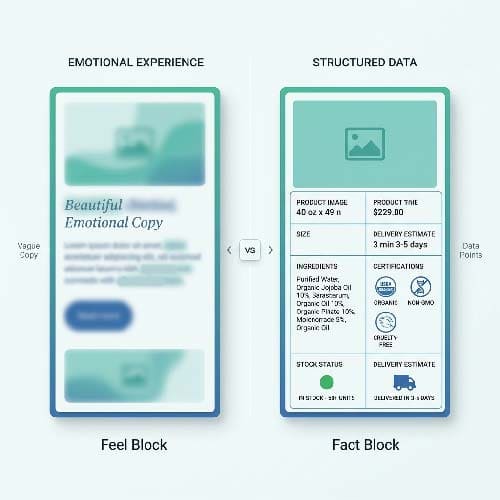
Emotional copy converts humans in consideration mode. Structured data converts agents in execution mode. You need both, but most brands have only one.
Emotional copy builds brand preference. Structured data enables agent transactions. One without the other leaves money on the table.
This is exactly the gap I audit and fix for D2C brands — the difference between AI-visible and AI-executable.
Where Brands Lose Revenue: The Conversion Gap
AI reaches your checkout — then drops when it cannot verify a constraint your store never bothered to structure.
This is where the revenue actually disappears. The agent made it to cart. The product was found. The price was right. Then it hits a wall.
The three most common verification failures I see:
1. Delivery timeline unclear → “Will this arrive by Thursday?” → FAIL. No structured delivery window by pincode or date. Agent abandons.
2. Inventory not verifiable → “Is this in stock?” → FAIL. Static page says “Available” but no real-time inventory API. Agent cannot confirm.
3. Policies not machine-readable → “Is this chemical-free?” → FAIL. Clean label claim exists in paragraph copy, not as a verifiable attribute. Agent cannot validate.
Brands running Shopify with basic product descriptions and standard checkout flows hit all three of these every time an AI agent touches their funnel — the same foundational product page mistakes that already hurt human conversion rates.
Before WebMCP: High AI traffic, sub-2% conversion from AI-originated sessions, high cart abandonment with no clear attribution. After WebMCP: Verified attributes, real-time inventory validation, 28%+ lift in AI-driven conversion rates.
Most D2C brands blame creative for low conversion. The real culprit is unverifiable data that stops agents mid-funnel.
If your store is getting AI traffic but the conversion rate looks broken, this is the problem. This is what I fix.
The Trust Problem: Why Founders Are Hesitant
WebMCP introduces real risk if implemented carelessly — and that hesitation is valid.
I’ve spoken to enough founders to know the objection: “You want AI agents to have access to my checkout flow? No thanks.”
The concern isn’t paranoia. It’s the “Lethal Trifecta” of poorly implemented agent infrastructure:
- Data access — agents seeing pricing, inventory, or customer data they shouldn’t
- External communication — agents triggering outbound actions without approval
- Untrusted inputs — agents being manipulated by prompt injection attacks from bad actors
Here’s the thing: WebMCP was designed with this in mind. The solution is a local-first control architecture — your business logic stays on your infrastructure. Agents call specific, scoped endpoints. They don’t get open access. They get controlled, permissioned function calls.
Think of it less like giving an agent a master key and more like giving a courier a specific locker code. Scoped, auditable, reversible.
The risk in WebMCP isn’t the technology — it’s bad implementation. Scoped, local-first architecture keeps your systems in control.
How WebMCP Actually Works (Plain-English)
WebMCP exposes your business functions as tools AI agents can safely use — no scraping, no guessing, no hallucination.
Here’s the system in plain terms:
Your store currently has data buried in product descriptions, PDFs, and static pages. WebMCP converts that data into structured, callable endpoints — the same shift required for AI visibility and structured data strategy to work in the first place:
- Product data → structured API endpoints with typed attributes (dimensions, ingredients, certifications, price)
- Checkout → controlled execution flow with defined permissions and guardrails
- Policies → verifiable rules (return window, shipping constraints, ingredient claims)
When an AI agent queries your store through WebMCP, the interaction looks like this:
- Agent sends a structured query: “Product X — sulphate-free? Stock in Mumbai? ETA?”
- Your MCP endpoints return:
{ sulphate_free: true, stock_mumbai: 47, eta_days: 2 } - Agent proceeds to checkout with verified data
No scraping. No interpretation. No hallucination risk. Direct system calls.
Brands like boAt, a consumer electronics and audio accessories brand, handle thousands of SKUs. Implementing MCP endpoints on even a subset of high-demand products dramatically changes how AI agents interact with their catalogue.
WebMCP replaces AI guesswork with direct verification — the difference between an agent trusting your store and abandoning it.
How I Approach This for D2C Brands
I turn your store into an AI-ready system — not just a content layer with better copy.
Most agencies will sell you a content refresh when your actual problem is infrastructure. I work differently.
My process for D2C WebMCP implementation — the same structured approach behind how I deliver WebMCP implementation support for scaling brands:
1. Audit Identify every attribute an AI agent would need to verify — and flag which ones currently exist as unverifiable paragraph copy.
2. Structure Convert product data, policy language, and inventory signals into machine-readable, typed formats.
3. Integration Enable MCP endpoints scoped to your specific business logic — no open-access, fully permissioned.
4. Validation Simulate agent interactions across your top 20 product queries. Close every gap that causes agent drop-off.
The outcome isn’t just technical. It’s commercial — and you can see this reflected in real implementation work across D2C brands:
- Higher AI conversion rates from existing traffic
- Fewer agent-triggered cart abandonments
- A store that agent-driven buyers can actually transact with
This work is right for scaling D2C brands processing consistent orders and brands with growing traffic but stalled conversion rates.
If you want your store audited for WebMCP readiness, [start here → contact page].
Should You DIY or Hire for WebMCP?
DIY works for low-stakes setups. Hire when failure costs you revenue, customer trust, or pricing integrity.
Let me be direct about this.
Don’t hire if:
- You’re pre-revenue or early-stage without consistent traffic
- You’re running a hobby store or testing a product concept
- You haven’t validated basic conversion fundamentals yet
Hire immediately if you meet any of these:
- You’re processing consistent daily/weekly orders and AI traffic is measurable
- You rely on performance marketing — a pricing or inventory error exposed via a faulty agent costs real CAC
- You cannot afford data errors — incorrect attribute claims, wrong pricing, or out-of-stock orders destroy trust faster than any bad review
The transition moment is usually this: when your DIY content setup was good enough to drive traffic, but you start noticing that traffic-to-transaction rates are stagnating despite volume growing. That’s the agent compatibility gap showing up in your data.
The risk you’re not thinking about: The “Confused Deputy Problem” — AI agents can be manipulated by malicious inputs to misuse the permissions you’ve granted them. DIY implementations without proper scope controls create this vulnerability. Amateur WebMCP is worse than no WebMCP.
A misconfigured WebMCP endpoint that allows pricing manipulation will cost more in one incident than hiring a specialist costs in a year.
If you’re at the stage where WebMCP failure would cost revenue, don’t DIY — contact me.
What Happens If You Ignore WebMCP?
You become invisible to AI-driven buying decisions. Your competitors become the default.
This isn’t a 2030 problem. It’s a 2026 problem.
AI agents are already making product recommendations, executing purchases on behalf of users, and filtering catalogues based on structured verification. The brands that show up in those decisions are the ones with machine-readable infrastructure.
The cascade looks like this:
- AI agents cannot verify your product data → they skip your store
- Competitor with structured endpoints becomes the default recommendation
- Your traffic keeps arriving but has nowhere to convert
- CAC rises because paid traffic increasingly co-exists with agent-deflected organic traffic
Brands like Plum, an Indian clean-beauty brand that leads with ingredient transparency, are positioned well for this shift because their product data is already structured around specific, verifiable claims. Brands that built on emotional positioning and lifestyle copy are exposed.
Traffic without infrastructure is a leaky bucket. You can keep filling it with ad spend, or you can fix the hole.
Ignoring WebMCP doesn’t protect you from change — it hands your market position to the first competitor who implements it.
If you want to know where your store stands, this is exactly how I approach strategy-led execution for D2C brands adapting to AI-driven commerce:
FAQ
What is WebMCP and how is it different from regular SEO?
SEO optimizes your store for search engine crawlers and human readers. WebMCP optimizes your store for AI agents that execute actions — verifying product data, checking inventory, and completing purchases. SEO drives visibility. WebMCP enables transactions. You need both, but they solve different problems in your funnel.
Do I need to be on Shopify to implement WebMCP?
No. WebMCP works across any e-commerce infrastructure that can expose structured API endpoints — Shopify, WooCommerce, custom builds. The implementation approach varies by platform, but the core principle is the same: structured, machine-readable data with scoped, permissioned agent access.
Is WebMCP safe to implement on a live store?
Yes, when implemented correctly. WebMCP uses a local-first, scoped architecture — agents are given specific, permissioned function calls, not open access to your systems. The risk is in DIY implementations without proper scope controls, not in the technology itself.
How do I know if my store needs WebMCP now?
Three signals: your AI-originated traffic is measurable but conversion from it is under 2%; your product attributes exist only in paragraph copy with no structured data layer; or your competitors in the same category are running structured ingredient/spec data while your PDPs rely on lifestyle copy. If any of these apply, the gap is costing you revenue today.
About the Author
Muhammed W is a content strategist at Izwiq Digital, working directly with small business, D2C and e-commerce brands on SEO content, social media systems, and conversion-focused design.
The insights shared here are based on hands-on client work across health, beauty, SaaS, and B2B — focused on improving engagement, trust, and conversion metrics. Learn more about our services