
The 3-Line Product Description Formula That Sells
TL;DR — For Busy Founders
Most D2C brands don’t have a traffic problem—they have a clarity problem. If your product description doesn’t communicate value in seconds, users leave—and your ad spend goes with them. The 3-line product description formula fixes this by focusing on the outcome, the differentiator, and the trust signal. Brands using this structure typically see 20–40% higher product page conversions.
Table of Contents
I’ve audited hundreds of Shopify stores over the past five years, and I keep seeing the same pattern: brands spending thousands on Meta ads, driving decent traffic to their product pages, and then watching 85% of visitors leave without buying.
When I dig into the data, the culprit is almost always the same—product descriptions that either read like technical spec sheets or sound like every other generic brand on the internet.
Here’s what I’ve learned:
Most founders think the product page is where you educate. It’s not. It’s where you close. And if your description takes more than three seconds to communicate value, you’ve already lost the sale. If you’re already spending on ads and struggling to push conversions beyond 2–3%, this is usually where the real bottleneck is.
That’s why I started using what I call the 3-line product description formula—a framework that’s helped D2C brands I’ve worked with increase product page conversions by 20-40% without changing anything else.
Why Most Product Descriptions Don’t Convert
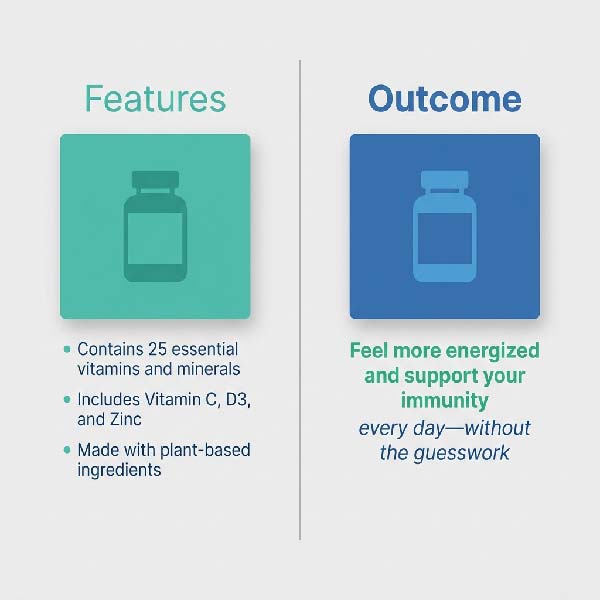
The common mistake: features without context
Walk into any founder’s Slack channel and ask them to describe their product. Nine times out of ten, they’ll start listing features:
- It’s made with organic cotton
- It has a 10,000mAh battery
- It contains hyaluronic acid and vitamin C.
But here’s the reality—your customer doesn’t care about your product.
They care about their problem.
I once saw a supplement brand describe their protein powder with: “20g of grass-fed whey isolate, cold-processed, with added digestive enzymes.” Technically accurate. Completely meaningless to someone just trying to find a protein that doesn’t upset their stomach.
When we rewrote it to lead with the outcome—”Finally, a protein powder that doesn’t leave you bloated”—conversion rate jumped 28%.
Why shoppers skim—and how copy must adapt
Eye-tracking studies on how users read online show that product page visitors spend an average of 7 seconds scanning before deciding to stay or leave. Seven seconds. That’s barely enough time to read a paragraph, let alone digest a wall of marketing copy.
This is why e-commerce product copywriting needs to work like a billboard, not a brochure.
You need to communicate the essential value proposition in the time it takes someone to glance at their phone while waiting for their coffee.
The cost of poor descriptions on paid traffic
If you’re spending $50 per customer acquisition through ads and your product page converts at 2%, you need 50 visitors to make one sale. Improve that conversion rate to 3%, and suddenly you only need 33 visitors per sale. Same ad spend, 33% more revenue. Every visitor who bounces because your description didn’t connect is wasted ad money.
If you’re already optimizing your product pages but still seeing drop-offs, you should look at your product page performance from a structural standpoint.
I’ve seen brands with $20K monthly ad budgets lose $6K-8K annually just from unclear product descriptions.
Why Traffic Doesn’t Convert (Even When Ads Work)
You can drive all the traffic you want—but if your product page doesn’t communicate fast enough, it won’t convert.
I’ve seen brands spending ₹1–2 lakh/month on Meta ads with solid CTRs… but stuck at 1.5–2% conversion rates. The issue isn’t traffic quality. It’s clarity.
Here’s what happens:
- The ad creates curiosity
- The click brings intent
- The product page creates confusion
And confusion kills conversions.
If your product description takes more than a few seconds to answer: “What is this, why should I care, and can I trust it?”
…the user leaves, and your ad spend goes with them.
This is where most D2C brands lose money—not in targeting, but in translation. You’re paying for attention but failing to convert it.
What Is the 3-Line Product Description Formula?
[IMAGE PLACEMENT HERE] The 3-line product description formula is dead simple, and that’s the point. It gives you a structure to communicate the three things every buyer needs to know before they’ll click “Add to Cart”:
Why this product matters to them (the outcome) Why this product is different (the differentiator) Why they can trust it (the confidence trigger)
Line 1 — The Core Outcome (Why it matters to the buyer)
This is where most brands faceplant. They lead with what the product is instead of what it does. Bad: “Premium stainless steel water bottle with double-wall insulation.” Good: “Keeps your drinks ice-cold for 24 hours, even in summer heat.” See the difference? The first one describes an object. The second one solves a problem. If you’re selling skincare, don’t lead with “retinol serum.” Lead with “smoother skin in two weeks.”
Line 2 — The Differentiator (Why this product is different)
Here’s where you earn the right to talk about features—but only the ones that actually separate you from the competition. Example: “Our patented VacuSeal lid is the only one on the market that’s 100% leak-proof and one-handed.” Notice how this ties directly back to the outcome? The differentiator reinforces why this product will deliver on the promise better than alternatives. I worked with a D2C mattress brand that was getting crushed by Casper and Purple. We moved their unique cooling gel layer to Line 2 and framed it as: “Unlike memory foam that traps heat, our gel layer keeps you cool all night.” Sales increased 34% in the first month.
Line 3 — The Confidence Trigger (Proof, reassurance, or risk reversal)
By Line 3, you’ve told them what they’ll get and why your product is special. Now you need to remove the last bit of friction—the voice in their head saying, “But what if it doesn’t work for me?” Examples:
“Over 10,000 five-star reviews from verified buyers.” “30-day money-back guarantee—no questions asked.” “Dermatologist-tested and recommended for sensitive skin.”
The confidence trigger doesn’t have to be complicated. It just needs to give permission to buy. Because here’s the truth: people are looking for reasons to say no. They want to protect themselves from buyer’s remorse. Line 3 says, “You’re safe here.”
The Psychology Behind the 3-Line Formula
Cognitive load and decision fatigue in e-commerce
When someone lands on your product page, they’ve probably already looked at three other brands. Their brain is tired. Cognitive load research shows that when people are overwhelmed with information, they either make impulsive decisions or no decision at all. The 3-line product description formula works because it reduces mental effort. You’re giving them three clear, digestible pieces of information in the order their brain naturally processes buying decisions.
How clarity beats creativity on product pages
I need to push back on something that’s become gospel in D2C circles: brand voice on product pages. Yes, your brand voice matters. But the product page? That’s not where you show off your copywriting chops. That’s where you make it absurdly easy to buy. I’ve seen brands lose sales because they tried to be too creative. A candle brand once described their product as “an olfactory journey through sun-dappled meadows.” Beautiful. Useless. What does it smell like? High-converting product descriptions prioritize clarity over cleverness every single time.
Real-World Examples (Before vs After)
Skincare product example
Before: “Our revolutionary serum combines cutting-edge peptide technology with botanical extracts to deliver clinically proven results.” After (3-line formula):
Line 1: Visibly reduces fine lines and dark spots in 4 weeks. Line 2: Our triple-peptide complex works 2x faster than retinol, without irritation. Line 3: Backed by clinical trials and 4,800+ five-star reviews.
Apparel or accessories example
Before: “Crafted from premium materials using sustainable manufacturing processes, this versatile piece seamlessly transitions from day to night.” After (3-line formula):
Line 1: Wrinkle-free fabric that looks polished even after travel. Line 2: Hidden stretch panels give you blazer structure with hoodie comfort. Line 3: Machine washable—no dry cleaning required.
Health / wellness product example
Before: “Premium quality sleep support supplement featuring a synergistic blend of natural ingredients.” After (3-line formula):
Line 1: Fall asleep faster and wake up refreshed—without grogginess. Line 2: Magnesium + L-theanine formula that’s non-habit forming (unlike melatonin). Line 3: Third-party tested for purity, with a 60-day satisfaction guarantee.
How to Apply the Formula Across Your Store
Homepage featured products
Your homepage is where first impressions happen. When you feature products there, the 3-line product description formula works even better because space is limited. For homepage placements, I usually make Line 1 slightly more aspirational and Line 3 more action-oriented.
Category pages vs product pages
Category pages need even tighter copy—stick religiously to the 3-line format. Product pages give you flexibility. You can use the formula as your “above the fold” hero copy, then add expandable sections below for ingredients, sizing, and care instructions.
If you want this implemented across your store without rewriting everything manually, explore our E-commerce Conversion Copywriting Services.
Mobile-first considerations
If 70% of your traffic is mobile (and it probably is), write for the smallest screen first. Keep each line under 12 words so it doesn’t wrap weird on iPhone SE screens. Make sure there’s enough padding between lines—cramped copy feels harder to process.
How to Turn This Into a Repeatable System
Most brands treat product descriptions as a one-off task. That’s the mistake.
What works is systemizing it:
- Start with your top 10 revenue-driving SKUs
- Apply the 3-line formula consistently
- Track conversion rate changes over 30 days
- Roll it out across remaining products
This isn’t about writing better copy once. It’s about building a structure your entire store follows.
Because consistency across product pages reduces friction—and friction is what kills scale.
Mistakes to Avoid When Using the Formula
Writing clever but vague lines
I’ve seen people write: “Transform your mornings. Designed by experts who care. Join thousands of happy customers.” Technically they followed the structure, but every line is generic fluff. Specificity is your friend. If you can swap your Line 1 with a competitor’s product and it still makes sense, you haven’t differentiated anything.
Repeating what’s already in the title
If your product title is “Ultra-Hydrating Face Cream,” don’t make Line 1: “Provides deep hydration for your skin.” We already know that. Instead, go deeper: “Locks in moisture for 48 hours, even in dry winter air.”
Ignoring objections and trust signals
Line 3 is where a lot of people phone it in with “High quality guaranteed.” That’s not a confidence trigger—it’s a platitude. Think about actual objections and neutralize them. If you sell supplements, mention third-party testing. If you’re a new brand without reviews, offer a no-questions-asked return policy.
When to Expand Beyond 3 Lines (and When Not To)
High-ticket vs low-ticket products
For products under $75, the 3-line formula is usually enough. For products over $200, you’ll probably need to expand—but keep the formula as your opening. I worked with a furniture brand selling $800 sofas. We kept the 3-line description at the top, then added expandable sections for details. Rule of thumb: The more expensive the product, the more justification buyers need. But even for high-ticket items, lead with the formula.
Testing and iteration tips
The first version you write probably won’t be perfect. The beauty of the 3-line product description formula is that it’s easy to test. Change Line 1 and see if conversion rate moves. Swap your differentiator in Line 2. Try a different confidence trigger in Line 3. If you have enough traffic, run A/B tests. If you don’t, swap versions every two weeks and compare month-over-month. Even directional data is better than guessing.
Why This Matters Even More in 2026 (AI + Shopping Behavior)
As AI agents start interacting with product pages—summarizing, recommending, and comparing products for users—clarity becomes even more critical.
These systems don’t interpret vague brand language well. They prioritize structured, outcome-driven information.
A clear 3-line product description doesn’t just help humans decide faster—it also makes your product easier for AI systems to understand, rank, and recommend.
In other words, this isn’t just conversion optimization anymore. It’s visibility optimization.
Final Thoughts
The 3-line product description formula isn’t magic. It’s a framework that forces clarity, differentiation, and trust—fast.
In a world where most D2C brands ramble or hide behind vague marketing-speak, that alone is enough to stand out.
Will it take time to implement across your store? Absolutely.
Will you need to refine it as you learn what resonates? For sure.
But the alternative—leaving your descriptions as-is and hoping conversions improve—isn’t a strategy.
Start with your top 10 SKUs. Rewrite them using this formula. Track results for 30 days.
You’ve already done the hard part: building a product and driving traffic.
Don’t let unclear copy be the thing that kills the sale.
Still Getting Traffic But Not Enough Sales?
If your product pages are getting clicks but not conversions, the issue usually isn’t traffic
it’s how your value is communicated.
Most D2C brands don’t have a traffic problem. They have a clarity problem.
If you’re already investing in ads and your conversion rate is stuck, it’s worth fixing what happens after the click.
Frequently Asked Questions
What is a 3-line product description?
A 3-line product description is a structured way to communicate your product’s value quickly using three elements: the outcome, the differentiator, and a trust signal.
Does this formula work for all types of products?
Yes, especially for D2C products. For higher-ticket items, you can use the 3-line formula as your opening and expand with more details below.
Why are my product pages getting traffic but no sales?
In most cases, it’s because the product page fails to clearly communicate value within the first few seconds. Visitors leave before they understand why the product matters.
How do I test if this formula improves conversions?
Apply it to your top-performing SKUs, track conversion rates over 2–4 weeks, and compare results. Even small improvements can significantly impact revenue.
About the Author
Muhammed W is a content strategist at Izwiq Digital, working directly with small business, D2C and e-commerce brands on SEO content, social media systems, and conversion-focused design.
The insights shared here are based on hands-on client work across health, beauty, SaaS, and B2B — focused on improving engagement, trust, and conversion metrics. Learn more about our services