
Agency Brochure vs Strategic Fit: The Hidden Filter in D2C Growth Agency Selection
TL;DR — For Busy Founders
Your agency brochure gets 10 seconds. If it opens with a services list, it’s already dead. In 2026, the best D2C founders are running a mental vetting process before they reply to a single email. They’re screening for specialist depth, exit safety, and proof of execution — not credentials and culture decks. This post breaks down what that filter looks like, what kills trust immediately, and what a brochure that actually converts looks like.
Table of Contents
The 10-Second Judgment: How Founders Actually Read Your Brochure
I’ve been on both sides of this table. I’ve hired agencies while running growth for D2C brands and I’ve pitched brochures myself. And the honest truth is this: founders don’t read agency brochures. They scan them for reasons to say no.
The mental model a founder brings to a brochure is identical to how someone reads a cold DM on LinkedIn — they’re looking for the sentence that confirms their suspicion that this is generic, this is not for me, and this is going to waste my time. The moment they find that sentence, they’re gone.
The scan goes in a fixed order: problem recognition first, then proof, then relevance. Does this agency understand what’s broken in my business right now? Have they fixed that specific thing before? And are they talking to someone who looks like me — a founder running a $500K supplement brand, not a Fortune 500 CMO?
If the first page of your brochure is a services list — SEO, Paid Media, Social Media Management, Email Marketing, Creative Production — you’ve already lost. A services list is a capabilities menu, and founders don’t need menus. They need surgeons. The moment you lead with a list of things you offer, you signal that the client has to do the heavy lifting of figuring out what they actually need. That’s the job they’re hiring you to do.
This matters enormously for D2C growth agency selection because founders at growth-stage brands — typically $200K to $3M annual revenue — are not procurement managers with months to evaluate. They’re operational, time-starved, and deeply skeptical. They’ve been burned before. Your brochure has one job: build enough trust in 10 seconds to earn the next 10 minutes.
The Shift from Full-Service to Specialist Thinking (2026)
Three years ago, “full-service” was a selling point. It meant the founder didn’t have to coordinate multiple agencies. Today, it’s a red flag. Here’s why that shifted.
The D2C brands that survived 2023–2024 did so on margin discipline. Rising CAC on Meta, iOS attribution collapse, and bloated retainers forced a recalibration. The brands that made it through — think skincare brands like Minimalist or snack D2C players like Go Goodness — were the ones that got fanatical about EBITDA-per-customer, not just topline growth. And the agencies that served them well were the ones with a specific operating philosophy around unit economics.
An agency that claims to do everything — and lists 11 services across 3 slides — signals the opposite of that discipline. It signals that they’ve scaled headcount to match client budget, not built a methodology around a specific problem. McKinsey research consistently shows that specialist firms outperform generalists on client retention and measurable ROI, particularly in execution-heavy functions like growth marketing. D2C founders have started internalizing this logic, even if they can’t articulate it precisely.
In practical terms, this means the e-commerce agency vetting process in 2026 starts with a specialization test: what is this agency actually world-class at? If the answer is “growth marketing,” that’s not a specialization. If the answer is “reducing 90-day churn for subscription supplement brands using email + SMS cadences tied to purchase behavior,” now we’re talking.
“We do everything” is the agency equivalent of a Swiss Army knife — theoretically useful, practically never the right tool for a surgery you actually need done.
What Founders Are Actually Evaluating (Not What You Think)
Most agencies think founders are evaluating services, portfolio logos, and team credentials. They’re not. Or rather, those are table stakes — they’re filters 3, 4, and 5. Filters 1 and 2 are harder to fake and less commonly addressed.
Filter 1: Do they understand my specific revenue problem? Not the general category of problem (acquisition is expensive), but the specific configuration of my problem (my Meta CPMs tripled, my email list is 80K but my 60-day repeat purchase rate is 14%, and my hero SKU has a 3.8x LTV:CAC that I can’t figure out how to replicate across the new bundle).
A brochure that demonstrates understanding of LTV:CAC dynamics, cohort analysis, and retention-led growth strategy instantly signals strategic depth. One that says “we use data-driven strategies to grow your brand” signals the opposite — that the agency learned marketing vocabulary without developing genuine analytical muscle.
If you want to understand how content that directly impacts revenue metrics should be structured for D2C brands, the principle is the same: surface-level language is the fastest path to being dismissed.
Filter 2: Can I trust them with execution, or just strategy? Founders have been burned by agencies that produced decks and frameworks and audits but couldn’t hold a Meta campaign together during a product launch week. The demand now is for execution proof — not capability claims.
The AI Implementation Gap
There’s a specific version of this filter playing out right now around AI. Every agency brochure in 2026 includes the word “AI” somewhere. But founders are increasingly sophisticated about the difference between AI buzzwords and AI execution.
The buzzword version: “We leverage AI to optimize your campaigns.” Meaningless. The execution version: “We run a weekly AI-powered content diagnostic that identifies which product claims are generating the highest engagement-to-conversion ratios, and we use that to brief creative.” That’s a diagnostic framework. That’s something you can verify.
Agencies that can show a specific AI workflow — not just say they use AI tools — are clearing the filter. The rest are not.
The Agency Lock-In Fear (Hidden Buyer Psychology)
Here’s something most agency brochures completely ignore: the single most powerful objection in the D2C founder’s head is not “can this agency deliver?” It’s “can I exit this agency safely if it doesn’t work?”
The e-commerce agency vetting process is deeply shaped by horror stories founders share in their networks. The agency that owned all their ad account access and took it with them when the contract ended. The one that built a custom tech stack no one else could operate. The one that embedded 11 different SaaS tools in a retainer — $400/month in tools — that all became liabilities when the engagement ended.
A bloated brochure — 20+ pages with case studies, team photos, awards, culture decks, and lengthy process descriptions — triggers this fear rather than allaying it. It signals complexity. It signals a large operational footprint. Founders read “we have a comprehensive onboarding process and proprietary methodology” and hear “you’ll be dependent on us within 6 weeks.”
The best brochures address exit safety directly, even if briefly. Something as simple as “you own all accounts, all data, and all creative assets from day one” does more to lower resistance than three pages of case studies.
Understanding how trust is built visually in seconds is as relevant here as anywhere — brevity and clarity signal confidence; complexity signals risk.
The 3 Brochure Mistakes That Kill Trust Instantly
Mistake 1: Listing Services Instead of Problems
The most common mistake. A page that reads “Email Marketing / Paid Social / SEO / Content Creation / Influencer Marketing / CRO / Analytics” is not a brochure. It’s a menu. The founder’s immediate question is: so what? Every agency in my LinkedIn inbox claims the same list.
The fix is not to remove the services — it’s to lead with the problem each service solves. Not “Email Marketing” but “Your email list is an untapped retention asset. We turn 60-day churn into 120-day LTV through behavior-triggered flows that Klaviyo data says outperform broadcast by 3–4x.” Now I know what problem you’re solving, for whom, and what the result looks like.
Mistake 2: Generic Case Studies Without Metrics
The second killer. “We helped a D2C beauty brand grow their social following by 40%” is not a case study. It’s a vague reference. Founders who are evaluating agencies for growth work need to see the specific lever that was pulled, the starting point, the intervention, and the outcome — ideally in a metric they recognize: ROAS, MER, 90-day repeat purchase rate, CAC payback period.
A supplement brand founder reading “we scaled a skincare brand to $2M revenue” thinks: how? Which channel? What was the margin at that revenue? What was CAC and LTV? What was the ad creative strategy? Without those answers, the case study is decoration, not proof.
Mistake 3: Culture Fluff Instead of Capability Proof
Team photos, mission statements, values slides, and pages about “why we started this agency” — this is what I call culture fluff. It’s not that it’s wrong to have a culture. It’s that it belongs in an employee brochure, not a founder-facing pitch. Founders do not care that your team is “passionate about brand building.” They care that the person running their Meta campaigns has handled a $150K/month ad budget before and has a framework for how to manage creative fatigue during peak season.
Seniority signals — specific names, specific roles, specific experience contexts — do more work in two lines than a full culture page.
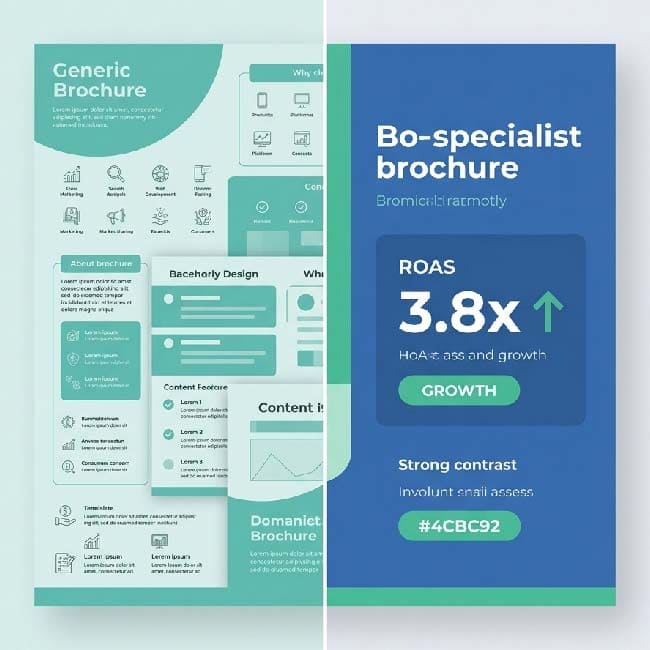
What a High-Converting Brochure Looks Like in 2026
If I were building a brochure today for a high-growth D2C marketing partner positioning, here’s the architecture I’d use:
Page 1 — Problem Entry. Name the specific type of D2C brand you work with and the specific problem configuration you solve. Not “we help brands grow.” Try: “We work with D2C supplement and wellness brands doing $300K–$3M annually who have solid product-market fit but can’t figure out why their repeat purchase rate is flat despite strong first-order ROAS.”
Page 2 — Specialization Proof. One or two specific services with the diagnostic framework behind them. Not “CRO” but “our 6-week CRO sprint uses session recording analysis, heatmaps, and 15-question post-purchase surveys to identify the three biggest friction points in your checkout flow.” That’s a deliverable, not a service label.
Page 3 — Metrics-Led Case Study. One case study. One page. Brand category, starting baseline, intervention, 90-day outcome in hard numbers. No stock photos of smiling founders. Just the data.
Page 4 — Seniority Clarity. Who exactly will work on this account? What’s their background? How many similar clients have they handled? A founder doesn’t want to know you have 40 people on staff. They want to know who picks up the phone on a bad Friday when Meta pauses their account.
Page 5 — The Offer + Exit Terms. What’s the first engagement, what does it cost, and what does the founder own at the end of it? Simple, clean, confidence-signaling.
As AI agents begin interacting with brand and agency websites in 2026 — crawling structured content to evaluate vendor fit on behalf of founders — brochures that are problem-led, metrics-dense, and clearly structured will surface in AI-powered shortlists. Agencies that bury their specialization in vague language will not appear in that layer at all. The shift to WebMCP-readable content isn’t just a technical SEO consideration; it’s a positioning one.
Specialist vs Generalist: Real-World Breakdown.
Let me make this concrete with category examples I’ve seen play out repeatedly.
Sneaker/streetwear brands like Snitch — these brands win when they find agencies with deep understanding of community-led growth, drop mechanics, and UGC-to-paid amplification pipelines. A generalist agency that puts the same content calendar and Meta structure they use for a home goods brand onto a streetwear brand will destroy the brand voice in six weeks. Niche alignment — agencies that have worked specifically with hype-cycle or community-first D2C brands — delivers outsized results here.
Subscription health brands — brands in the subscription supplement or functional food space require an agency that lives and breathes LTV:CAC. Their entire business model depends on reducing churn in months 3–6 of the subscription cycle. An agency that has never thought about cohort analysis or retention-led content strategy — that has only ever optimized for acquisition — is actively harmful in this category. Every rupee spent acquiring a customer who churns in 60 days makes the P&L worse.
Generic agencies lose in both cases not because they lack capability in aggregate, but because the specific problem configuration of these categories requires prior pattern recognition. You can’t fake that. And a well-constructed brochure either signals that prior pattern recognition — or it doesn’t.
The “Surgical Entry” Model (Winning Agency Credentials vs Strategic Fit)
The positioning I’d recommend to any growth agency in 2026 — whether you’re a three-person specialist team or a 20-person boutique — is what I call the Surgical Entry model. You solve one high-stakes problem, demonstrably, before asking to expand the scope.
The founder’s biggest fear in the agency credentials vs strategic fit equation is not that you’ll fail — it’s that you’ll fail expensively and slowly. A $6,000/month retainer that produces unclear results for six months is a $36,000 mistake that also cost six months of growth. The Surgical Entry model reframes the engagement: “Give us 45 days and a defined brief. We solve one specific problem. If we do, you’ll know exactly what we’re capable of.”
This structure reduces the risk perception dramatically. It signals that you’re not dependent on a long retainer to prove value. It signals that your methodology is tight enough to produce a result in a compressed window. And it gets you inside the business — where you can identify the next three problems — in a way that a brochure alone never could.
Brands like Boat or Mamaearth didn’t build their agency relationships on 12-month retainer commitments from the jump. The agencies that became embedded partners got in by solving something specific first. The brochure that leads with the Surgical Entry offer — here’s the one problem we’d fix first, here’s what it costs, here’s what you’ll own at the end — converts far better than the one that sells the full-service retainer on slide one.
Quick Founder Checklist: Should You Trust This Agency?
Before you sign anything — even a discovery call commitment — run this filter:
| Criteria | Weak Brochure | Strong Brochure |
|---|---|---|
| Focus | Services list | Problem-led entry |
| Proof | Generic case studies, no metrics | Specific metrics — ROAS, LTV, churn rate |
| Positioning | “Full-service” / “we do everything” | Named specialization and brand category |
| Risk Signal | Proprietary tools, complex onboarding | You own all assets from day one |
| AI Claims | “We leverage AI-powered strategies” | Named AI workflow with defined output |
| Team Clarity | Team photos + culture page | Named senior lead + specific track record |
| First Offer | 12-month retainer pitch | Defined 30–45 day scoped entry engagement |
If the brochure you’re reviewing passes fewer than four of these criteria, keep looking. There are more specialist agencies operating in your category than you think — and the right one will be self-evident from the brochure alone.
If your content is getting engagement but not revenue, the breakdown is usually in how that content is structured to convert. At Izwiq Digital, we build content systems for D2C brands that turn attention into measurable growth — without high production overhead.
FAQ
What is the most important element of a D2C agency brochure in 2026?
The most important element is a problem-led entry point — the ability to name the specific growth problem that the agency solves, for a specific type of D2C brand, in concrete terms. Founders screen for relevance before they screen for capability. A brochure that leads with a services list fails this filter immediately, while one that opens with a clearly named problem (e.g., “flat repeat purchase rates despite strong first-order ROAS for supplement brands”) signals strategic depth from the first line.
Why do full-service agency brochures perform worse in D2C growth agency selection today?
Full-service positioning signals risk to growth-stage D2C founders because it implies broad but shallow capability, large operational footprint, and potential agency dependency. Post-2023, D2C brand operators shifted to an EBITDA-first mindset that values specialist execution over general coverage. An agency claiming to do everything well is implicitly claiming no specialization — and founders looking for a high-growth D2C marketing partner are looking for exactly that specialization.
What is the “agency lock-in fear” and how should brochures address it?
Agency lock-in fear is the hidden buyer psychology where founders worry about their inability to exit a retainer safely — specifically losing access to their ad accounts, creative assets, or data when an engagement ends. Brochures should address this directly by stating clearly that the founder owns all accounts, assets, and data from day one. This one sentence does more to lower resistance than multiple case study pages.
What does the Surgical Entry model mean for agency positioning?
The Surgical Entry model is a positioning approach where the agency leads with a scoped, time-limited engagement to solve one high-stakes problem before proposing a broader retainer. Rather than pitching a 12-month commitment in the brochure, the agency offers a 30–45 day engagement with a defined output, clear cost, and full asset ownership. This reduces risk perception dramatically, signals methodology confidence, and gets the agency inside the business where they can identify additional growth opportunities organically.
About the Author
Muhammed W is a content strategist at Izwiq Digital, working directly with small business, D2C and e-commerce brands on SEO content, social media systems, and conversion-focused design.
The insights shared here are based on hands-on client work across health, beauty, SaaS, and B2B — focused on improving engagement, trust, and conversion metrics. Learn more about our services