
D2C Content Distribution Strategy: You’re Publishing Content, Not Strategy
TL;DR — For Busy Founders
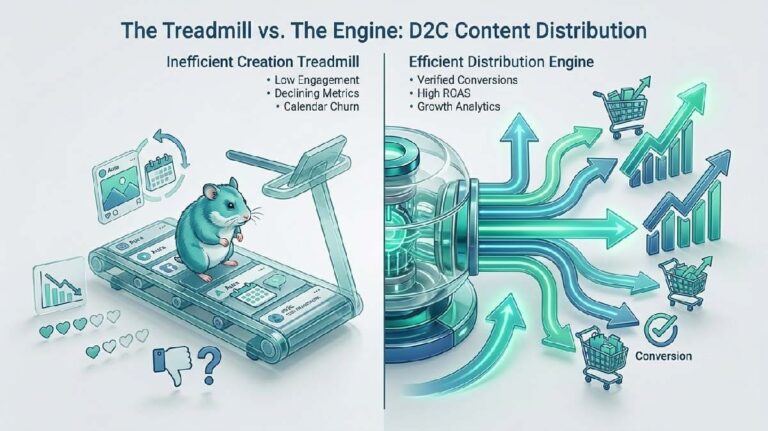
Most D2C brands are stuck in a content treadmill — producing at high volume, seeing low returns, and wondering why CAC keeps climbing. The problem isn’t your content quality. It’s that you don’t have a distribution system — you have a posting schedule. In 2026, AI-driven discovery rewards depth and authority over frequency. Brands that shift to a distribution-first model — fewer assets, aggressive amplification, and ROCS-based measurement — will cut acquisition costs and build the retention loops that volume-chasing brands never will. This post shows you exactly where the breakdown happens and how to fix it.
Running a content operation that isn’t driving revenue? That’s a structural problem, not a creative one — and it’s fixable. See how I work with D2C brands →
Table of Contents
Why Is Your Content Not Driving Revenue?
Content without a distribution system is just an archive. That’s the short answer.
You’re not underperforming because your content is bad. You’re underperforming because you built a publishing calendar where you should have built a distribution engine. The two look similar on a spreadsheet. They produce very different revenue outcomes.
Here’s what’s actually happening:
- “Post and pray” is dead. Organic reach on every major platform has collapsed. Without deliberate distribution, your content reaches 3–5% of your own audience — and almost none of your target customers.
- CAC is up 60% across D2C categories over the last three years. Every rupee of wasted content spend makes this worse.
- Content without a path is just content. If there’s no clear journey from “I saw this” to “I bought this,” you’ve created brand awareness for someone else’s retargeting campaign.
Insight: A brand that publishes 20 pieces of content with no distribution system will lose to a brand that distributes 5 pieces with intent.
For context on how this connects to your broader acquisition cost problem, read D2C Unit Economics Content Strategy: Why Blog Writing Drives Revenue.
This is exactly the problem I solve for D2C brands. If your content spend isn’t traceable to revenue, your operation needs a rebuild — not more content. Let’s talk →
What Changed in 2026 Content Marketing?
AI discovery rewards authority, not frequency. If you’re still running a volume strategy, you’re already behind.
The way people find information has shifted faster than most marketing teams have adapted. Platforms like Perplexity, ChatGPT search, and Google’s AI Overviews don’t serve the most recent content — they serve the most structured, cited, and contextually deep content. Volume signals noise now, not credibility.
This shift is backed by broader industry data — recent content benchmarks 2026 show that depth, structured insight, and distribution-backed content consistently outperform high-frequency publishing models.
What’s actually happening at the platform level:
- AI tools like Perplexity prioritize depth and entity clarity. A 400-word post with 12 bullet points and no original insight gets skipped. A well-structured, first-person, evidence-backed piece gets cited.
- Zero-click consumption dominates. A growing percentage of searches end on the AI-generated answer. If your content isn’t the source being cited, it isn’t getting seen.
- Frequency no longer equals visibility. Posting every day with no distribution is like shouting into a crowd that’s wearing headphones.
Insight: In 2026, publishing more content is not a distribution strategy — it’s a production cost with no guaranteed return.
This shift is not a warning. It’s already the operating reality. Brands that don’t adjust their content strategy now will find themselves producing content that no human or AI ever surfaces. For a deeper look at how AI is reshaping D2C content execution, see D2C Creative Testing Framework: Why Content Publishing Fails in 2026.
Are You Stuck in the “Consistency Trap”?
Yes, if you’re prioritizing your calendar over conviction.
I’ve worked with brands posting 4x a week on Instagram, running a weekly newsletter, and publishing two blogs a month — with under 1% engagement across all of it. The team is exhausted. The content director is proud of the output. The founder is asking why revenue isn’t moving.
That’s the consistency trap. You’ve confused activity with effectiveness.
Run this diagnostic on your current content operation:
- Posting 3–5x per week with no defined distribution plan per piece
- Average engagement below 1% across primary platforms
- Repeating the same content templates — carousels, tips posts, product showcases — with slight variation
- No measurement of revenue contribution per content asset
- No repurposing system — each piece lives and dies on one platform
Insight: If your content operation runs on calendar logic instead of distribution logic, you’re optimizing for output, not outcomes.
This section is the audience qualification moment. If three or more of those bullets describe your brand, your content problem is structural, not creative. This is where most brands struggle — and this is where I help.
Why Brands Like Liquid Death Win While Others Fade
They built a distribution-first content system before they scaled volume.
Liquid Death, a canned water brand that turned a commodity product into a cult brand, didn’t win because they posted more. They won because every piece of content was designed to be distributed — to shock, to spread, to earn shares and press coverage organically. Entertainment wasn’t a style choice. It was a distribution mechanism.
Compare that to a generic skincare brand running three product carousel posts a week. Same budget. Completely different philosophy.
| Content-First Approach | Distribution-First Approach |
|---|---|
| Create → publish → hope | Identify channel → create for it → amplify |
| Frequency = credibility | Depth + reach = authority |
| Posts per week as KPI | Revenue per asset as KPI |
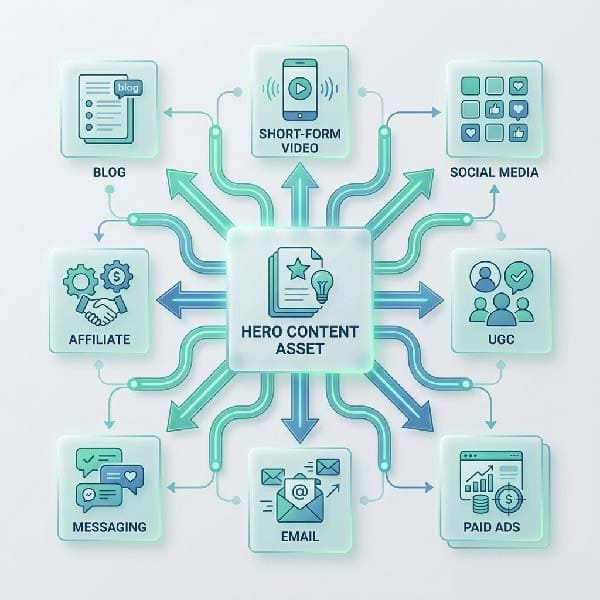
| Platform-native content, platform-native death | One hero asset → multiple distribution layers |
| Audience grows slowly | Retention and CAC improve together |
Brands like boAt, a consumer electronics brand, and Mamaearth, a D2C skincare brand, didn’t scale on content volume. They scaled on a handful of high-conviction assets distributed aggressively across paid, earned, and owned channels.
Insight: One hero asset distributed across five channels will outperform five mediocre assets distributed across one.
The difference between brands that scale and brands that plateau isn’t budget — it’s whether content is connected to a distribution system. I build that system for D2C brands. See the approach →
Where Brands Lose Revenue
At the content-to-conversion bridge. That’s where the money disappears.
This is the section most content teams skip because it’s uncomfortable. You can have great content — genuinely good creative, solid engagement, strong reach — and still not convert. The problem isn’t the content. It’s that there’s no bridge between attention and action.
Here’s where the breakdown happens:
- Platform-native content doesn’t connect to the product. A Reel that performs well on Instagram doesn’t automatically drive someone to your Shopify product page. There’s no navigation architecture, no CTA sequence, no next step.
- No transition from interest to utility. Someone watches your educational skincare content and learns something. Then what? If the answer is “they scroll to the next post,” you’ve done a favour for the category, not your brand.
- No retention loop. First-time buyers who don’t get re-engaged through content become one-time buyers. Content that doesn’t serve post-purchase journeys isn’t a content strategy — it’s acquisition spend with no compounding.
Insight: Attention without architecture is wasted spend. Your content can perform and still cost you revenue if there’s no conversion bridge.
Brands like Minimalist, a science-backed skincare brand, and Plum, a vegan beauty brand, have built post-content journeys — email sequences, WhatsApp flows, retargeting — that convert engaged audiences into buyers. That’s what a content-to-conversion bridge looks like in practice.
If you’ve recognised your brand in this section, the gap isn’t hard to close — but it does require a system rebuild, not just better content. You can see how I’ve approached this problem in the Izwiq portfolio.
If your content is generating engagement but not revenue, you have a conversion architecture problem. That’s a solvable problem — with the right system behind it. Fix it with Izwiq →
What Is a Real D2C Content Distribution Strategy?
A system where content is a variable inside distribution — not the other way around.
Most brands build content first and figure out distribution later. That’s backwards. A real content distribution strategy starts with the question: “Where does our customer actually convert — and how do we engineer content backwards from that point?”
Here’s how the model works:
- Distribution → Creation (not the reverse). Identify your highest-converting channels first. Then create content specifically engineered for those channels.
- The 80/20 rule applies here. Spend 20% of effort on creation and 80% on distribution, amplification, and repurposing. Most teams have this inverted.
- Backend tools complete the loop. Shopify, a leading ecommerce platform, supports conversion tracking, product page integration, and retargeting pixels. Your content strategy should be built on top of that data — not disconnected from it.
Insight: Content strategy that isn’t connected to your conversion data is a creative exercise, not a growth system.
If you’re using AI tools — whether it’s ChatGPT for drafting or Perplexity for research — your customers are using them too. Content structured for AI citation (clear entities, direct answers, quotable statements) now has distribution value beyond your own channels. That’s the WebMCP opportunity most D2C brands are completely ignoring.
The Practical Fix: Build a “Hero Asset System”
Create fewer, higher-impact assets and distribute them aggressively. That’s the whole system.
I’ve used this with both early-stage Shopify brands and $2M+ D2C operations. The principle scales. The execution varies. But the logic is always the same: one great asset, distributed intelligently, beats ten average ones published and forgotten.
Here’s how to build it:
Step 1: Create 1 High-Conviction Piece
This is your hero asset — a long-form blog, a definitive guide, an in-depth video, or a research-backed post. It needs to take a clear position, include real data, and be structured for both human readers and AI citation. No fence-sitting. No generic tips.
Step 2: Slice Into Platform-Native Formats
From one hero asset, extract:
- 3–5 short-form video scripts (Reels, Shorts, YouTube)
- 2–3 LinkedIn posts with direct insight angles
- 1 email newsletter section
- 5–7 WhatsApp or push notification messages
- 1–2 Pinterest infographics
Step 3: Allocate Paid + Organic Distribution
Don’t publish and move on. Put paid spend behind your top-performing slice. Use retargeting to re-engage people who engaged with the hero asset. Build a 7-day distribution window per asset, not a 24-hour one.
Step 4: Track ROCS Per Asset
Return on Content Spend = Revenue attributed to that asset ÷ Total cost to create and distribute it. If a hero asset generates ₹2L in attributed revenue and cost ₹15K to produce and distribute, your ROCS is 13x. That’s your benchmark. That’s what you optimise for — not impressions.
Insight: The hero asset system replaces volume with intent. Less content. More impact. Measurable return.
What Metrics Actually Matter Now?
Return on Content Spend (ROCS), not reach. Reach is a media metric. ROCS is a business metric.
The shift from vanity metrics to revenue metrics is non-negotiable if you want your content function to survive budget scrutiny. CMOs who can’t tie content spend to revenue outcomes lose budget to performance marketing. Full stop.
| Old Metrics | New Metrics |
|---|---|
| Reach and impressions | Revenue per content asset |
| Follower growth | Retention contribution rate |
| Post frequency | Asset distribution depth |
| Engagement rate | Conversion rate from content entry |
| Video views | Attributed purchases per asset |
Huel, a D2C nutrition brand, tracks content performance against customer LTV, not just acquisition metrics. That’s the standard D2C brands should be holding themselves to.
Insight: If your content metrics don’t connect to CAC, LTV, or retention — you’re measuring the wrong things.
Every asset you produce should have a trackable UTM, an attributed revenue number, and a retention contribution figure. If it doesn’t, you’re flying blind.
When to Stop DIY and Hire
At some point, the cost of doing this yourself exceeds the cost of getting it done right. Most founders reach that point and don’t recognise it until six months later.
Here are the three signals that tell you it’s time:
- Your CAC has increased for two consecutive quarters and your content volume hasn’t changed. You’re producing more of the same thing, expecting different results. The system is broken and you’re too close to it to see where.
- You have content but no conversion architecture. Blogs that don’t link to products. Social posts with no CTA sequence. Email campaigns not connected to purchase intent data. These are structural problems that a content calendar won’t fix.
- You’re making content decisions based on gut feel, not ROCS. If you can’t tell me which of your last ten pieces of content drove the most revenue — and why — you’re running a content operation on intuition. That’s expensive at scale.
The cost of not hiring isn’t just wasted content budget. It’s the compounding revenue loss from a broken conversion bridge, rising CAC with no correction mechanism, and the six to twelve months of audience trust you lose while competitors build authority you’re ignoring.
The transition moment looks like this: you’ve tried fixing it internally, the metrics haven’t moved, and the next quarter’s budget discussion is going to be painful unless something changes. That’s when the ROI of external expertise becomes obvious.
Insight: DIY content strategy has a ceiling. When you hit it, the question isn’t whether to hire — it’s how much you’ve already lost by waiting.
How I Approach This for D2C Brands
I don’t do content for content’s sake. Every brief I take starts with one question: “What revenue outcome does this content need to drive?”
Here’s what the engagement looks like in practice:
What I do: I audit your existing content operation, identify the conversion gaps and distribution failures, and rebuild it as a revenue system. That means a hero asset framework, a platform-specific distribution plan, ROCS tracking infrastructure, and repurposing workflows that reduce your production cost by 30–40% while increasing content reach.
Who it’s for: D2C and e-commerce brands spending on content without a clear attribution model. Founders who’ve hit the consistency trap. Marketing leads who need to justify content ROI to a board or investor. Teams producing at volume with flat or declining engagement.
What outcome it drives: Lower CAC through better content-to-conversion architecture. Higher LTV through retention-focused content loops. A measurable ROCS baseline within the first 60–90 days.
I’ve been doing this across D2C, e-commerce, and agency contexts for 18 years. The brands I work with don’t just get content — they get a system that connects every asset to a business outcome.
Why brands hesitate: The most common objection I hear is “we already have a content team.” That’s not an argument against bringing in external strategy — it’s an argument for it. An internal team without a distribution system is a production line without a factory. They need the infrastructure as much as the output. External strategic input isn’t a replacement — it’s the architecture your team builds on.
See the full scope of what I do → or review client work in the portfolio →
What Should You Do Next?
Audit and rebuild your content system. Not tomorrow. Before your next content calendar goes live.
Here’s the exact sequence:
- Identify dead content. Pull your last 30 pieces. How many of them have a measurable revenue contribution? If fewer than 30% do, you have a distribution problem, not a content problem.
- Map distribution paths. For every piece of content you’re currently producing, answer: “Where does this take someone next?” If you can’t answer that in one sentence, it has no distribution path.
- Reduce volume, increase depth. Cut your content output by 40%. Reinvest that time into distribution, repurposing, and paid amplification of your best-performing assets.
- Introduce ROCS tracking. Set up UTM parameters for every asset. Connect content to conversion data in your analytics stack. Start with your top three content channels.
- Build one hero asset this month. Not three. One. Do it right, distribute it aggressively, and measure it for four weeks before producing the next one.
The content brands that win in 2026 won’t be the ones that post the most — they’ll be the ones that distribute with precision and measure with discipline.
Every week you run on a volume strategy is a week your CAC goes up and your content budget delivers less. That’s not a content problem. That’s a business problem with a content solution.
If this post described your current content operation, the fix starts with one conversation. I work with D2C brands to rebuild content into a distribution system that drives measurable revenue. No retainers until the audit makes sense. Start here →
FAQ
What is a D2C content distribution strategy?
A D2C content distribution strategy is a system where content is designed to be distributed and monetized — not just published. It means identifying your highest-converting channels first, creating content engineered for those channels, and measuring performance by revenue generated per asset, not reach or impressions.
Why doesn’t frequent posting work anymore?
AI-powered discovery platforms like Perplexity and Google’s AI Overviews prioritize content with depth, authority, and clear entity structure — not recency or frequency. Posting more content without distribution backing doesn’t increase visibility. It increases production cost with diminishing returns.
What is ROCS and how do I calculate it?
ROCS stands for Return on Content Spend. It’s calculated as: Revenue attributed to a content asset ÷ Total cost to create and distribute that asset. A ROCS of 10x means every ₹1 spent on that asset generated ₹10 in revenue. It replaces reach-based metrics as your primary content performance indicator.
How do I fix low-performing content?
Stop producing more of it. Pull your last 30 pieces, identify the ones with measurable revenue contribution, and map why they worked. Then shift your operation to fewer, higher-impact hero assets with aggressive distribution plans. Cut volume by 40% and reinvest that time into amplification and tracking.
If your social content is getting likes but not conversions, the design layer is usually where the breakdown happens. At Izwiq Digital, we help e-commerce and D2C brands build content systems that pass the trust test — without expensive production.
About the Author
Muhammed W is a content strategist at Izwiq Digital, working directly with small business, D2C and e-commerce brands on SEO content, social media systems, and conversion-focused design.
The insights shared here are based on hands-on client work across health, beauty, SaaS, and B2B — focused on improving engagement, trust, and conversion metrics. Learn more about our services