
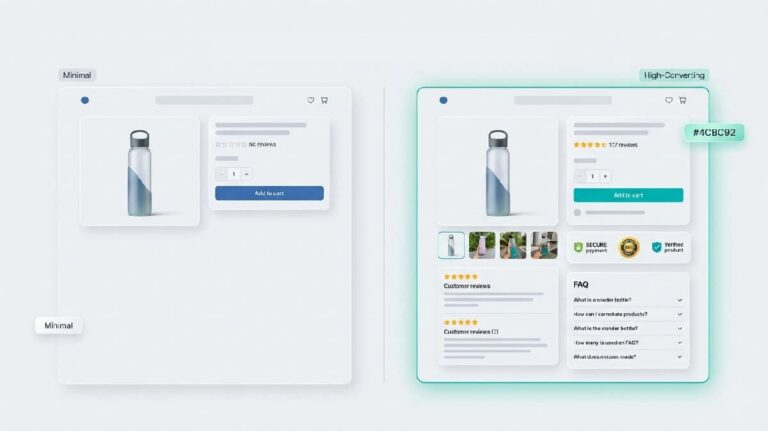
Why D2C Product Page Optimization Fails to Convert
TL;DR — For Busy Founders
Most D2C product pages fail because they prioritize aesthetics over certainty. Clean design doesn’t remove doubt — proof does. This post breaks down the exact elements that turn product pages into conversion assets: layered social proof, strategic friction, and content depth. If you’re spending on ads and seeing low CVR, your product page is the leak.
Who this is for: D2C and e-commerce brands already running traffic — paid or organic — who are seeing consistent drop-off between the ad click and the cart.
Table of Contents
Why Most D2C Product Pages Fail to Convert
They prioritize aesthetics over certainty.
A minimal page looks professional. It also looks like a risk.
When a buyer lands on your product page, they’re not judging your design — they’re looking for reasons to trust you enough to pay. If the page can’t answer their doubts, they leave.
Most brands invest in ads before fixing their product pages — which is exactly the conversion gap I cover in detail for D2C brands who wonder why traffic doesn’t convert.
What minimal pages actually communicate to buyers:
- Lack of detail = lack of confidence in the product
- No reviews or UGC = unverified brand
- Clean template = “this looks like every other Shopify store”
If a product page doesn’t remove doubt, it won’t convert.
What Has Changed in Buyer Behavior (2026)
Buyers are research-heavy and video-first.
Three years ago, a good hero image and a short product description could carry a moderate conversion rate. That’s done.
Today’s D2C buyer — especially in competitive categories like skincare, supplements, and apparel — scrolls deeper, watches before they read, and expects transparency before they trust.
Buyer behavior has shifted in ways most Shopify store owners haven’t caught up with, especially around content-led trust building as a conversion lever.
Modern buyers validate before they purchase. Video reduces uncertainty faster than text. Depth signals legitimacy in D2C.
What’s changed:
- Video > static images. Buyers want to see the product used, not styled.
Video can increase conversion rates by up to 80% in e-commerce. - Long-form scrolling is now normal. A 3,000-word product page isn’t overwhelming — it’s thorough.
- Transparency = premium signal. Brands like Minimalist, a science-backed skincare brand, publish full ingredient percentages. That’s not just education — it’s conversion strategy.
Short product pages signal perceived risk. More depth communicates more confidence.
The Real Conversion Driver: Certainty, Not Design
People buy when doubt is removed.
Design is not a conversion lever. Certainty is.
Certainty is the primary driver of conversion. Design attracts attention, but proof closes sales.
The page’s job isn’t to look good — it’s to answer every question the buyer has before they ask it. Specs reduce anxiety. Social proof reduces risk. Detailed content filters serious buyers from browsers.
The page needs to do the selling — and that starts at the bottom of the funnel, not the top. Most brands think of product pages as part of the browsing experience. They’re not. They’re the closing layer.
Three things that build certainty:
- Specs and materials — “What exactly am I getting?” answered upfront
- Layered social proof — Not just star ratings, but photos, videos, use-case reviews
- Detail as filtering — The buyer who reads everything and still adds to cart is your highest-intent buyer
Insight: Over-explaining your product doesn’t scare buyers away — it qualifies the ones worth converting.
If your page looks clean but doesn’t convert, this is why. Design isn’t the problem — depth is.
Where Brands Lose Revenue (The Conversion Gap)
Generic pages create a trust gap that ad spend can’t fix.
This is the section most brand founders skip over because they assume the problem is the ad creative or the targeting. It’s rarely either.
Visibility doesn’t equal revenue — and the data on cart abandonment from Baymard Institute consistently shows that product page trust signals are among the top reasons buyers exit without purchasing.
Traffic without trust results in wasted spend. Low-trust pages inflate CAC.
Where the revenue leak actually happens:
| Signal | What Buyers See | What It Costs You |
|---|---|---|
| Template-feel layout | “This looks like dropshipping” | Immediate bounce, zero trust |
| No UGC or real reviews | “How do I know this works?” | High exit rate, wasted CPC |
| Missing FAQs or specs | “I’ll think about it later” | Cart abandonment, lost sale |
| No certifications/trust badges | “Is this brand legitimate?” | Low add-to-cart rate |
This is where most ad budgets bleed — and it’s the kind of gap I fix through structured content before brands scale their paid spend.
Insight: Every rupee spent on ads pointing to a low-trust product page is a rupee spent accelerating your bounce rate.
If you’re running ads right now, this gap is costing you daily. Let’s look at your page before you spend another month on broken infrastructure.
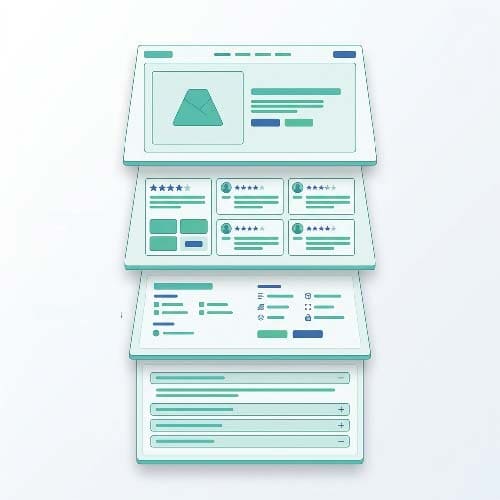
What a High-Converting Product Page Actually Includes
It behaves like a landing page, not a catalog.
A catalog page shows the product. A landing page sells it. High-converting D2C product pages do the latter — and they’re structured, not just designed.
The 10 elements that separate converting pages from non-converting ones:
- Video-first hero — Autoplay loop showing product in real use, not just flat lay
- Lead with the outcome — First headline answers “what does this do for me?”
- UGC block — Real photos from customers, ideally before/after or in-context User-generated content can increase conversion rates by over 20%.
- Star rating + review count — Visible above the fold, not buried
- Technical breakdown — Ingredients, materials, specifications with clear language
- Trust badges — Certifications, payment security, returns policy in plain sight
- Comparison table — Why this vs. alternatives, positioned as clarity not sales pressure
- FAQ block embedded in page — Not a separate page, right in the buying flow
- Use-case storytelling — “Who this is for” in specific, real language
- Sticky ATC bar — Add-to-cart follows the scroll, especially on mobile
Structure converts. Design makes it look good while it does.
The “Strategic Friction” System
Add intentional depth to filter and convert the right buyer.
“Friction” gets a bad reputation in CRO conversations. Everyone wants a frictionless experience. But the wrong buyers converting is a bigger problem than some buyers not converting at all — it drives returns, negative reviews, and support load.
Friction isn’t the enemy — and strategic content depth is one of the clearest ways to add it without slowing your conversion rate on high-intent buyers.
Friction filters low-intent buyers. More information increases buyer confidence.
What strategic friction looks like in practice:
- Size guides and fit calculators — Reduce returns, increase confidence
- Ingredient/material transparency — Converts informed buyers, filters out impulse buyers who’ll return
- “Who this is for / not for” block — Brutal honesty. Builds massive trust.
- Comparison table with competitors — Not pushy. Informative. Buyers respect it.
- Care instructions or usage guide — Shows you stand behind the product post-purchase
The business case: Brands that add these elements don’t just see higher CVR — they see lower return rates, fewer support tickets, and better review quality. That’s a CAC efficiency win, not just a conversion tactic.
Strategic friction doesn’t reduce conversions — it improves the quality of every conversion you get.
You need a structured approach, which is why I built a content-to-conversion system specifically for scaling D2C brands on Shopify.
Aesthetic vs Information: The Balance Most Founders Miss
You don’t choose between them — you layer them.
The most common mistake I see from founders who’ve worked with designers: the page is beautiful but bare. The most common mistake from founders who’ve done it themselves: the page is thorough but visually chaotic.
Neither converts well. The answer isn’t balance — it’s sequencing.
Structure determines conversion, not aesthetics alone.
The three-zone product page layout:
| Zone | What Goes Here | Purpose |
|---|---|---|
| Top (above fold) | Hero image/video, product name, hook, star rating, CTA | Stop the scroll, create desire |
| Mid (scroll zone) | UGC, reviews, social proof, certifications, comparison table | Build trust, remove doubt |
| Bottom (deep scroll) | Specs, ingredients, FAQs, “who this is for” | Convert the serious buyer, filter the rest |
BoAt, an Indian audio and lifestyle brand, does this well on their higher-SKU products. The top is clean and visual. By the mid-scroll, you’re in full proof mode. It’s not accidental — it’s architecture.
Beautiful pages that lack proof convert at the top of the funnel. Proof-heavy pages without visual clarity fail at the top. Layer them in sequence — don’t choose.
Real Example: What Winning Brands Do Differently
They prioritize certainty over beauty.
I’ve worked across Shopify stores at very different scales — from ₹50K/month brands testing their first ad sets to brands pushing ₹2Cr+ in monthly revenue. The pages that convert at scale all share one trait: volume of proof. Adding proof layers can double conversion rates without increasing traffic.
Not production value. Volume of proof.
What I consistently see on high-CVR product pages:
- UGC-heavy layout — Real customer photos with real use cases, not polished editorial shots
- Certification stacking — Mamaearth, a toxin-free personal care brand, stacks certifications (MADE SAFE, dermatologist-tested) right below the fold. This signals safety before the buyer has to ask.
- Scroll-based storytelling — The page tells a story as you scroll: problem → solution → proof → specs → FAQ. Each section hands off to the next.
- Review diversity — Not just 5-star reviews. Brands that show mixed reviews with genuine responses convert better than brands with suspiciously perfect scores.
Before/After scenario I’ve seen play out:
A skincare brand with a minimal, design-forward page was converting at 0.9% on paid traffic. After rebuilding the page with a proof layer (adding UGC, a certification block, an embedded FAQ, and a “who this is for” section), CVR moved to 2.4% within 45 days. Same ad spend. Better page. The math is obvious.
High trust pages aren’t built on better design — they’re built on more evidence.
I rebuild product pages as conversion systems — you can see how this plays out in my client portfolio.
Who This Is NOT For
Not for early-stage or low-traffic brands.
Let me be direct: product page optimization only moves the needle if there’s traffic to convert. If you’re at the stage where you’re still figuring out who your customer is or you haven’t validated your product-market fit yet, this framework won’t help you — and hiring someone to execute it will waste your budget.
Skip this if:
- You’re getting fewer than 500 sessions/month to product pages
- You haven’t run any paid or organic campaigns consistently
- You haven’t validated your offer with at least 30–50 real sales
This is for you if:
- You’re spending on Meta or Google ads and seeing consistent drop-off at the product page
- Your add-to-cart rate is below 5% despite reasonable traffic
- You’re scaling a Shopify store that’s past ₹5L/month in revenue and wants to grow without increasing CAC
Insight: Strategy only works when there’s something to optimize. Traffic and proof-of-concept come first.
How I Approach This for D2C Brands
I rebuild product pages as conversion systems, not design projects.
Most agencies and freelancers treat product page work as a copy and design task. I treat it as a revenue architecture problem.
My process:
- Audit trust gaps — I review the page against buyer psychology checkpoints: what questions are unanswered? Where does doubt exist?
- Map the buyer journey — Where is traffic coming from? What does the buyer already know before landing? The page strategy changes based on this.
- Layer proof and friction — I add the proof elements in the right zones and add strategic friction that filters serious buyers.
- Align with ad messaging — The product page must match the promise made in the ad. Disconnect between the two is one of the biggest CVR killers I see.
Outcomes I focus on:
- Higher CVR (specifically add-to-cart and purchase rate)
- Lower CPA (better buyer quality means fewer post-sale issues)
- Better buyer fit (lower return rate, higher LTV)
Who I work with: Shopify-based D2C brands in the scaling stage — typically spending ₹1L–₹10L/month on ads and hitting a ceiling because of weak conversion infrastructure.
Every brand I work with gets a page audit first — learn more about my D2C content services.
If your product page isn’t converting the traffic you’re paying for, that’s a fixable problem. Let’s talk about your store — I’ll tell you within the first conversation whether your page is the issue.
What You Should Do Next
Audit your current product pages against this framework.
Don’t wait for the metrics to get worse. Most brands only look at CVR when they’re already bleeding budget.
Three things to do today:
- Run the trust gap check — Go through your product page as if you’re a new buyer who doesn’t know your brand. How many doubts does the page leave unanswered?
- Add what’s missing — Pick 2–3 elements from the high-converting page checklist (video, UGC, FAQ block) and add them within the next sprint.
- Compare against this framework — Run your page through each section above and score yourself. Be honest.
Fix the page before scaling traffic.
If you’re getting traffic but not conversions, the page is the problem.
Ready to stop guessing and start converting?
FAQ
What is D2C product page optimization?
D2C product page optimization is the process of restructuring and improving product pages to increase conversion rate. It involves adding trust signals, social proof, strategic content, and information depth — not just improving design. The goal is to remove buyer doubt and drive more purchases from existing traffic.
How many elements does a high-converting product page need?
There’s no magic number, but high-converting D2C product pages typically include: a video-first hero, layered social proof (UGC + reviews), technical specifications, trust badges, an embedded FAQ section, a comparison element, and a “who this is for” block. Each element targets a specific buyer objection.
Does product page optimization work for Shopify stores?
Yes — and Shopify is one of the most common platforms where this type of optimization is needed. Most Shopify themes prioritize clean design over conversion depth. Adding proof layers, FAQ blocks, and content-rich sections within a Shopify theme (or headless setup) can significantly improve add-to-cart and purchase rates.
How long does it take to see results from product page optimization?
Brands I’ve worked with typically start seeing measurable CVR changes within 30–60 days of implementing the core elements — particularly trust signals, social proof, and FAQ blocks. The timeline depends on traffic volume. Higher traffic = faster feedback loop.
About the Author
Muhammed W is a content strategist at Izwiq Digital, working directly with small business, D2C and e-commerce brands on SEO content, social media systems, and conversion-focused design.
The insights shared here are based on hands-on client work across health, beauty, SaaS, and B2B — focused on improving engagement, trust, and conversion metrics. Learn more about our services