
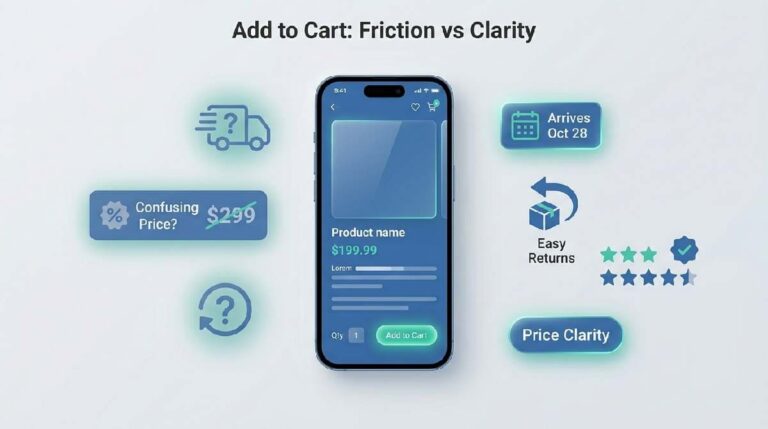
Add to Cart Optimization: Why Shoppers Click But Don’t Buy (And How to Fix It)
TL;DR — For Busy Founders
Your Add to Cart rate looks fine. Your purchase rate tells a different story.
Most D2C brands are haemorrhaging revenue in the six inches of screen space between the ATC button and checkout. Shoppers click Add to Cart to investigate, not to buy. Until your product page answers every pre-purchase question before that click — delivery timelines, returns, fit, price — you’re funding browsers, not buyers.
Business impact: Brands that reduce ATC-to-checkout friction typically see 20–40% improvement in purchase conversion without spending an extra rupee on ads. That’s lower CAC, better ROAS, and revenue from traffic you already own.
This post breaks down 7 specific elements that separate a product page that converts from one that just looks decent.
Table of Contents
The Real Problem With Add to Cart in 2026
Here’s what nobody tells you about your ATC metrics: a high Add to Cart rate is not always a good sign.
On mobile — which is where 70–80% of your traffic is landing right now — sessions are fragmented. Someone opens your product page, tabs out to check a WhatsApp message, comes back, scrolls halfway, and clicks Add to Cart. Not because they want to buy. Because it’s the fastest way to save the product while they figure out whether they actually want it.
ATC has become a digital sticky note.
This matters because most brands optimise for getting that click. They A/B test button colours, fiddle with CTA copy, and celebrate when ATC rate goes up — without noticing that purchase rate stays flat. The click is not the conversion. The purchase is.
What you actually have is a confidence gap. Your shopper is interested, but they’re not convinced. And that gap — between curiosity and commitment — is where your revenue is silently disappearing.
The Conversion Gap No One Talks About
If your ATC-to-purchase rate is below 30%, you don’t have a traffic problem. You have an intent mismatch problem.
There are two types of clicks on any product page. There are buy-ready clicks — shoppers who have already resolved their doubts, know the price, understand the return policy, and are ready to move forward. And then there are information-seeking clicks — people using the cart as a research tool because your page didn’t answer their questions upfront.
When you dig into session recordings for most D2C brands — beauty, supplements, apparel, home goods — the pattern repeats. Shoppers click ATC, then scroll back up to look for shipping info. Or they abandon cart and go searching on Google for “[brand name] return policy.” They wanted the answer before the click. You made them work for it after.
The fix isn’t driving more traffic. It’s converting more of the intent that’s already on your page.
Most of these issues start at the product page level — something we’ve broken down in detail in our ecommerce product page optimization guide
Brands spending ₹5L+ per month on performance ads but running a product page that doesn’t answer basic pre-purchase questions are essentially buying traffic to fund a leaky bucket. Fix the bucket first.
Where Brands Lose Revenue at the Add to Cart Stage
Walk through a typical mid-size Indian D2C product page — skincare, supplements, or casual apparel — and you’ll usually find the same four problems.
Missing delivery clarity. The shopper doesn’t know when the product will arrive. “3–7 business days” is not an answer anymore. HOKA, for instance, shows estimated delivery dates dynamically based on pincode before you’ve even added anything to cart. Most Indian brands bury this information in a FAQ tab, if at all.
No real product context. Static images of a product on a white background don’t answer the question: “What is this actually like to use?” A protein powder tin looks the same as every other protein powder tin. The brand that shows a 30-second reel of someone making a shake, describing the taste, and talking about how it mixes — that brand wins the click.
Generic CTAs. “Add to Cart” says nothing. It performs adequately when every other element of the page is doing its job. When the page has gaps — and most do — a generic CTA is just friction with a button attached.
Fake urgency. Countdown timers that reset on page refresh. “Only 3 left in stock” on a product that’s clearly always available. Shoppers — especially returning visitors — have seen this playbook. It doesn’t create urgency. It creates distrust. And distrust kills conversion faster than almost anything else.
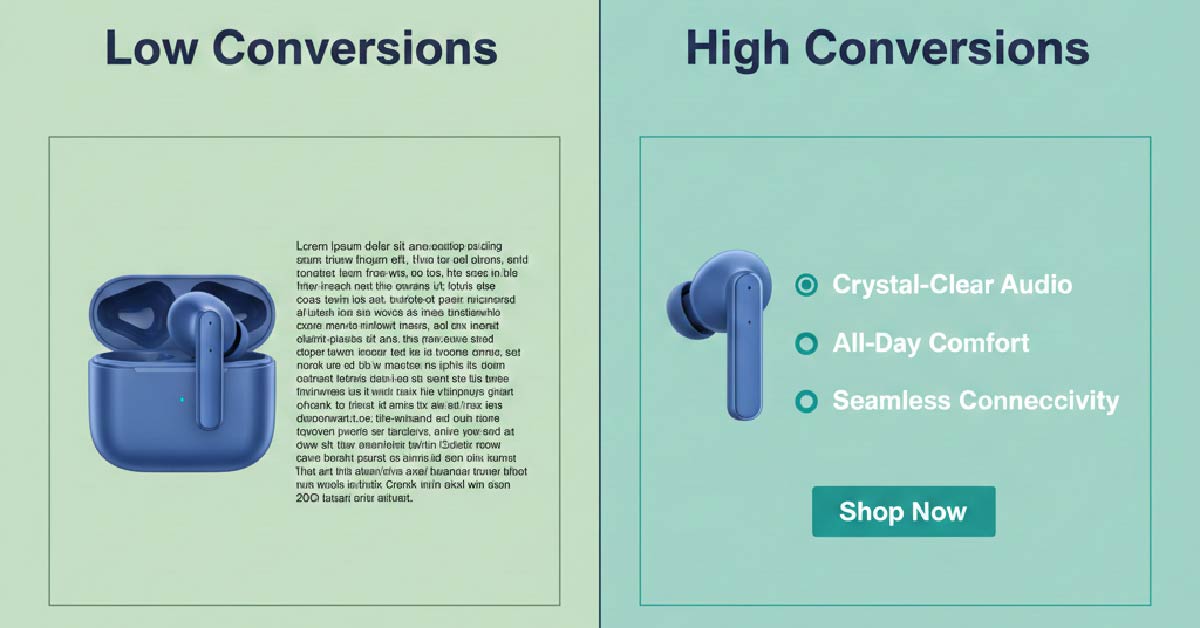
The 7 Elements That Drive Instant Purchase Decisions
These aren’t suggestions. Each one directly addresses a specific hesitation point that sits between your shopper and the purchase decision.
1. Delivery Transparency Before the Click
Show the delivery estimate on the product page, above the fold, before anyone clicks anything. Not in the cart. Not in a tooltip. Right there, dynamically, based on the user’s location. Brands like Minimalist have started integrating pincode-based ETA directly on PDPs. It removes one of the most common reasons for cart abandonment: “I don’t know when this will get here.”
2. Contextual CTA (Not Generic Buttons)
“Add to Cart” can become “Get It by Thursday” or “Ships Free — Add to Bag” or “Low Stock — Secure Yours.” None of this is complicated to implement. All of it converts better than a static label because it speaks to a real shopper concern at the moment they’re deciding. Dynamic CTA copy tied to inventory, delivery, or offer context closes the confidence gap faster than any design change.
3. Product-in-Use Proof (Video/Reels)
Replace at least one static image with a short video showing the product being used by a real person. This isn’t about production quality. Mamaearth and The Souled Store have both leaned into UGC-style video on PDPs with measurable impact on time-on-page and conversion. A founder reviewing their own supplement on camera outperforms a polished product shoot. Show the product working. Show it fitting. Show it in context.
4. Risk Reversal Near the ATC Button
Put your return policy, guarantee, and refund terms next to the Add to Cart button — not in the footer, not in a separate FAQ page. Three lines max: “30-day returns. No questions. Full refund.” Brands like Plum have built significant trust equity by making this impossible to miss. Risk reversal placed at the point of decision converts. Risk reversal buried in small print doesn’t exist.
5. Micro Social Proof
Not star ratings in a tab below the fold. Real-time or near-real-time proof near the CTA: “5,200 bought this month.” “Rated 4.7 by 1,800+ customers.” “Bestseller in Vitamin C serums.” This works because it answers the subconscious question every shopper is asking: have other people who are like me bought this and been happy with it? boAt does this well across their accessory range — social proof isn’t a section, it’s embedded throughout the page.
6. Fit/Usage Clarity (Reduce Anxiety)
For apparel: a proper size guide with real measurements, not a generic S/M/L chart. For supplements: a daily usage example with timing, dosage, and expected results. For home products: a room dimension reference or lifestyle shot. The question your shopper is really asking is: “Will this work for my situation?” If your page doesn’t answer that specifically, they’ll answer it themselves — usually with a no.
7. Price Transparency (No Surprise Costs)
Show the final price, inclusive of taxes and with shipping costs resolved, before checkout. Surprise costs at checkout are the single biggest driver of abandonment according to Baymard Institute research. If shipping is free above a threshold, say so clearly on the PDP. If there’s a discount applied, show the original price and the savings. Ambiguity about the final number creates friction. Clarity removes it.
Surprise costs at checkout are the biggest driver of abandonment, according to Baymard Institute research
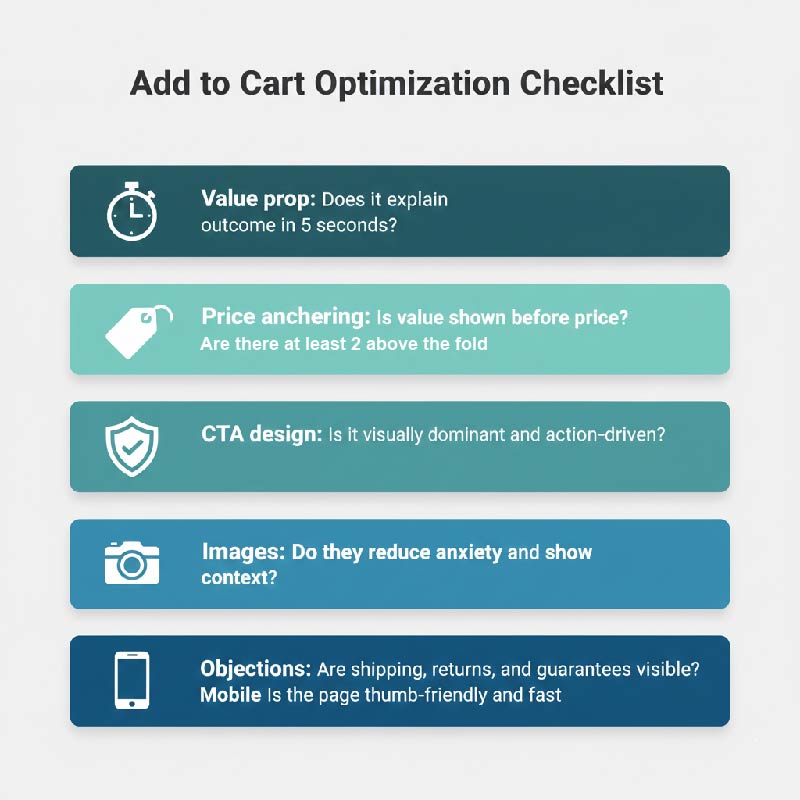
The “Unspoken Return Anxiety” Problem
There’s a specific hesitation that doesn’t show up in your analytics but drives a significant share of cart abandonment: the fear of being wrong.
Shoppers — particularly first-time buyers — are not just deciding whether they want the product. They’re deciding whether they’ll regret the purchase. Wrong size. Doesn’t match the colour on screen. Tastes different than expected. Doesn’t deliver the promised result fast enough.
This is why ATC gets used as a bookmark. The shopper isn’t saying “I want this.” They’re saying “I’m thinking about this while I figure out whether I’ll hate myself for buying it.”
The fix is to answer post-purchase regret before the click. That means showcasing real return experiences (not just policy text), showing what the unboxing looks like, making the “what if it doesn’t work for me” scenario feel resolved and low-risk. When a shopper feels confident they can course-correct without pain, they’re far more likely to move forward.
The Practical System: Frictionless Education Layer
This is the actual execution sequence. It’s not complex. It just requires doing it deliberately instead of leaving the page as an afterthought to your ad spend.
Step 1: Move key information above the ATC button. Delivery estimate, price clarity, return policy — all of it should be resolved before the shopper encounters the CTA. Anything that currently lives below the button or in a separate tab is an abandonment risk.
Step 2: Replace the generic CTA with contextual messaging. Test at minimum two variants: one tied to delivery (“Get It by [date]”) and one tied to scarcity or social proof (“Join 4,000+ happy buyers”). Measure ATC-to-purchase, not ATC rate.
Step 3: Add visual proof near the CTA. One short video, one UGC-style image, or one before/after. Place it directly adjacent to the button, not in a separate carousel six scrolls away.
Step 4: Audit and remove fake urgency signals. If your countdown timers reset, remove them. If your stock warnings are permanent, fix them or remove them. Trust, once broken, is nearly impossible to rebuild in a single session.
One counterintuitive outcome of this approach: your raw ATC rate may drop slightly. That’s fine. What you’re doing is filtering out information-seeking clicks and increasing the proportion of buy-ready clicks. Your revenue quality goes up. Your CAC effectively decreases because you’re closing a higher share of the traffic you’re already paying for.
By 2026, this layer becomes even more critical. AI shopping agents — the kind embedded in browsers and assistant tools — crawl product pages to answer user queries directly. If your delivery information, return policy, and product context are buried or absent, the agent either skips your page or presents your competitor’s cleaner data instead. Structured, upfront product page information isn’t just a conversion tactic anymore. It’s how you stay visible to the next generation of buying behaviour.
Quick Self-Check: Are You Attracting Buyers or Browsers?
If you’re running paid ads and your product pages haven’t been audited for friction, answer these honestly:
- Do users click ATC and then scroll back up looking for shipping information?
- Is your ATC-to-purchase conversion rate below 30%?
- Is your delivery estimate hidden in the cart or at checkout?
- Does your return policy live in the footer or a separate page?
- Is your only social proof a star rating below the product description?
If you answered yes to two or more of these, you have an intent mismatch problem. Your ads are bringing buyers. Your product page is turning them into browsers.
This is a D2C-specific problem that gets worse as you scale. At ₹50K/month in ad spend, a leaky product page is annoying. At ₹5L/month, it’s a structural revenue problem.
What High-Growth Brands Do Differently
The brands that consistently outperform on conversion — HOKA being the clearest global example, Minimalist and Huel being strong reference points in their categories — share one approach: they treat Add to Cart as a confirmation step, not a discovery step.
By the time a shopper on those pages reaches the ATC button, they already know the delivery date, the return terms, the price, what the product looks and feels like in real use, and what other buyers experienced. The button isn’t the beginning of a decision. It’s the end of one.
That’s the standard to build toward. Not more traffic. Not a better button colour. A page where every question is answered before it’s asked, so the ATC button becomes the obvious next move — not a hesitation point.
If your conversion rate is stuck and your ad spend keeps climbing, the problem is almost certainly not your creative. It’s the six inches of screen that come after the click.
That’s the gap worth fixing. And if you want help auditing where your product pages are losing buyers
FAQ
What is a good Add to Cart to purchase conversion rate for D2C brands?
Most industry benchmarks put ATC-to-purchase between 20–40%. If you’re below 25%, it’s a strong signal that your product page has unresolved friction — typically around shipping, returns, or product confidence — that’s stopping buyers at the last step.
Why do customers add to cart but not checkout?
The most common reasons are unexpected shipping costs discovered at checkout, missing delivery information on the product page, lack of trust signals (returns policy, social proof), and using the cart as a “save for later” tool because the page didn’t build enough confidence upfront.
How does add to cart optimization affect ROAS?
Directly. If you’re spending on ads to drive traffic but your ATC-to-purchase rate is low, your effective ROAS is suppressed. Improving on-page conversion with the same traffic budget means more revenue from the same spend — which shows up immediately in your ROAS figures.
Should I show the return policy on the product page or just at checkout?
On the product page, adjacent to the Add to Cart button. Return anxiety is a pre-click hesitation. Addressing it at checkout is too late — the shopper has already decided whether to trust you before they click. Visible, upfront return terms directly improve ATC-to-purchase rates.
About the Author
Muhammed W is a content strategist at Izwiq Digital, working directly with small business, D2C and e-commerce brands on SEO content, social media systems, and conversion-focused design.
The insights shared here are based on hands-on client work across health, beauty, SaaS, and B2B — focused on improving engagement, trust, and conversion metrics. Learn more about our services