

Content Strategy: Why Blog Writing Still Drives Real Revenue in 2026
TL;DR — For Busy Founders
Most D2C blogs are built to attract traffic. That’s the wrong goal. In 2026, with rising customer acquisition costs (CAC) and AI flooding the internet with generic content, blogs that don’t convert are just overhead. This post breaks down why a D2C unit economics content strategy — built around buyer intent, not search volume — is what separates brands that grow from brands that stagnate. You’ll get the framework, the mindset shift, and a step-by-step execution plan.
Table of Contents
The 2026 Reality — Traffic ≠ Revenue
I’ve worked with brands pulling 80,000 monthly visitors and struggling to break even on their paid channels. I’ve also worked with Shopify stores doing ₹12 lakh a month off a blog that gets 6,000 visits. The difference isn’t traffic volume. It’s intent.
Here’s what nobody wants to say out loud: paid acquisition has become a losing game for most D2C brands under ₹5 crore in revenue. Meta CPMs are up. Google Shopping is brutally competitive. And unless you have deep pockets, you’re fighting for margin on every rupee spent. The brands that are winning right now are the ones who treated their content — especially their blog — as a unit-economics lever, not a brand awareness play.
Blogs now serve three jobs that paid channels can’t do cheaply: they support conversion by answering buyer objections at the moment of decision, they build retention by keeping existing customers educated and engaged, and they compound in value over time without burning budget every month. Paid traffic stops the moment you stop paying. A well-written, intent-driven blog post can work for you for three years.
That’s the core of a D2C unit economics content strategy — treating every blog post as an asset with a measurable return, not a content calendar checkbox.
The Real Problem — You’re Attracting the Wrong Audience
Here’s a scenario I see constantly: a supplements brand has a blog post ranking #2 for “what is magnesium good for.” It drives 4,000 visits a month. Their conversion rate from that post? 0.18%.
The post is not the problem. The keyword is.
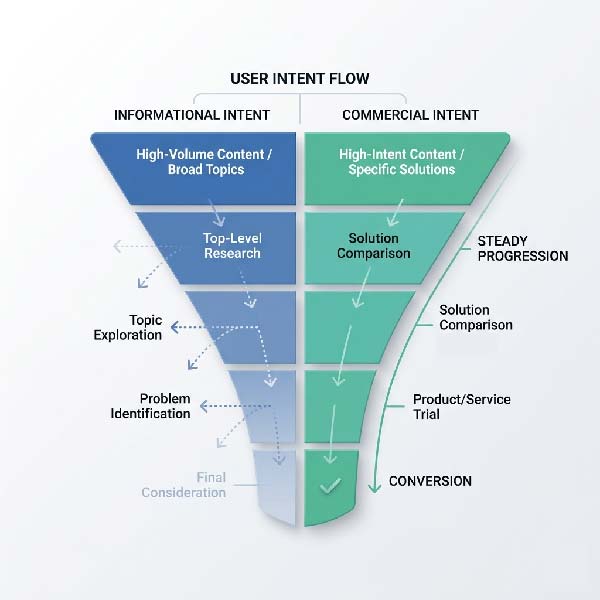
There’s a critical difference between informational intent and commercial intent, and most D2C content teams either don’t know it or don’t act on it. Informational intent is someone researching a topic — they might buy eventually, but not today. Commercial intent is someone who has already decided they want to buy and is choosing between options. These are completely different people at completely different points in their journey.
A post titled “What is magnesium good for?” attracts curious people. A post titled “Magnesium glycinate vs. magnesium oxide — which one actually helps you sleep?” attracts buyers. One of those posts earns revenue. The other earns pageviews.
The intent mismatch is the single biggest reason D2C brands see the “50K traffic, 0.2% conversion” gap. They’ve built a content library full of informational posts that serve awareness-stage readers and then wonder why their blog doesn’t move product. Fix the intent, and the numbers follow.
The ROI Shift — Why Blogs Still Win
Let me be direct about something: blogging is not dead. Blogging done badly is dead.
According to HubSpot’s research, SEO and organic content consistently rank as the top ROI channel for B2C and e-commerce brands when measured over a 12-month horizon. But there’s a shift happening in what “good blogging” means. The era of 3,000-word comprehensive guides optimized purely for search volume is over. What’s working now is shorter, sharper, higher-value posts built around specific buyer decisions.
I’ve seen 700-word comparison posts outperform 4,000-word pillar pages on conversion. Not because Google loves them more — but because a buyer who is three days away from purchase doesn’t want to read 4,000 words. They want the answer. Give it to them fast, with a clear POV, and your conversion rate climbs.
ROI blogging in 2026 means: fewer posts, more precision, mapped directly to stages where money changes hands.
The Trust Engine — Blogs Build Buyer Confidence
I’ll tell you something that surprised me the first time I saw it work: a blog post that tells people who the product is not for converts better than one that pitches everyone.
D2C buyers — especially in categories like supplements, skincare, pet food, and functional beverages — are skeptical. They’ve been burned by marketing claims before. What earns their trust isn’t another “5 reasons to buy” post. It’s founder-led content with a clear point of view. Content that says: here’s what this is, here’s what it’s not, here’s exactly who it’s built for.
Trust doesn’t come from publishing more — it comes from clarity, positioning, and a well-defined strategic content and brand positioning approach that aligns every piece of content with real buyer intent.
Example Breakdown — Huel-Style BOFU Content
Huel does this well. Their content isn’t “why meal replacement shakes are healthy.” It’s built around specific use cases — busy professionals, athletes tracking macros, people who travel and can’t meal prep. Every piece of content speaks to someone specific, not everyone generally.
Compare that to a generic D2C food brand writing “Top 10 Benefits of Protein.” One of those brands has a content strategy. The other has a content calendar. Bottom-of-funnel (BOFU) content — the stuff that closes sales — is built around buyer objections, specific comparisons, and precise use cases. That’s the Huel approach. That’s the approach that works.
The Subscriber Multiplier Effect
Here’s a stat that should restructure your entire content budget: approximately 70% of revenue for most established D2C brands comes from existing customers.
Read that again. Seven in ten rupees come from people who have already bought.
Yet most D2C content strategies are almost entirely focused on acquisition — getting new people in the door. Blogs are treated as top-of-funnel traffic drivers, not retention and education tools. That’s a massive missed opportunity.
A blog that helps your existing customer use your product better — get more from their skincare routine, understand ingredient stacking in supplements, troubleshoot their first month on a subscription box — keeps them subscribed longer, reduces churn, and increases lifetime value (LTV). Those are unit-economic wins that don’t show up in traffic dashboards but absolutely show up in revenue.
Your blog is a retention layer. Build it like one.
The Death of Generic Content
AI has done something irreversible to the content landscape: it made generic content completely worthless. When any brand can produce 50 blog posts a month with a prompt and a tool, the brands publishing generic content aren’t building authority — they’re building noise.
Google’s 2025 and 2026 algorithm updates have made this painfully clear. Helpful Content signals, E-E-A-T (Experience, Expertise, Authoritativeness, Trustworthiness) requirements, and an increasing emphasis on first-hand experience mean that content with no real POV, no specificity, and no human voice is getting filtered out. Publishing frequency is not authority. Publishing quality is.
A big part of that quality comes down to how content is presented — structure, clarity, and visual hierarchy directly impact how trustworthy your content feels. This is where elements like design and consistency play a role in perception, something explored in How Social Media Design Builds Trust for D2C Brands.
| Generic Blog | Intent-Driven Blog | |
|---|---|---|
| Primary Goal | Traffic volume | Revenue contribution |
| Keyword Focus | High-volume, broad | Commercial & decision-stage |
| Tone | Neutral, informational | POV-driven, specific |
| Conversion Rate | 0.1–0.4% | 1.5–4%+ |
| Trust Signal | Low | High |
| Long-Term ROI | Declines with AI saturation | Compounds over time |
The brands still churning out “10 Tips for Better Skin” posts are playing a game they’ve already lost.
The Winning Strategy — Intent-Led Blogging
The shift from traffic-led to intent-led blogging is not complicated. It’s a different set of questions at the brief stage.
Instead of asking “what are people searching for?” ask “what is someone thinking about 72 hours before they buy this product?” That question leads you to a completely different set of topics.
Comparison posts work because they meet buyers at the decision point. “Brand A vs Brand B,” “Collagen peptides vs whey protein,” “Monthly subscription vs one-time purchase” — these posts exist at the exact moment someone is choosing. They don’t need to be convinced to buy; they need to be helped to choose.
Problem-solution posts work because they connect a specific pain to a specific product. Not “benefits of zinc” but “why you’re waking up at 3am and what it has to do with your zinc levels.” One of those is educational. The other is sales.
Transition content — posts that capture people moving from paid search to organic research — is where a lot of D2C revenue gets left on the table. Someone clicks a Meta ad, doesn’t convert, Googles the brand name later, and finds a well-written comparison or use-case post. That’s your second chance to close them, without paying for another impression.
In 2026, there’s one more dimension worth building for: AI agent traffic. As tools like Perplexity, ChatGPT shopping integrations, and Google’s AI Overviews increasingly act as intermediaries between buyers and products, your blog content becomes the source material those agents draw from. Brands with clear, well-structured, intent-specific content will be surfaced in AI-generated recommendations. Brands with generic content won’t. This isn’t future-speculation — it’s already happening in categories like supplements, baby products, and home goods.
How to Align Blog Content with Revenue
Every blog post should map to a stage where a buying decision happens. Full stop.
Awareness stage: A buyer discovers they have a problem. Your content names the problem clearly and positions your brand as the category expert. This is where informational content belongs — but even here, it should link forward to decision-stage content.
Consideration stage: A buyer is evaluating options. Your content should be comparisons, ingredient breakdowns, “is this right for me” posts, and use-case specifics. This is where most D2C blogs are completely absent.
Decision stage: A buyer is ready to purchase. Your content should address final objections — shipping, returns, ingredient quality, brand credibility. Testimonial-backed posts, founder letters, and FAQ-style deep dives live here.
Most D2C blogs are 80% awareness content and 20% everything else. The brands winning on conversion have it closer to 40/40/20 — awareness, consideration, and decision content in roughly balanced weight.
Aligning your blog content with buyer objections and decisions — not just search volume — is the core discipline of a D2C unit economics content strategy.
Execution Framework (Actionable Steps)
Step 1: Identify High-Intent Keywords Start with buyer-language, not search-tool volume. What does your customer type into Google the week before they buy? What questions do they ask in your post-purchase survey? What objections does your customer support team handle most? Those are your content topics.
Step 2: Create POV-Driven Content Every post needs a clear position. Not “here are the pros and cons” but “here’s what we’ve seen work and what doesn’t.” Readers trust opinions backed by evidence. They skim neutrality.
Step 3: Add Friction and Positioning Tell readers who your product is not for. Add a section that explicitly says “this isn’t the right fit if…” Counterintuitively, this builds more trust than any feature list. It signals confidence.
Step 4: Optimise for Conversion, Not Clicks Your CTA should match the intent of the post. A comparison post gets a direct “try this one” CTA. An awareness post gets a “read next” or email opt-in. Don’t send a BOFU-intent reader to a generic homepage. Build the path to purchase into the post itself.
If your social content is getting likes but not conversions, the problem is rarely reach — it’s trust.
At Izwiq Digital, we help e-commerce and D2C brands fix the design and content gaps that block conversions.
FAQ
How often should a D2C brand be publishing blog posts?
Frequency is the wrong metric. One high-intent, well-researched blog post per fortnight outperforms four generic posts per week. Quality and intent alignment are the variables that matter for a D2C unit economics content strategy.
Should our blog target informational or commercial keywords?
Both — but in the right ratio. Informational content builds brand awareness and organic reach. Commercial and decision-stage content drives conversions. Most D2C brands need to shift weight toward commercial intent. A 40/60 split (informational to commercial) is a reasonable starting point.
How do we measure blog ROI as part of our unit economics?
Track assisted conversions in GA4, not just last-click. Look at time-to-purchase for visitors who read a blog post vs. those who don’t. Track scroll depth and CTA click rate per post. The goal is to connect content consumption to purchase behaviour — not just to page views.
How does AI-generated content affect our blog strategy?
AI has flooded the internet with surface-level content. This makes first-hand experience, original data, and strong editorial POV more valuable — not less. Use AI as a production tool for outlines and drafts, but the voice, the specificity, and the positioning must be human and brand-specific to stand out.
About the Author
Muhammed W is a content strategist at Izwiq Digital, working directly with small business, D2C and e-commerce brands on SEO content, social media systems, and conversion-focused design.
The insights shared here are based on hands-on client work across health, beauty, SaaS, and B2B — focused on improving engagement, trust, and conversion metrics. Learn more about our services