
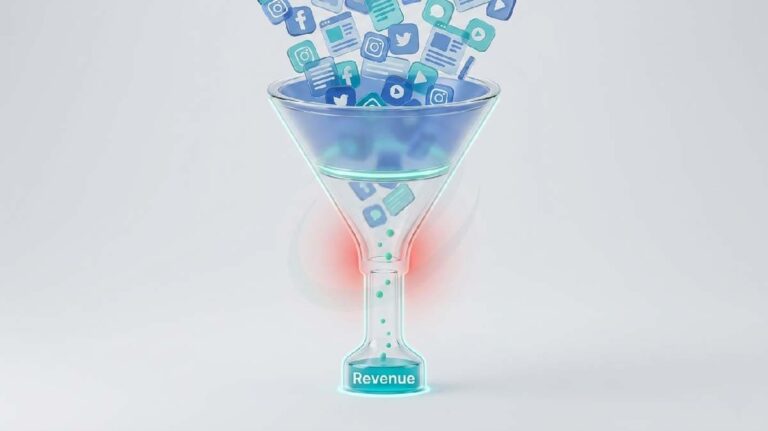
TL;DR — For Busy Founders
Most D2C brands treat content as a reach game. They track views, shares, and follower growth — and wonder why none of it shows up in revenue. A real content strategy isn’t about publishing volume. It’s about mapping every content piece to a buyer decision. If your content doesn’t resolve objections, it’s not doing the job. Fix that, and your content starts compounding — not just collecting impressions.
Table of Contents
D2C Content Strategy for Revenue: What a Real Strategy Actually Looks Like
1. Why Your Content Strategy Isn’t Driving Revenue
Most content strategies are built to generate reach, not purchase decisions.
Brands publish consistently, maintain a content calendar, hit their posting frequency — and still miss revenue targets. The calendar gets checked. The conversions don’t come.
The core problem: content is being measured by the wrong metric Reach, impressions, and engagement are outputs of a distribution system — not a sales system. When content doesn’t tie to buyer decisions, it doesn’t move revenue regardless of how well it performs algorithmically.
Content measured by reach cannot predict revenue.
- You’re optimising for platform approval, not buyer intent
- Your content answers no question a buyer is actively asking
- You’re creating awareness with no path to resolution
- See why most blogs fail: Why Your E-Commerce Blog Has 40 Posts and Zero Sales
Content that doesn’t resolve a buying objection is not part of your sales system — it’s a broadcast.
2. What a Real Content Strategy Actually Does
A real strategy maps buyer doubts to content — and connects that content directly to your product pages.
It’s not about aesthetics. It’s not about being consistent on Instagram. A working content strategy is a structured objection-resolution system. Every piece has a job. That job is tied to a buyer’s stage.
A content strategy without buyer mapping cannot influence purchase decisions.
Here’s what that actually looks like:
- Maps doubts to content: What does a buyer need to believe before they purchase? Build content around that specific belief
- Aligns platform content with site: A Reel drives awareness — it must link to content that drives consideration
- Drives decision, not just attention: Decision-stage content (comparison pages, proof content, FAQs) is the last mile
Mamaearth, a skin and haircare D2C brand in India, built significant organic traction not through lifestyle posts but through ingredient-led educational content that mapped directly to buyer concerns like “chemical-free” and “toxin-free.” The content did the selling before the product page loaded.
Strategy without funnel alignment is just a publishing schedule.
3. The Shift: From Reach to Revenue Density
The highest-ROI content in your stack is almost certainly getting the fewest views.
Revenue density = revenue generated per content piece. Most brands never measure this. They chase reach because reach is visible. But a comparison blog post with 800 monthly visitors and a 4% conversion rate outperforms a viral reel with 200K views and zero purchase intent.
| Content Type | Typical Reach | Conversion Intent | Revenue Density |
|---|---|---|---|
| Trending Reel / TikTok | High | Very Low | Low |
| Brand Awareness Blog | Medium | Low | Low |
| Comparison / “vs” Blog | Low | High | High |
| BOFU FAQ / Objection Page | Low | Very High | Very High |
boAt, a consumer electronics and audio brand, doesn’t rely on viral content alone. Their structured category and comparison content — “best headphones under ₹2000” type content — drives buyers who are ready to decide. That content doesn’t go viral. It converts.
Low-reach, high-intent content generates more revenue per visit than any viral post. Measure revenue density, not vanity reach.
4. Why This Doesn’t Convert
High-energy social content creates interest. Landing pages that don’t match that energy kill the conversion.
This is the most expensive disconnect in D2C content. A brand runs a punchy, emotionally charged Reel. Someone taps the link. They land on a generic product page with stock photography and feature bullets (Fix this here: D2C Product Page Optimization). The energy collapses. The buyer leaves.
Mismatch between content promise and landing page reduces conversion rate instantly.
Three specific failure points:
- Social promise ≠ landing experience: The content sells a feeling; the page sells a product spec
- High engagement → low clarity: Engagement metrics mean the content resonated emotionally — not that the buyer is ready to purchase
- Engagement does not equal purchase intent.
- No decision support on the page: The buyer arrived ready to consider — and found no comparison, no proof, no objection handling
Every rupee spent driving traffic to a misaligned landing page is wasted. The traffic cost is fixed. The conversion loss is compounding.
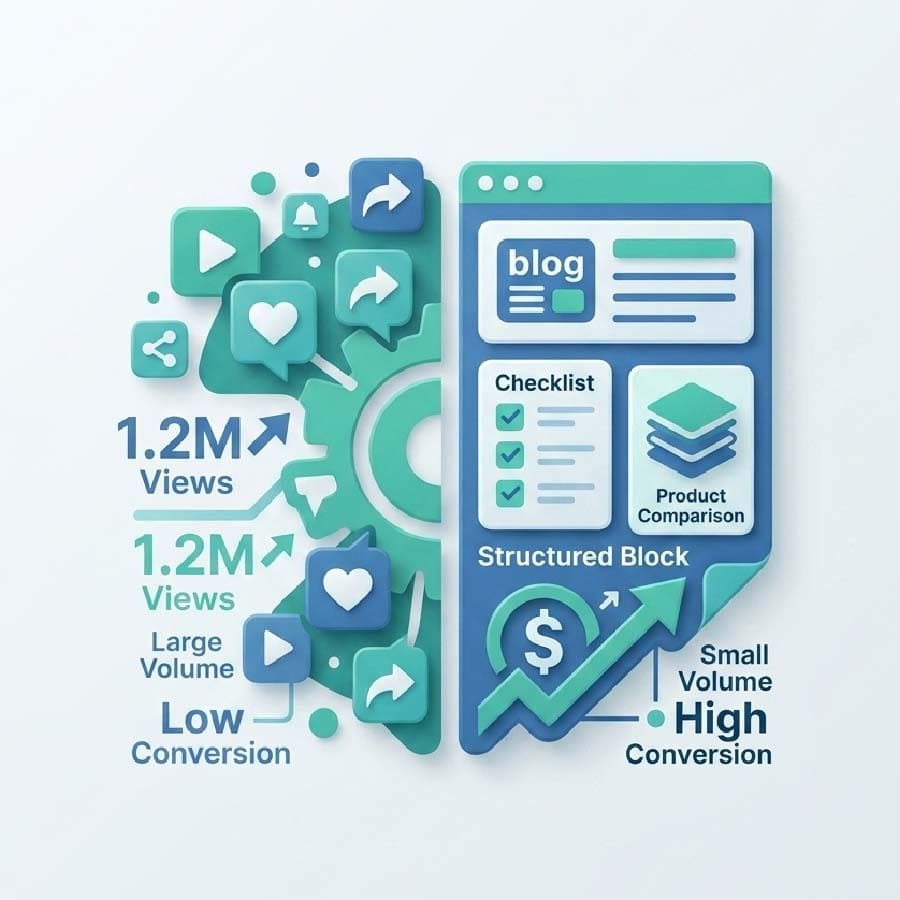
Conversion rate problems are rarely a traffic problem. They’re an alignment problem between the content promise and the landing experience.
5. The Conversion Gap Most Brands Ignore
There’s no bridge between where your buyers discover you and where they’re supposed to decide.
This is the gap that bleeds revenue silently. A buyer sees a TikTok from Minimalist, a science-backed skincare brand. They’re interested. They visit the site. They browse a few product pages. They leave. No purchase.
Without bridge content, discovery traffic rarely converts.
What’s missing is the bridge content — the piece that sits between discovery and decision.
Common examples of this gap:
- TikTok to blog mismatch: The content covers a trend; the site has no supporting article that deepens the claim
- Ad to PDP disconnect: The ad makes a specific promise; the product page is generic and doesn’t reinforce it
- Missing proof layer: No before/after, no clinical reference, no review synthesis — nothing that closes the loop
Brands that close this gap typically see conversion rate improvements of 15–30% without increasing ad spend. The traffic was always there. The bridge wasn’t.
High-intent content reduces CAC by converting existing traffic more efficiently.
The conversion gap isn’t a creative problem — it’s a structural one. Add bridge content and your existing traffic starts performing.
6. Proof: What High-Converting Content Looks Like
The content that converts isn’t the content that looks best. It’s the content that resolves the final objection.
I’ve seen brands obsess over aesthetics while their competitors publish detailed, slightly-ugly comparison guides and capture 80% of the decision-stage traffic. Utility beats aesthetics at the bottom of the funnel — every time.
Aesthetic content attracts attention; utility content drives purchase.
High-converting content has these characteristics:
- Technical breakdowns: Explains exactly how the product works, not just what it does
- Objection handling: Directly addresses “is this worth the price?” and “will this work for me?”
- Price justification: Contextualises the cost — against alternatives, against the problem it solves
- Third-party validation: Cites certifications, reviews, or comparisons that the buyer didn’t have to seek out
Plum, a vegan beauty brand, uses ingredient transparency pages and skin-type guides that double as objection handlers. They don’t rely on aesthetics alone. The content answers the question: “Is this the right product for me?” That question is what determines purchase — not the visual polish of a Reel.
Buyers convert when their last objection is resolved. Build content that targets the final doubt, not the first impression.
7. The Practical System: Revenue-Driven Content Mapping
Map every content piece to a buyer decision stage. If it doesn’t fit, it doesn’t get published.
This is the operational shift that separates brands building a content-to-revenue system from brands running a content calendar. The framework is simple:
Stage 1 — Awareness: Problem Naming
- Content type: Short-form video, social posts, trend-led blogs
- Job: Help the buyer name their problem
- Example: “Why your moisturiser isn’t working” (Minimalist-style education)
Stage 2 — Consideration: Comparison Content
- Content type: “X vs Y” blogs, ingredient guides, category comparisons
- Job: Help the buyer evaluate options
- Example: “Retinol vs Niacinamide: What your skin actually needs”
Stage 3 — Decision: Proof + ROI Clarity
- Content type: Before/after, case studies, FAQ pages, objection-handling PDPs
- Job: Remove the final barrier to purchase
- Example: “Why Minimalist 10% Niacinamide is worth ₹599 vs drugstore alternatives”
Most brands have Stage 1 content in abundance. Stage 3 content is almost always missing. That’s where revenue is being lost.
Decision-stage content typically converts 2–5x higher than awareness content.
Decision-stage content is the most underpublished and highest-converting asset in D2C. Most brands stop at Stage 1 and wonder why awareness doesn’t convert.
For the full distribution layer behind this system, read the D2C Content Distribution Strategy.
8. Who This Strategy Is Actually For
This framework works for brands with a real product and a specific buyer. It will not work for brands chasing trends.
Before going further, a qualification check:
This works for you if:
- Your product has a clear, defensible value proposition
- You know your buyer’s primary objection before purchase
- You’re willing to measure content by revenue contribution, not reach
This is not your strategy if:
- You measure success by follower growth or viral posts
- You’re building “content for visibility” without a conversion plan
- You don’t have a product page that can hold the conversion after the content does its job
Feastables, a snack brand built by MrBeast, leveraged content-to-purchase alignment from launch — the founder’s audience was the discovery layer, but the purchase experience had to close independently. For brands without that built-in audience, the content system has to work harder at every stage.
Content strategy without a qualified buyer profile is just content production. Know who you’re moving through the funnel before you map a single piece.
9. How to Fix Your Content Strategy This Week
Stop creating Stage 1 content until you’ve built Stage 3 content for every product you’re actively selling.
Here’s a practical three-step audit:
Step 1 — Audit your top 10 content pieces Pull the 10 content assets with the most traffic or engagement. Tag each one: Awareness / Consideration / Decision. Most brands find 8 out of 10 are Awareness-stage. That’s the gap.
Step 2 — Add one comparison or decision-stage piece per product For each hero product, create one piece of content that answers: “Why should I buy this over the alternative?” Build it as a standalone blog, a PDP section, or a dedicated FAQ.
Structure it using: The 3-Line Product Description Formula.
Step 3 — Align your landing pages to your content source If a buyer arrives from a specific piece of content, the landing page should match the claim that drove them there. A blog about sensitive skin should link to a landing page built for sensitive skin — not the generic homepage.
This week’s action changes the output without changing the volume. You’re not publishing more — you’re publishing with intent.
Content volume does not fix conversion gaps; alignment does.
One high-intent piece of decision-stage content will consistently outperform ten awareness posts in revenue contribution.
Improve conversion further: Add to Cart Optimization
If your social content is getting likes but not conversions, the design layer is usually where the breakdown happens. At Izwiq Digital, we help e-commerce and D2C brands build content systems that pass the trust test — without expensive production.
FAQ
What is a revenue-driven content strategy?
A revenue-driven content strategy maps every content piece to a specific buyer decision, not a traffic goal. Instead of publishing for reach, every piece is designed to move a buyer from one stage — awareness, consideration, decision — to the next, with the product page as the final destination.
Why doesn’t viral content convert?
Viral content creates attention without resolving buying objections. A post can generate 200K views and zero purchases because it never answered the question: “Is this product right for me?” Reach and purchase intent are different buyer states — and most viral content targets the former, not the latter.
What is revenue density in content?
Revenue density is the revenue generated per content piece, not the views or shares per piece. A blog post with 800 monthly visitors and a 4% conversion rate has higher revenue density than a viral post with 100K impressions and no conversion path. Revenue density is the correct metric for any brand serious about content ROI.
What type of content converts best for D2C brands?
Decision-stage content consistently converts best: comparison pages, objection-handling FAQs, ingredient or feature breakdowns, and price-justification content. These pieces resolve the buyer’s final doubt — which is what triggers purchase. Awareness content drives traffic; decision-stage content closes it.
About the Author
Muhammed W is a content strategist at Izwiq Digital, working directly with small business, D2C and e-commerce brands on SEO content, social media systems, and conversion-focused design.
The insights shared here are based on hands-on client work across health, beauty, SaaS, and B2B — focused on improving engagement, trust, and conversion metrics. Learn more about our services