

AI-Driven Growth Strategy: Why AI Content Isn’t Converting in 2026
TL;DR — For Busy Founders
AI didn’t just change content production — it broke it. Every brand is publishing more, but fewer readers are converting. The reason isn’t volume or SEO. It’s trust. Pure AI content floods the market with generic, undifferentiated output that users detect and dismiss instantly. Brands running a Human-AI-Human workflow are seeing up to 32% better conversion rates compared to pure AI publishing. If you’re still measuring content success by output, you’re tracking the wrong metric.
Table of Contents
Why Is AI Content Everywhere but Results Are Flat?
AI increased output. It did not increase effectiveness.
Every brand — from a 3-person Shopify store to a VC-backed D2C label — has access to the same AI tools, the same prompts, and the same content templates. When everyone produces content at the same cost and speed, the content stops competing. It blends in.
- AI made average content essentially free to produce
- A flooded market means diminishing attention per piece
- Users now scroll past generic content faster than ever before
The market didn’t get better at content. It got louder. Louder is not the same as more trusted, more persuasive, or more converting.
More content does not increase conversions—it increases competition for attention
When content production becomes commodity, volume stops being a competitive advantage.
What Changed in 2026 That Broke AI Content Performance?
Trust replaced visibility as the primary growth lever.
Visibility brings traffic, but trust converts it into revenue, as shown in how content builds trust in seconds.
Google’s algorithm updates throughout 2025 and early 2026 accelerated E-E-A-T (Experience, Expertise, Authoritativeness, Trustworthiness) as a dominant ranking signal, as reflected in how Google ranks search results. Pure AI content — with no first-person experience, no verifiable claim, no author identity — lost credibility with both algorithms and readers.
- Brands running pure AI content strategies saw ranking drops of up to 23% in competitive categories
- 56% of users report disengaging from content they perceive as generic or templated
- “Top-of-trust” has overtaken “top-of-mind” as the metric that drives purchase decisions
Take Minimalist, a skincare brand built on ingredient transparency. Their content works not because it’s frequent — but because it’s credible. Every article carries a specific claim tied to a specific formulation decision. That’s not AI output. That’s editorial intent.
Generic content doesn’t just underperform — it actively trains your audience to ignore you.
Repeated low-quality content conditions users to disengage permanently, which explains why content publishing fails in 2026.
Being seen and being believed are two different outcomes. Only one of them drives revenue.
What Actually Works Now? (The Hybrid Content Model)
Human-plus-AI workflows outperform both extremes — pure human and pure AI.
This isn’t a philosophical position. It’s a performance one. The brands converting traffic into buyers right now are using AI for scale and humans for strategy. The split matters more than the ratio.
- Brands using hybrid workflows report up to +32% improvement in content conversion rates versus pure AI publishing
- AI handles: keyword clustering, draft generation, structural expansion, metadata
- Humans handle: POV, lived experience, brand positioning, editorial judgment
Conversion improves when content reflects real product decisions, which is why content strategy tied to unit economics performs better.
Brands like Perfora, a D2C oral care brand, are producing content that reads like a founder explaining why they built the product. That specificity — that this is why we chose activated charcoal over fluoride alternatives — cannot come from a prompt. It comes from someone who made that decision.
AI is a production tool, not a thinking tool. The thinking still needs to come from you.
AI scales production, but humans create persuasion.
Where Brands Lose Revenue
AI removes the founder’s intent from content — and that intent is what creates belief.
This is the most expensive mistake I see D2C brands make. They use AI to explain their product. Explaining is not the same as persuading. Content that describes a product does not create urgency. It creates awareness, which is a completely different stage in the funnel.
| Dimension | Pure AI | Pure Human | Hybrid |
|---|---|---|---|
| Speed | High | Low | High |
| Cost | Low | High | Medium |
| Trust | Low | High | High |
| Conversion | Low | Medium–High | High |
Conversion gaps usually appear between product understanding and purchase intent, which is why add-to-cart optimization principles matter.
- No emotional trigger → no urgency → no purchase
- No founder story → no differentiation from 40 competitors selling the same SKU
- Feature lists are not persuasion; outcomes are
Features tell. Proof converts. Every piece of content that describes what your product does without explaining what it changes in the buyer’s life is a missed conversion opportunity.
Product pages that explain without proof consistently underperform, as seen in why product pages don’t convert.
Awareness without persuasion does not generate revenue.
Content that explains without persuading costs you CAC without recovering it in revenue.
Why Editing AI Content Is Slowing You Down
AI doesn’t eliminate writing work — it shifts it from creation to correction.
I call this the Editing Paradox. Teams adopt AI to move faster, then spend 60–70% of their content time fixing tone, removing filler, adding specificity, and rewriting conclusions. The net saving is close to zero. In some cases, it’s negative — because the editor now owns work they didn’t originate and can’t fully own. Efficiency without strategy increases workload instead of reducing it, which is why content strategy templates matter
- Correcting tone in AI output often takes longer than writing from scratch
- Rewrites signal strategic input was skipped, not saved
- Most teams underestimate editing load by 3–4x when they first adopt AI workflows
AI shifts effort from creation to correction.
This isn’t an AI problem. It’s a workflow problem. AI produces output at the quality level of its input. Weak strategic input → weak draft → expensive editing cycle.
If you’re spending more time editing AI than you saved generating it, your workflow is broken.
Why This Doesn’t Convert
AI content fails to convert because it lacks specificity, lived experience, and trust anchors.
Readers — especially D2C buyers who are sophisticated and increasingly skeptical — detect generic content immediately. They may not name it. But they feel it. Something is missing. And what’s missing is proof that a real person made a real decision about this product.
- No real use-case depth: “This serum hydrates skin” vs. “After 14 days of monsoon travel, my skin retained moisture through two 10-hour flights”
- No unique insight: saying what every competitor says, just faster
- No trust anchors: no named author, no referenced test, no brand-specific claim
Generic content doesn’t just fail to convert — it raises CAC. You pay for traffic that bounces because the content doesn’t hold the reader long enough to build belief.
Traffic without conversion is a direct increase in CAC, which explains why blogs generate traffic but no sales.
Specificity builds trust faster than volume.
A reader who arrives and doesn’t believe is more expensive than a reader who never arrived.
This is where WebMCP and AI agent readiness also matter. When AI agents browse and evaluate your content on behalf of a buyer — as increasingly happens with research-based purchases — they’re filtering for specificity, authority, and credibility. Generic content fails that filter too.
What System Fixes This? (Human-AI-Human Workflow)
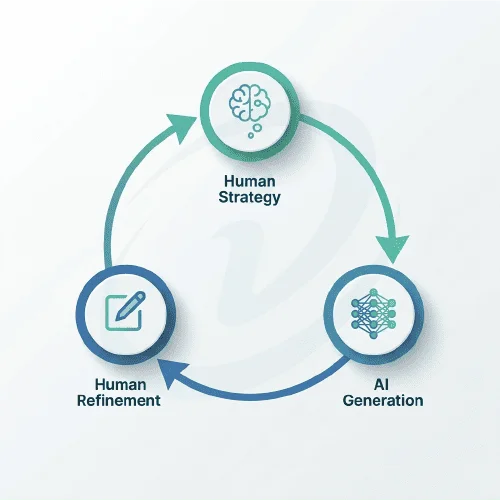
A structured three-phase workflow separates strategic thinking, AI generation, and human refinement.
Most teams collapse all three into one step: prompt → publish. That’s where the quality breaks down. The fix is architectural, not creative.
Step 1 — Human Strategy (Before AI touches anything):
- Define the single insight this piece must communicate
- Identify the reader’s specific objection or question
- Write 3–5 sentences of raw POV in your own voice
Strong strategy determines whether content attracts buyers or just visitors, which is why content strategy templates for revenue growth are critical.
AI amplifies clarity—it cannot create it.
Step 2 — AI Generation (Structured, not open-ended):
- Feed your POV, angle, and target keyword as structured input
- Use AI to expand structure, generate draft, fill supporting sections
- Do not let AI choose the angle — it will default to the average
Step 3 — Human Refinement (Non-negotiable):
- Inject proof: a specific result, a brand example, a customer outcome
- Restore voice: remove hedges, passive constructions, and AI-isms
- Add a trust anchor: a named decision, a sourced claim, or a tested outcome
The quality of your AI content is determined in Step 1 — before the AI generates a single word.
Who This Works For (And Who It Won’t)
This system works for brands optimizing conversions — not content volume.
If you’re running a D2C brand, a content-led SaaS, or a small team trying to convert traffic into revenue without a 10-person editorial team, this is built for you. If your primary metric is articles published per month, this framework will feel slow — because it front-loads thinking.
Works well for:
- D2C brands with a defined product story and target buyer
- SaaS companies building trust-first content pipelines
- Small teams (1–5 people) who need output that converts, not impresses
Does not work for:
- Bulk content publishers who need 50 articles a week at any quality level
- Teams with no strategic input available upstream
- Brands without a clear point of view on their category
This system requires an opinion. AI can generate content indefinitely. It cannot generate conviction.
Brands without positioning struggle to convert, which connects to brand consistency vs performance marketing.
If your brand doesn’t have a position, no workflow — human or AI — can save your conversion rate.
What Should You Do Next?
Audit your existing content for conversion performance — not output volume.
Before you restructure your workflow, you need to know which content is already failing. Most brands I work with discover that 60–70% of their published content generates traffic with zero measurable revenue impact. That’s not an SEO problem. That’s a content strategy problem.
Three actions this week:
- Pull your last 30 days of published content — rank by sessions, then by conversion events (not by views)
- Identify your bottom-quartile performers — these are the pieces most likely built on pure AI output
- Pick one underperforming piece and rebuild it using the Human-AI-Human framework above
If your content is generating traffic but not revenue, the problem is in the trust gap — between the click and the belief. That gap is what hybrid content closes.
Every month you run pure AI content, you’re spending money on CAC for traffic that won’t convert. That’s the cost of inaction.
If more than half your content isn’t driving revenue, your strategy—not your effort—is the problem.
See how a structured, conversion-led approach fixes this Explore how Izwiq Digital builds conversion-led content strategies for D2C brands
Your content isn’t broken. Your strategy is
We help D2C brands turn traffic into revenue with structured, conversion-led content systems.
FAQ
Is AI content bad for SEO in 2026?
Pure AI content — unedited, generic, lacking E-E-A-T signals — performs poorly in current search. Hybrid content that combines AI efficiency with human authority and first-person experience performs significantly better. The issue isn’t AI as a tool; it’s AI as a complete replacement for strategic editorial judgment.
Why doesn’t AI content convert even when it ranks?
Ranking and converting are two separate outcomes. AI content can rank for informational queries but fails to convert because it lacks specificity, real use-case depth, and the trust anchors buyers need before making a purchase decision. Traffic without belief doesn’t become revenue.
Should small D2C teams still use AI for content?
Yes — but as a production support tool, not a strategy replacement. AI handles drafting, expansion, metadata, and structural tasks. Humans own the angle, the proof, the voice, and the CTA logic. Small teams that flip this ratio end up with fast, cheap, non-converting content.
What is the single biggest mistake brands make with AI content?
Using AI to replace thinking instead of accelerating it. The brands that fail with AI content skip Step 1 — they go straight from a keyword to a prompt. The output inherits that absence of strategic intent, and no amount of editing fully recovers it.
About the Author
Muhammed W is a content strategist at Izwiq Digital, working directly with small business, D2C and e-commerce brands on SEO content, social media systems, and conversion-focused design.
The insights shared here are based on hands-on client work across health, beauty, SaaS, and B2B — focused on improving engagement, trust, and conversion metrics. Learn more about our services