
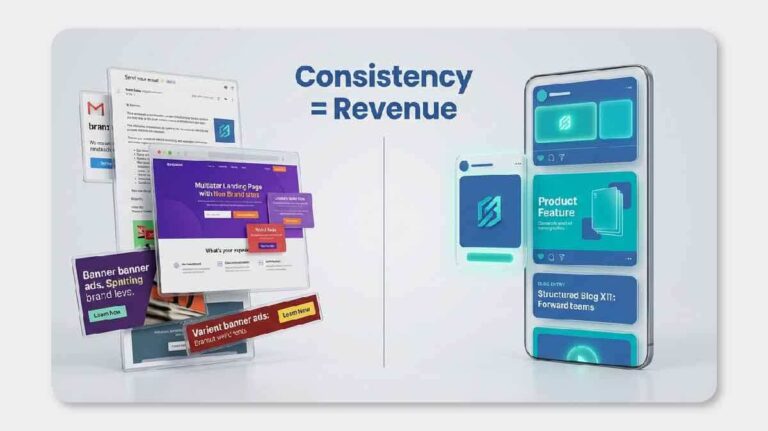
The Hidden Cost of Inconsistent Branding: From Clicks to Lost Revenue
TL;DR — For Busy Founders
You’re spending on paid ads, CTRs look okay, but repeat purchases are thin and CAC keeps climbing. The problem isn’t your media buyer. Your brand looks like three different companies across touchpoints. Fix that, and your spend starts compounding instead of leaking.
Table of Contents
The Real Cost of Inconsistent Branding (The “Trust Gap Tax”)
Most brand consistency conversations get stuck in aesthetics — fonts, color palettes, mood boards. That’s not the conversation I want to have. I want to talk about margin loss.
There’s a stat that should make every D2C founder stop scrolling: 71% of product returns are driven by a mismatch between what the customer expected and what they received. A massive chunk of that expectation is set before they ever buy — built inside your ad, your landing page, your first email. When those three don’t feel like the same brand, you create a trust gap. And the customer fills that gap with hesitation, skepticism, or a return request.
Think about what that actually costs. A return isn’t just a refunded order. It’s reverse logistics, restocking, customer service time, and a buyer who almost certainly isn’t coming back. You paid to acquire them. You paid to ship to them. Now you’re paying again to get the product back — and you’ve permanently lost the LTV that made the acquisition cost make sense.
I call this the Trust Gap Tax. Unlike shipping or ad costs, it doesn’t show up as a line item. It quietly bleeds across your P&L while your team argues about hook angles.
The 5-Touchpoint Rule and Why Brand Recall Matters
Here’s something performance marketers don’t love saying out loud: you don’t make money on the first purchase. For most D2C brands — supplements, skincare, apparel — profitability kicks in on the third or fourth order. Around 60% of revenue for healthy D2C brands comes from repeat buyers.
So your entire growth model depends on someone remembering you well enough to return.
Brand recall doesn’t happen by accident. It’s built through consistent repetition across touchpoints — ad, landing page, email, packaging, social. The brain is pattern-matching constantly. When each interaction with your brand looks slightly different, there’s no pattern to lock onto. The customer moves on, and they don’t consciously decide not to come back — they just forget you exist.
“If I don’t recognise you instantly, I won’t come back. It’s not personal — it’s just how memory works.”
This is especially brutal for high-volume paid traffic brands. You might be pulling 10,000 new visitors a day, but if none of them build a memory structure around your brand, you’re buying attention — not equity.
D2C Brand Consistency vs Performance Marketing: The Core Conflict
This is the tension I see most often, and it’s a structural problem — not a people problem.
Performance teams optimize for CTR, hook velocity, scroll-stop rate. Their job is to find what works right now. And they’re good at it. The problem is that what performs in the feed isn’t always what aligns with the brand. A winning ad might use a jarring color, an off-tone voiceover, or a claim your brand would never make in any other context.
Over time, you end up with what I call a Franken-brand. Your top-performing ads look nothing like your website. Your website looks nothing like your emails. Each piece is technically functional, but the sum doesn’t add up to anything recognisable.
Scaling a Franken-brand doesn’t compound — it fragments. You’re not building equity with every impression. You’re just buying impressions again and again, with no residual brand memory accumulating between purchases.
Scaling ≠ compounding. Scaling a broken brand just breaks it faster.
If you’ve been wondering why your growth feels like running on a treadmill — CAC going up, repeat rate flat — this is likely the root cause. And it’s fixable. I’ve seen it fixed on a $200/month Shopify store and a $2M D2C brand running the same way.
For a closer look at how this plays out on individual pages, read E-commerce product page mistakes that are costing you 30% of sales.
Cognitive Fluency in Ecommerce: Why Familiarity Converts
There’s a psychological principle behind all of this: cognitive fluency. The brain processes familiar patterns faster and with less effort — and it interprets that ease as trustworthiness.
When a shopper lands on your product page after seeing your ad, their brain is running a background check: does this feel like the same brand? If the answer is yes — same visual language, same tone, same energy — the friction drops. Decisions happen faster. Bounce rate falls. Checkout conversions go up.
If the answer is something feels off, even subconsciously, they hesitate. They add to cart, then leave. They read the reviews twice. They open a competitor’s tab.
Cognitive fluency in ecommerce isn’t a branding theory — it’s a conversion lever. Brands like Glossier built their entire acquisition model on it. Every touchpoint, from a Reddit comment to the checkout page, feels like the same person talking to you. That consistency removes micro-decisions from the purchase journey.
Where Inconsistency Creates Micro-Friction
Micro-friction is the silent killer of conversion rates. It’s not one big problem — it’s six small mismatches that collectively drain your funnel.
Ad vs Landing Page Mismatch
Your ad promises a lifestyle. Your landing page delivers a product spec sheet. The emotional register shifts completely between the two. The customer who clicked on the ad didn’t sign up for that shift — and they bounce. I’ve audited D2C brands where fixing this single mismatch moved conversion rate by 15–20%.
UGC vs Website Identity Clash
Raw creator content drives 70–80% of top-performing paid social for most D2C brands right now. But that same raw, casual UGC sitting next to your polished brand website creates a jarring disconnect. Customers who see the ad and then land on the site feel like they’ve walked into a different store.
Email vs Product Page Tone Shift
Your email sounds warm, witty, founder-led. Your product page reads like a generic Shopify template. The customer who opened your email because your voice felt real is now reading copy that could belong to any brand. That moment — “this doesn’t feel like the same brand” — is where the purchase decision quietly dies.
The UGC Problem Nobody Solves
Everyone is talking about UGC as the answer to creative fatigue. And for raw performance metrics — hook rate, view-through, CTR — it often is. The problem is the part nobody talks about: you don’t control creators.
Their lighting is different. Their energy is different. Their framing of your product is different. You end up with a content library where every asset looks like it came from a different brand. Which, technically, it did.
The UGC consistency gap is one of the most underrated problems in D2C right now. Brands are outsourcing their visual identity to a rotating cast of creators and wondering why brand recall is weak. The content is performing. The brand is disappearing.
There’s no system in place to bridge the two — and that’s exactly where the next framework comes in.
The Visual Anchor Framework
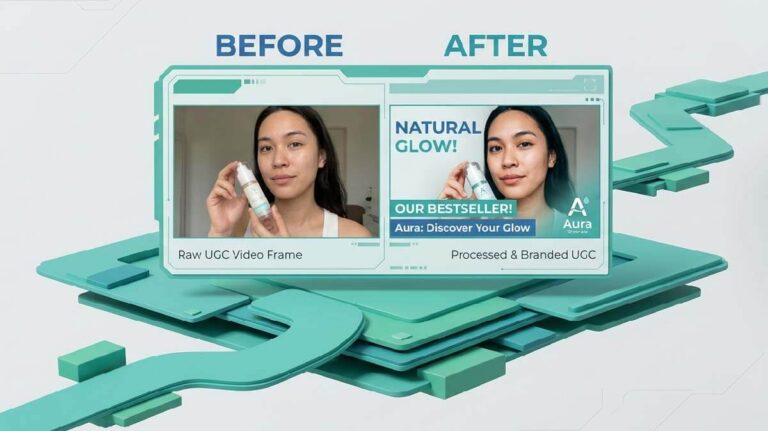
The solution isn’t to stop using UGC. It’s to brand-wrap it.
I use a three-component system I call the Visual Anchor Framework. It takes raw creator content and converts it into a branded asset without stripping out the authenticity that made it perform in the first place.
Component 1 — Typography Overlay Same font. Always. Whether it’s a product callout, a stat, or a CTA — one typeface, consistent weight. Train your audience’s visual memory to associate that font with your brand.
Component 2 — Color Grading Filter Apply a signature LUT or color grade to every video asset before it goes live. Subtle enough that it doesn’t look filtered, strong enough that your feed has a consistent visual temperature. Rhode does this exceptionally well — their content looks like it was shot by the same person even when it wasn’t.
Component 3 — Intro/Outro Hook A repeatable identity cue — a logo animation, a sound, a consistent opening line format — at the start and end of every video. This is the equivalent of a TV show’s opening title sequence. Over time, it trains instant recognition.
The outcome: raw UGC content becomes a branded asset. You scale without losing identity.
Creative Fatigue vs Brand Identity
There’s a myth in performance marketing that creative fatigue means it’s time to rethink your brand. That’s backwards.
Creative fatigue is a format problem — not a brand problem. When an ad stops performing, it’s because the audience has seen that specific execution too many times. The fix is new formats, new hooks, new angles. Not a new visual identity.
The brands that conflate the two end up refreshing their entire look every quarter, resetting whatever brand recognition they’d started to build. They’re in a perpetual loop of starting over.
Variation lives inside consistency. You can test ten different hooks and still use the same fonts, colors, and tone. You can test static vs video, long-form vs short, funny vs earnest — all within a brand system that stays recognisable.
This is also addressed in an earlier piece: Why inconsistent branding is hurting your content strategy.
Omnichannel Brand Alignment in 2026
The channels you need to align in 2026 aren’t complicated — but most brands are treating them like separate departments:
- Paid ads — your first impression, sets the expectation
- Website — where the expectation is confirmed or broken
- Email — where the relationship deepens or disappears
- Social (organic) — where the brand personality lives between purchases
I use a simple internal tool I call a Vibe Profile — a one-page reference that defines the visual, tonal, and emotional register of the brand. Before any creative goes live, the question is: does this fit the Vibe Profile? If no — it doesn’t go out, even if the hook is strong. Especially if the hook is strong.
There’s also a new dimension coming in fast: AI search. When ChatGPT, Perplexity, and Google’s AI Overviews pull brand information, they’re looking for consistent entity signals across the web — the same name, positioning, tone, and visual context appearing coherently across multiple sources. Brands with inconsistent signals are essentially invisible to these systems. Omnichannel brand alignment isn’t just a conversion strategy anymore — it’s your SEO moat for the next three years.
Case Study Contrast: Rhode vs Aggregator Supplement Brands
Two ends of the spectrum illustrate this better than any framework can.
Rhode (Hailey Bieber’s skincare brand) has built one of the most cognitively fluent brands in D2C. Every touchpoint — paid creative, website, email, TikTok, packaging — maintains the same soft, intimate visual language. The result: exceptionally high brand recall, repeat purchase rates that don’t require aggressive discounting to maintain, and organic word-of-mouth that compounds.
On the other end: most aggregator-style supplement brands. High CTR ads — often bold, loud, claim-heavy. But the landing pages are generic. The email sequences feel like a different company. The checkout page looks like it was built in 2019. Attention without alignment — and the CAC keeps climbing because none of that attention is converting into memory.
The distinction isn’t budget. It’s intentionality. Rhode is intentional about every pixel. The aggregator is optimising each channel in isolation.
| Factor | Inconsistent Brand | Consistent Brand |
|---|---|---|
| CAC | High & rising | Lower over time |
| Bounce Rate | High | Lower |
| Brand Recall | Weak | Strong |
| LTV | Unstable | Compounding |
| AI Visibility | Low | High |
Action Plan: Fix Your Brand Consistency in 7 Days
No agency required. No brand refresh needed. Seven days, working with what you have.
Day 1 — Define Your Visual Anchor Pick one font, one primary color, one tone descriptor. Write it down. This is your brand’s non-negotiable.
Day 2 — Audit 5 Touchpoints Open your top paid ad, landing page, welcome email, Instagram profile, and product page side by side. Do they feel like the same brand? Note every mismatch.
Day 3 — Remove Off-Brand Creatives Pause any paid creatives that don’t fit your Visual Anchor — even if they’re performing. Short-term CTR isn’t worth long-term brand fragmentation.
Day 4 — Align Your Top 3 Revenue Channels Pick the three channels driving the most revenue. Update copy, visuals, or tone to bring them into alignment. This doesn’t mean a redesign — a font swap and a color correction can be enough.
Day 5 — Build Your Vibe Profile One page. Visual direction, tone of voice, what you’d never say, what you always say. Share it with everyone who touches creative.
Day 6 — Set Testing Boundaries New creative tests stay within the Vibe Profile. New hooks, yes. New identity, no.
Day 7 — Review and Document Walk through all five touchpoints again. Screenshot what’s aligned. That’s your new baseline.
F.A.Q.
Can a small D2C brand realistically maintain brand consistency while running lots of creative tests?
Yes — and this is the exact myth I push back on. Testing and consistency aren’t opposites. You test within a brand system. Hook format, angle, format length — all testable. Visual identity, tone, fonts — non-negotiable. The brands that conflate the two end up resetting their brand every quarter.
How does brand inconsistency directly affect CAC?
When a new customer encounters your brand across multiple touchpoints and each one feels slightly different, trust doesn’t build. They don’t come back. That forces you to keep acquiring new customers to replace the ones who didn’t return — driving CAC up indefinitely. Repeat purchase rate is the most direct lever on CAC, and brand consistency is the most underused lever on repeat purchase rate.
Should UGC be brand-wrapped before going live on paid channels?
Yes. Not to strip out the authenticity — but to add identity cues so the content works as both a performance asset and a brand-building asset. A consistent typography overlay and color grade takes under ten minutes per asset and meaningfully closes the gap between raw UGC performance and brand coherence.
How does brand consistency affect SEO and AI search in 2026?
AI search engines (Perplexity, ChatGPT, Google AI Overviews) identify brand entities by looking for consistent signals across the web — same name, same positioning, same tone. Inconsistent brands send weak or conflicting entity signals, making them harder for AI systems to surface confidently. Consistent brands, by contrast, become well-defined entities that AI agents can recommend with confidence. It’s the new SEO moat.
About the Author
Izwiq Digital delivers strategic content marketing and graphic design for agencies and e-commerce brands. Our blog covers proven frameworks for SEO content, email marketing, and conversion-focused copywriting — built from real client work across health, beauty, SaaS, and B2B industries. Learn more about our services