
Why Your Social Media ROI Looks Premium But Gets Zero Engagement (And How to Fix It)
TL;DR — For Busy Founders
If your D2C brand’s social content looks polished but performs poorly, the design is the problem — not the algorithm. In 2026, trust signals outperform aesthetic signals every time. This post breaks down the design shift that separates brands with growing communities from brands with growing ad spend. Stop optimising for beautiful. Start optimising for believable.
Table of Contents
The Engagement Illusion: Why “Good Design” Is Failing in 2026
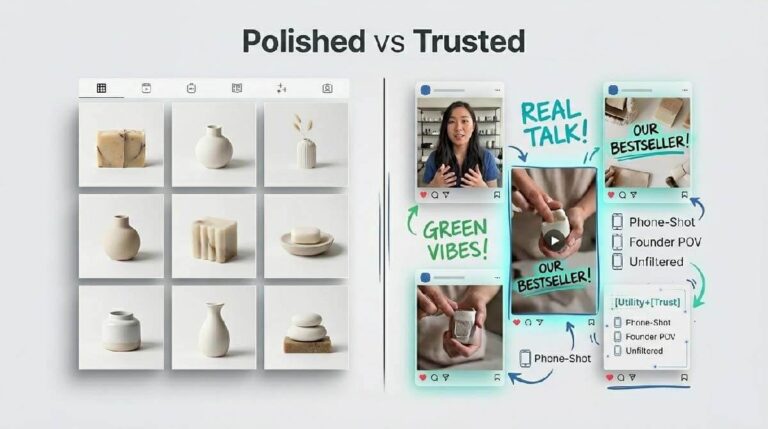
I’ve audited hundreds of brand social accounts over the years. And there’s a pattern I keep seeing — a beautifully curated grid, consistent colour palette, clean product photography. And then I open the post insights. Single-digit saves. 0.3% engagement rate. Zero comments that aren’t emoji responses from bots.
The brand looks premium. It just doesn’t perform like one.
Here’s what happened: the grid aesthetic — that perfectly cohesive Instagram layout that every D2C skincare and supplement brand chased for three years — is functionally dead. Reels and Explore dominate discovery now. Nobody lands on your grid first. They land on a single piece of content, and in under two seconds, they decide whether to stop or scroll.
In that context, “looking premium” is the same as blending in. When every brand in the health supplements space is using the same white backgrounds, the same clean sans-serif, the same soft lifestyle photography — there’s no visual hook. No reason to pause. You’ve out-designed your competitors and still lost.
The problem with treating social media engagement for D2C as a design problem — specifically a polish problem — is that it sends brands in exactly the wrong direction.
The Social Search Shift: Why Design Must Answer, Not Impress
Over 60% of product discovery now happens on social platforms, not Google. I’m not surprised — my clients’ analytics have been showing this shift for the past eighteen months. But what most brands miss is what people are actually doing when they “discover” on social.
They’re not browsing aesthetics. They’re searching for answers.
They want proof that the product works. They want to see a real person using it. They want the experience of the product — the texture of a skincare serum, the pour of a cold brew, the before/after of a supplement — documented like evidence, not advertised like a campaign.
Think about how someone searches “best protein powder for women” on Instagram or TikTok in 2026. They’re not stopping on a brand post with a clean product shot. They’re stopping on a video where a real founder explains why they made the product, a customer rant about how it fixed their digestion, or a split-screen comparison with a competitor.
That means your human-centric brand design isn’t just a creative choice — it’s a discoverability strategy. If your content is built to impress a creative director, it will lose to content that’s built to answer a customer’s actual question.
Creative Fatigue & the Rise of “Creative Velocity”
Here’s something nobody wants to admit: your best-performing piece of studio content will stop working. Not because the market changed, but because you published it ten times.
This is creative fatigue, and it hits polished content harder than raw content. Why? Because a studio shoot is an event. You produce 20 assets and rotate them for three months. By week six, your audience has seen the same aesthetic so many times it becomes invisible.
Even Meta’s 2025 Creative Effectiveness Report supports this — high-frequency, less-polished creatives consistently outperform static studio assets in engagement and conversion.
A lo-fi content strategy for brands operates differently. You’re not producing 20 assets in a day — you’re producing 2-3 raw, authentic pieces every day. The variety itself is the hook. The imperfection signals freshness.
The brands that are scaling social media engagement right now have shifted from “campaign” thinking to “loop” thinking. Instead of planning a monthly content calendar around two studio shoot outputs, they’re building daily content loops — founder clips shot on a phone, customer screenshots, quick text-based posts responding to questions in their DMs.
Volume beats perfection. Not because quality doesn’t matter, but because consistent human presence outperforms occasional polished presence every time in an algorithm designed to reward recency and interaction.
The Trust Equation: Utility + Raw Delivery
This is the framework I use with every D2C client, and it’s the core of everything I’m arguing in this post.
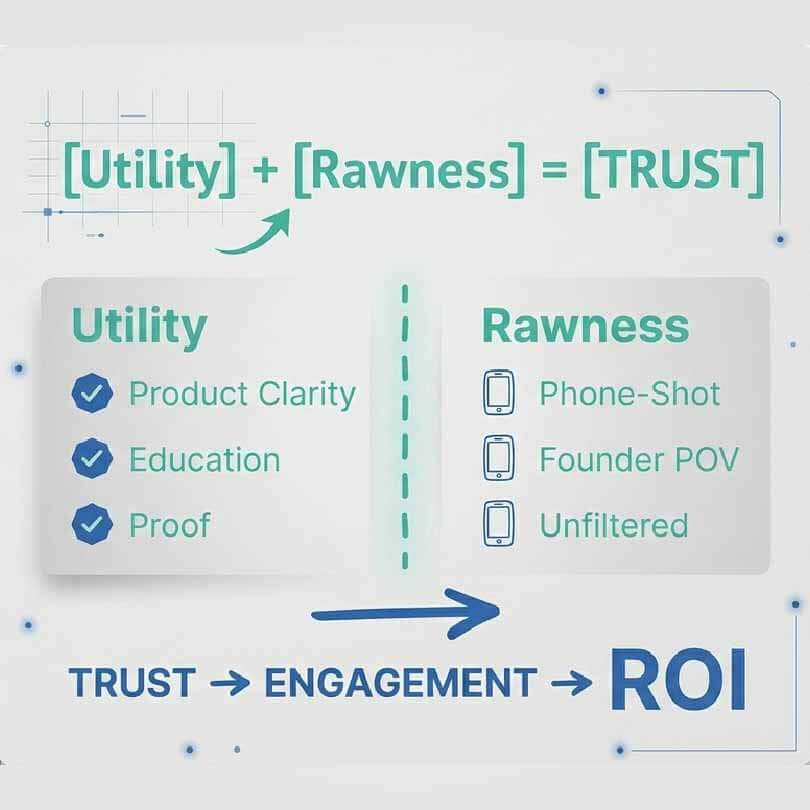
Trust = High-Quality Utility × Raw Delivery
Both variables matter. Get one wrong and the equation breaks.
High-Quality Utility (Non-Negotiable)
The content has to earn the stop. That means:
- Product clarity: Can someone understand exactly what your product does in the first three seconds? Not what it looks like. What it does.
- Education: Are you teaching your audience something they didn’t know before? Ingredient deep-dives, process explainers, myth-busting content — this is the stuff that gets saved and shared.
- Proof: Results. Real ones. Ingredients with clinical backing. Customer stories with specific outcomes. Before/afters. Process documentation.
Utility is table stakes. If your content doesn’t deliver it, no amount of rawness will save you.
Raw Delivery (Trust Multiplier)
This is where most “premium” D2C brands refuse to go — and it’s exactly why they plateau.
Raw delivery means:
- Phone-shot videos (not stabilised, not colour-graded)
- Screenshots of real customer messages
- Founder POV content — this is what we were thinking when we made this product
- Behind-the-scenes of things going wrong, not just going right
The counterintuitive truth is this: premium is built by what you say, not how polished it looks. A founder explaining their product’s sourcing on a shaky phone camera builds more brand equity than a studio ad with the same information. Because one feels like a pitch. The other feels like a conversation.
The “Designed Friction” Framework
Designed friction is a concept I’ve been using with clients for the past year, and it’s become one of the most effective tools in the content toolkit.
The definition: intentionally imperfect visuals that slow the scroll.
When every post in a feed is clean and optimised, anything that breaks that pattern creates pattern interruption. That interruption is attention. And attention is the only currency that matters.
Practical examples of designed friction in marketing:
- Handwritten overlays on product images — a scrawled “this one” pointing at an ingredient, a quick handwritten note that looks like it belongs in a WhatsApp message
- Messy annotations — circle something on a packaging shot, add a rough arrow, label it with a font that doesn’t match your brand guide
- Unstructured layouts — a post that doesn’t align to a grid, that breaks the clean format you’ve been maintaining
None of this means abandoning brand identity. It means introducing deliberate interruptions within that identity. The brand stays recognisable. The content stops being ignorable.
Case Study: The Whole Truth (TWT) — Trust Over Perfection
If I had to point to one D2C brand that embodies everything I’m arguing here, it’s The Whole Truth.
They’re a health snacks brand in a category dominated by visual perfection — clean packaging, aspirational lifestyle photography, fitness influencer partnerships. TWT went in a completely different direction.
Founder Shashank Mehta built the brand on radical transparency. “Nothing to hide” isn’t just a tagline — it’s the entire content strategy. Ingredient lists shared as content. Manufacturing process documented openly. Founder clips where the product development challenges are discussed plainly, not polished into a success story.
The results: premium pricing that holds in a category known for heavy discounting, and a community that genuinely advocates for the brand rather than just consuming its content. That’s community-led growth 2026 in practice — not manufactured through influencer deals, but earned through consistent trust signals over time.
TWT doesn’t look like the most beautifully designed brand in the health snacks space. They look like the most honest one. In 2026, that’s the stronger competitive advantage.
Why Most “Luxury” D2C Brands Plateau
The visual language of “luxury D2C” has become a commodity. Walk through any premium skincare, wellness, or gourmet food brand’s Instagram in 2026 and you’ll find the same template:
- White or cream backgrounds
- Stock-adjacent model photography
- Minimalist sans-serif typography
- Soft, neutral palette
It’s a visual language that says “we are serious and premium” — and it says it in the same voice as 400 other brands in the same category.
The result: no differentiation, no emotional signal, and steadily rising CAC as brands compete on paid channels because their organic content doesn’t do enough work.
When I look at UGC vs Studio Photography ROI for most of these brands, the UGC content outperforms on every metric that matters — saves, shares, profile visits, link clicks — despite costing a fraction of the studio content to produce.
The brands that built a “luxury” aesthetic to signal quality ended up building a cage. They’re too scared to break the visual language because they think it will cheapen the brand. But the aesthetic was never the brand. The product and the story are the brand.
| Factor | Studio Content | UGC / Lo-fi Content |
|---|---|---|
| Trust | Low | High |
| Engagement | Low | High |
| Cost | High | Low |
| Scalability | Low | High |
| CAC Impact | Negative | Positive |
How to Transition Without Killing Your Premium Brand
This is the question I get every time I make this argument to a founder. “But we’ve spent two years building a premium visual identity. If we go lo-fi, won’t that undermine everything?”
No. Here’s how to do it right.
Step 1 — Separate Product Visuals from Content Visuals
Your product photography stays premium. Your packaging shots, your e-commerce images, your hero visuals for ads — all of that keeps the polish. When someone lands on your website, the premium identity is intact.
Your content is where you introduce humanity. These are two different contexts with two different jobs.
Step 2 — Introduce Controlled Rawness
Start with the content types that have the most natural permission to be unpolished:
- Customer testimonials — a screenshot of a real WhatsApp message or DM is more credible than a designed quote card
- Behind-the-scenes — product development, packaging day, team moments
- Founder clips — even 60 seconds of a founder explaining one decision they made builds more trust than a week of studio content
You’re not replacing your content system. You’re adding a layer to it.
Step 3 — Build a Content System (Not One-Off Posts)
Lowering CAC with authentic content only works when the content is consistent, not occasional. Build weekly repeatable formats:
- Myth-busting Monday — challenge one common misconception in your category
- Customer story Thursday — one real customer result, told plainly
- Founder POV — one honest opinion per week, no hedging
The goal is a content system that runs on repeatable formats, not inspiration.
In 2026, this also matters for a reason most founders haven’t thought about yet: AI agents. When customers use AI shopping assistants to research products, those agents pull from indexed content — reviews, articles, social posts, Q&As. A brand with a library of educational, utility-first content is infinitely more discoverable to an AI shopping agent than a brand whose online presence is primarily visual. Your raw, answer-first content strategy isn’t just a trust play. It’s infrastructure for how your brand gets found next.
The New Design Stack for Engagement (Checklist)
Stop doing this:
- ❌ Optimising for grid perfection
- ❌ Over-edited, heavily produced creatives
- ❌ Stock-adjacent visuals that could belong to any brand
- ❌ Monthly content drops instead of daily presence
Start doing this:
- ✅ UGC-style posts — customer voice, customer footage
- ✅ Founder presence — even if it’s uncomfortable
- ✅ Raw storytelling — process, failure, decisions
- ✅ High-frequency publishing — volume builds trust signals over time
- ✅ Designed friction — intentional pattern interruption
- ✅ Utility-first content — answer questions, don’t just advertise
Final Take: Engagement Is a Design System, Not a Creative Idea
Stop chasing viral. There’s no repeatable business model built on viral moments.
What scales is a repeatable system of human signals — content that consistently demonstrates that real people make and use this product, that the brand has a genuine point of view, and that customers’ results are worth talking about.
D2C social media ROI isn’t a paid media problem. It’s not an algorithm problem. It’s a trust-design problem — and it’s one you can solve with a system, not a campaign.
Build the system. Publish consistently. Let the humans show up in your content. That’s what engagement looks like in 2026.
If your social content is getting likes but not conversions, the design layer is where it’s breaking.
At Izwiq Digital, we help D2C brands fix that — without expensive production.
FAQ
Does lo-fi content work for luxury or premium D2C brands, or only for budget brands?
Lo-fi content works especially well for premium brands, because the trust gap between a polished aesthetic and a real customer result is wider. When a high-priced product is backed by genuine customer proof and founder transparency, the premium positioning becomes more credible, not less.
How much lo-fi content vs polished content should a D2C brand be posting?
A practical starting ratio is 70% raw/utility content to 30% polished brand content. The polished content anchors the visual identity; the raw content does the trust-building and engagement work.
Will raw content hurt my brand’s perceived value on paid channels?
Separate your paid and organic strategies. Studio content for paid ads can maintain polish because it’s serving a different function — interrupting a feed rather than building a relationship. On organic social, authenticity consistently outperforms polish.
How do I get my founder to appear in content if they’re not comfortable on camera?
Start with text-based founder posts — a plain opinion, a product decision explained, a lesson learned. Founder presence doesn’t require video. A strong, honest text post from the founder’s perspective builds the same trust, and it’s lower-friction to start.
About the Author
Muhammed W is a content strategist at Izwiq Digital, working directly with D2C and e-commerce brands on SEO content, social media systems, and conversion-focused design.
The insights shared here are based on hands-on client work across health, beauty, SaaS, and B2B — focused on improving engagement, trust, and conversion metrics.