
Why Publishing Content Isn’t a Strategy: A D2C Creative Testing Framework for 2026
TL;DR — For Busy Founders
Most D2C brands publish content. Very few test it. The difference is not aesthetic — it’s structural. Brands that treat content as a creative testing engine for paid growth consistently outperform brands that treat it as a brand-building exercise. If your content calendar is not feeding your ad account, you are spending money twice: once on content, once on ads that fail because nobody tested the creative. This post breaks down the D2C creative testing framework that turns organic posts into a pipeline for paid performance.
Table of Contents
Why Publishing Content Isn’t a Strategy
Publishing content without measurement does not create business outcomes.
Most D2C brands run on a publishing calendar. They assign topics, pick formats, write captions, schedule posts, and measure likes. That is a content operation. It is not a growth strategy.
A growth strategy has inputs and outputs. You test something, you measure the response, you iterate. What most brands call “content strategy” is closer to broadcast media — push something out, hope people engage, repeat next week with something new.
This is not a minor distinction. Olaplex built its early organic presence by testing product education angles obsessively. They did not just publish — they watched what made people stop scrolling, click, and search. That difference is where revenue comes from.
- Posting content does not generate learning without testing.
- Engagement metrics do not indicate purchase intent.
- Views without clicks signal passive attention, not demand.
If your content plan does not include a mechanism for learning what works, you are not strategising — you are publishing.
This is exactly where a structured content strategy for D2C brands becomes critical if you want your content to drive measurable business outcomes.
What High-Growth D2C Brands Do Differently
High-growth brands treat content as a testing lab for paid performance.
Brands like Hims & Hers and Feastables are not optimising for ROAS on the first dollar. They are optimising for CLV:CAC ratios — and the way they do that is by using organic content to validate creative before it becomes an ad.
Hims & Hers reportedly operates with a CLV significantly higher than CAC (e.g., ~$350 vs ~$200), reflecting strong unit economics typical of high-performing DTC brands. You can see real-world examples in a Hims & Hers CLV vs CAC case study.
The logic is straightforward: an organic reel that stops the scroll on Tuesday gives you real audience data by Thursday. Scale that to paid by the weekend. A brand that skips this step and goes straight to paid creative is spending media budget to run experiments that could have been free.
High-growth brands validate creative before spending on distribution.
- Test hooks organically before paying to promote them
- Scale only validated creatives to paid channels
- Use first-party engagement data over platform-reported metrics
- Track add-to-cart and landing page behaviour, not just impressions
- Organic validation reduces paid media risk and lowers CAC.
This is not a big brand luxury. I have seen Shopify stores doing INR 1.5L/month run the same process with a founder-led Instagram and a simple UTM structure. The discipline matters more than the budget.
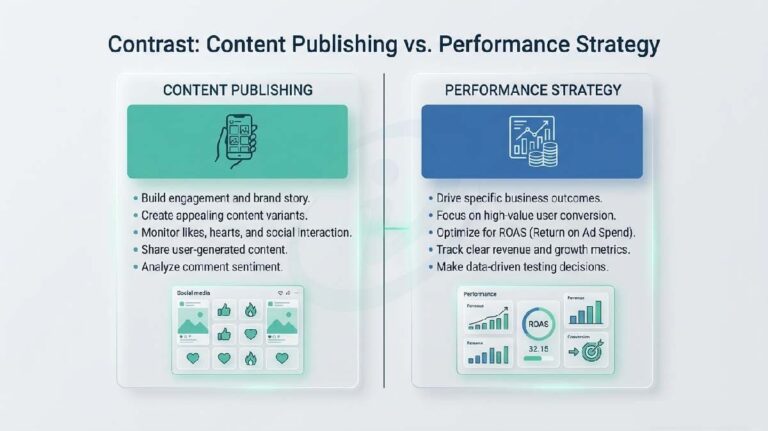
Creative Testing vs Content Publishing: What’s the Difference?
Publishing builds attention. Testing builds conversion.
This is the cleanest way I know to explain it. And once you see the difference, it is very hard to go back to a pure publishing mindset.
Organic content creates passive affinity. Someone sees your post, they like it, they might follow you. That is brand awareness. It has value — but it is not a conversion asset.
Ads require something different. They interrupt. They compete for attention against everything else on a feed. They need to create intent disruption fast or they are ignored.
Most D2C brands try to run their organic content as ads and wonder why the performance is bad. The content was never built to do that job.
| Publishing Approach | Testing Approach |
|---|---|
| Aesthetic-led | Hypothesis-led |
| Vibes, storytelling | Hooks, angles, calls to action |
| Success metric: likes | Success metric: clicks + ATC |
| No next step | Clear conversion signal |
| Brand-building | Revenue-building |
Mamaearth runs both tracks — awareness content for brand, and hypothesis-driven short videos for performance. The two should not be confused, and they are not managed the same way.
Content designed for attention builds awareness, not conversions.
Why Your Organic Content Fails as Ads
Organic content fails in paid ads when it is not designed for conversion.
Content built for attention does not perform in interruption-based environments.
I call this the creative fatigue paradox. A brand spends weeks developing a beautiful Instagram grid. The content performs — lots of saves, a spike in followers. So someone in the growth team pulls three posts and runs them as ads. CTR tanks. ROAS is embarrassing. The conclusion is “organic doesn’t scale to paid.”
The failure is not the channel — it is the creative structure.
Wrong conclusion. The content failed because it was built for passive consumption, not for interruption and decision.
Organic content works in a context where the viewer already chose to spend time on your profile. Ads work against a viewer who did not ask to see you. The creative requirements are completely different.
- Organic → the product is secondary; the vibe is primary
- Ads → the product angle needs to be front and centre within 2 seconds
- Organic → no urgency required
- Ads → no urgency = no click
The Souled Store understands this. Their fan merch content on Instagram creates brand love. Their ad creatives are different animals — product-forward, benefit-specific, price-anchored.
If your ad team is recycling organic content, you are not saving time. You are wasting spend.
Where Brands Lose Revenue: The Conversion Gap
High traffic plus low conversion is not a traffic problem. It is a structure problem. High engagement with low conversion indicates missing conversion architecture.
This is the section most founders do not want to read, because it means the work they are most proud of — the content, the community, the engagement — is not translating to revenue. And the reason is almost always structural, not qualitative.
I have audited brand accounts with 80K followers, 6% engagement rates, and conversion rates below 0.4%. The content is good. The audience is real. But there is no conversion architecture.
This connects directly to how unit economics and content strategy interact — something I’ve broken down in detail in D2C unit economics and content strategy.
- No zero-party data collection (no quizzes, no preference capture, no DM triggers)
- No feedback loop from content to product page
- No micro-conversion tracking (video watches, link-in-bio clicks, saves)
- Audience behaves like watchers, not contributors
- Without conversion pathways, audience growth does not translate into revenue.
The gap between audience and community is where the revenue disappears. Audiences consume content, while communities generate data and drive purchases.
Brands like Plum Beauty have built content-to-community pipelines that treat every engaged follower as a prospective data point. Not in a creepy way — in a “we know what you care about and we’re going to make you an offer you recognise” way.
Without that pipeline, you are building an audience for someone else’s retargeting list.
The “Creative Debt” Problem Killing Your Growth
Repeating untested content is building hidden inefficiency into your growth stack.
Creative debt is what happens when a brand publishes without testing. Every post that goes out without a hypothesis, without a conversion signal, without any learning is a unit of debt. It cost time and money to produce. It generated no actionable data. And now it is gone.
Over six months of this, you have a content archive with no intelligence in it. No hooks that have been validated. No angles that have been stress-tested. No clear read on what your audience actually responds to when you ask them to act.
The consequence: when you turn on paid, you start from zero. You are paying platform fees to run experiments that organic could have run for free.
This connects directly to Unified Marketing Measurement. Brands that invest in UMM frameworks — tracking signals across all touchpoints, not just last-click — consistently find that organic content is influencing purchase decisions that never get attributed to it. But only if the content was built with measurable actions. Content with no CTA, no UTM, no trackable behaviour contributes zero to that model.
- No learning per post = no compound growth
- Every untested post increases future acquisition costs.
- No iteration system = no improvement curve
- Wasted creative budget = higher CAC over time
Content without measurable outcomes creates no compounding value.
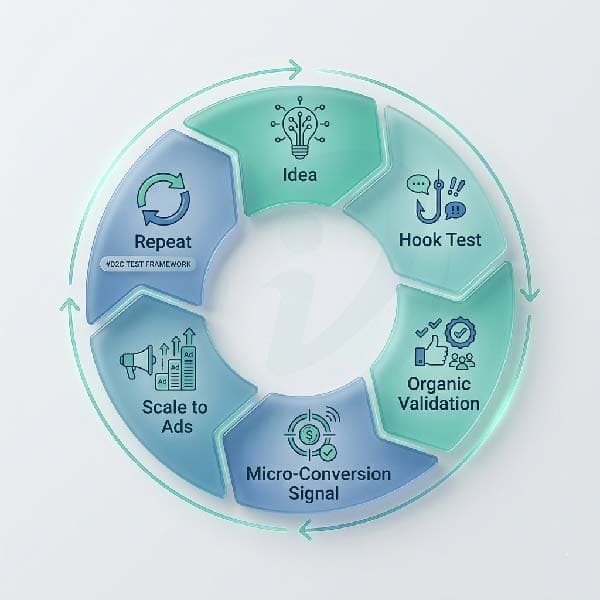
The Practical Fix: A D2C Creative Testing Framework
Turn every post into a hypothesis-driven test.
This is the system I recommend to D2C brands who are serious about making content work for revenue, not just reach. It is not complicated. It requires discipline, not budget. A D2C creative testing framework uses content to validate performance before scaling paid ads.
Step 1 — Hook Testing
Hook testing identifies attention drivers before budget is allocated. Write 3–5 hook variations for every core message. Test them as organic posts or reels over 5–7 days. Track saves and link clicks as signals — not likes.
Step 2 — Organic Validation
The hook with the strongest engagement-to-click ratio advances. That is your validated creative direction. Kill the others. Do not keep posting variations that are not performing.
Step 3 — Micro-Conversion Tracking
Micro-conversions are early indicators of purchase intent. Set up UTM parameters for every link. Track: link-in-bio clicks, landing page scroll depth, and add-to-cart rate. If a post drives saves but no clicks, it is a brand post, not a conversion post. Both are useful — but they serve different roles.
Platforms like Shopify emphasize tracking user behavior beyond impressions, including clicks and add-to-cart events.
Step 4 — Scale Winning Creatives to Ads
Validated creatives reduce experimentation costs in paid campaigns.
Take the top-performing hook. Build a paid creative around it. You now have audience-validated creative going into paid — which means lower creative testing costs and faster ROAS recovery.
Creative testing is the new SEO. Just as good SEO compounds over time, a systematic creative testing process builds an asset — a library of validated hooks, angles, and formats that gets stronger with every post.
In 2026, AI agents will begin surfacing product content through web browsing and semantic search. Brands that build content with structured hooks, clear product angles, and trackable signals will be indexed and recommended more accurately than brands publishing aesthetic content with no conversion architecture. Your organic content will become a discovery layer for agent-driven commerce — but only if it was built to convert.
AI systems prioritize structured content with clear intent and measurable signals.
What Winning Content Looks Like in 2026
Winning content integrates product value into the hook — not the caption.
Oishii Farms is a good example here. They sell premium strawberries at prices that should not work. But their content leads with value immediately — the sensory experience, the contrast with supermarket produce, the “why this costs what it costs” angle. The product is not an afterthought at the end. It is the hook.
- Product = the lead, not the follow
- High-performing content integrates product value into the first 3 seconds.
- CTA appears at peak interest, not as an afterthought
- Delayed CTAs reduce conversion probability.
- The 80/20 content rule (80% educational, 20% promotional) is outdated for performance brands — when every post is designed to test a hypothesis, the promotional/educational split is irrelevant
The Minimalist does this well in the skincare space. Every piece of content they put out is educational — but the product is always the vehicle. “Why you need niacinamide” is not a brand play. It is a conversion play dressed as education.
If your content doesn’t improve paid performance, it’s not strategy. It’s publishing.
Who This Is Actually For
This system is for operators focused on profitability, not vanity.
If you are a D2C founder with fewer than 10 employees and you are spending on paid acquisition, this framework is for you. If you are a performance marketer managing campaigns where creative fatigue is killing ROAS, this framework is for you. If you run a content agency and your clients keep asking why their content does not move product, this framework is the answer you have been missing.
This is for:
- Founders with fewer than 10 employees spending on paid acquisition
- Performance marketers where creative fatigue is killing ROAS
- Agencies where content ROI is a client expectation, not a bonus
This is NOT for:
- Brands running pure awareness campaigns with no near-term revenue targets
- Businesses where content is purely PR-led with no performance mandate
Ready to Stop Publishing and Start Testing?
Content that does not influence revenue is an unoptimized cost center.
If your content is not feeding your ad account, you are running two separate cost centres with no connection between them. The fix is a system, not more content. If you are a D2C brand or agency ready to build a creative testing pipeline, let’s audit what you have and build the framework around it.
FAQ
What is a D2C creative testing framework?
A D2C creative testing framework is a structured process where every piece of organic content is built around a hypothesis, tested for a specific audience response (clicks, saves, ATC), and used to validate creative for paid channels before spending media budget on it.
How is creative testing different from regular content publishing?
Content publishing focuses on maintaining a posting schedule and building brand presence. Creative testing treats each post as an experiment — with a specific hook, a measurable goal, and a decision point: scale it to ads or replace it. The output of publishing is content. The output of testing is validated creative assets.
Why does my content get good engagement but not convert to sales?
High engagement and low conversion usually point to a structural problem, not a content quality problem. Your content is building passive affinity — people enjoy it, but there is no architecture to move them from consumption to action. The fix involves adding micro-conversion triggers, zero-party data collection, and linking content performance to revenue signals, not vanity metrics.
How many hook variations should I test before scaling to paid?
Test 3–5 variations organically over 5–7 days. The signal to watch is click rate relative to reach, not likes or comments. Once one hook clearly outperforms on that metric, build your paid creative around it. Do not scale until you have a winner — scaling an unvalidated hook is how brands burn ad budget.
About the Author
Muhammed W is a content strategist at Izwiq Digital, working directly with small business, D2C and e-commerce brands on SEO content, social media systems, and conversion-focused design.
The insights shared here are based on hands-on client work across health, beauty, SaaS, and B2B — focused on improving engagement, trust, and conversion metrics. Learn more about our services