
Generative Engine Optimization (GEO) for D2C: Why Blocking AI Is Killing Your Visibility
TL;DR — For Busy Founders
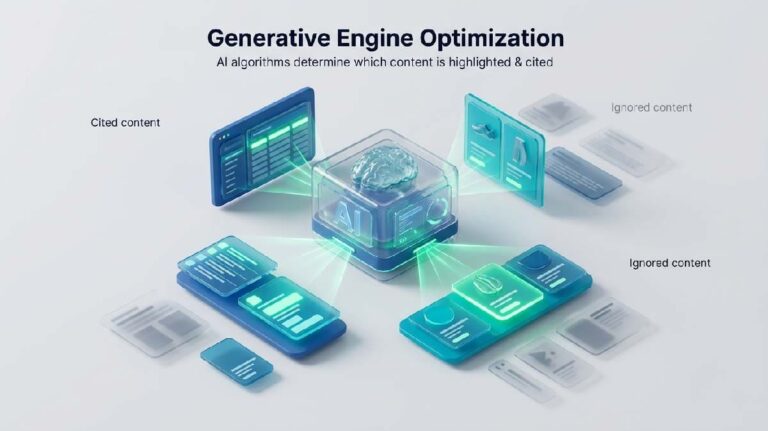
AI search is no longer just summarizing the web — it’s deciding who gets seen and who doesn’t. AI Overviews have dropped organic CTR from 1.76% to 0.61% on affected queries. Traffic is falling for brands that haven’t changed anything about their SEO. The reason isn’t algorithm updates — it’s a structural shift in how search works. The brands winning right now aren’t publishing more content. They’re building citation ecosystems: structured data, off-site mentions, and AI-readable page architecture. This is what Generative Engine Optimization (GEO) looks like in practice — and this post breaks down exactly what needs to change.
Table of Contents
1. What Changed in How Google AI Visits Websites
Google’s AI doesn’t crawl pages the way Googlebot does. It extracts, infers, and cites — selectively. That distinction changes everything about how your content needs to be built.
The old model: crawl → index → rank → user clicks.
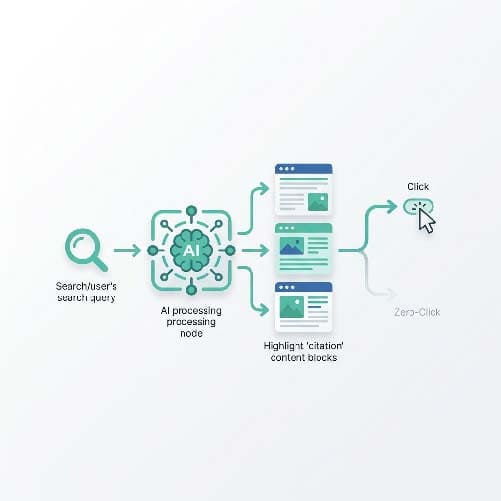
The new model: AI reads the web at scale → builds a summarized answer → cites 2–3 sources → user may or may not click through.
Your robots.txt can block certain AI crawlers. It cannot block the inference layer that already knows about your brand from Reddit threads, product review sites, third-party blogs, and cached training data.
What this means for your brand:
- Your page structure now determines whether AI can extract a clear, citable answer
- Your off-site presence determines whether AI trusts that answer enough to use it
- Your robots.txt settings determine whether you have any control at all over what gets cited
Robots.txt blocks the crawler. It doesn’t block the citation. Brands confuse the two and lose both.
Key Takeaway: AI doesn’t index your content — it audits it for extractability. If your pages aren’t structured for extraction, you simply don’t exist in AI-generated answers.
2. Why Traffic Is Collapsing (And It’s Not Your SEO)
AI Overviews are absorbing clicks before users ever reach your site. This isn’t an SEO failure — it’s a structural change in how queries resolve.
Organic CTR dropped by 61% with AI Overviews—on the same queries, with the same rankings, and no change to your content.
What’s driving this:
- Zero-click behavior: Users get the answer in the Overview and leave. No click happens.
- Long-tail query absorption: The exact queries that used to deliver high-intent traffic — “best moisturizer for oily skin under ₹500,” “Shopify vs WooCommerce for small D2C” — are now answered entirely in the AI card.
- Position irrelevance: Being ranked #1 means less when the AI card sits above it and already answers the question.
If your brand is in the skincare, supplements, apparel, or home goods space — categories where Mamaearth, a D2C skincare company, or The Minimalist, a science-backed skincare brand, compete — you’ve almost certainly felt this already without knowing why.
Traffic drops with no ranking drops means AI is intercepting the query, not a competitor.
This is where most brands panic and start publishing more content. That’s the wrong move. Volume doesn’t fix a structural visibility problem.
Key Takeaway: Your SEO ranking didn’t fall. Your click opportunity did. Those are different problems with different fixes.
3. The New Metric: Citation Over Traffic
If AI is deciding who gets seen, the new goal isn’t traffic — it’s being the brand AI cites. Brands that get cited see 91% higher paid CTR and a 35% lift in organic traffic from non-cited queries.
That gap exists because of trust transfer. When AI cites your brand, it signals authority to the user before they’ve even visited your site. You’re no longer a link they found — you’re the answer they were given.
What citation visibility actually does for your business:
- Reduces top-of-funnel CAC because users arrive pre-convinced
- Increases conversion rate because AI-sourced traffic carries stronger intent
- Builds brand recall in zero-click sessions where no click happens but your name still surfaces
Think of AI search as a personal shopper layer sitting between your brand and your customer. That shopper either recommends you or doesn’t. Getting on that recommendation list is the new SEO.
A brand cited by AI gets credibility before the first click. That’s free conversion infrastructure.
This is exactly where I help D2C brands — not just building content, but building the kind of structured, citable content architecture that gets picked up by AI systems.
Key Takeaway: Traffic is a lagging indicator. AI citations are a leading indicator of where your next revenue comes from.
4. The Hidden Risk: The Reddit-to-AI Pipeline
Blocking Google-Extended from crawling your site does not make you invisible to AI. It makes you undefended.
Google has a direct data pipeline with Reddit. AI models train on Reddit, Quora, product review sites, and third-party blog content. If your brand exists in the world — and any scaling D2C brand does — it exists in that training data, whether you opted in or not.
The risk isn’t absence. It’s unmoderated presence.
Here’s what that looks like in practice:
- A Reddit thread from 2023 criticizes your packaging quality
- AI trains on that thread as part of brand sentiment data
- A user asks “is [Brand] worth buying?” — AI summarizes that Reddit thread as part of the answer
- You blocked AI crawlers from your site, so there’s no counter-narrative from your own pages
Mokobara, a premium luggage brand, has handled this well by actively seeding Reddit and structured communities with genuine product experiences alongside clean structured data on their site. The result: AI-generated answers about their brand skew positive because the signal ecosystem is managed.
Blocking AI doesn’t erase your brand from AI — it just removes your ability to shape what AI says about you.
Most brands don’t realize they have a perception problem until a competitor’s name starts showing up in AI answers where theirs should be.
Key Takeaway: Your robots.txt strategy needs a PR strategy beside it. They’re the same problem now.
5. Where Brands Lose Revenue (The Conversion Gap)
Even when AI does cite your brand and the user clicks through, the conversion often falls apart on the landing page. This is a specific, fixable problem — and it costs real revenue.
AI-generated summaries pull structured, scannable information: key specs, ingredient lists, price anchors, comparison points. Your landing page was built to persuade. The user arrives expecting a clear answer and gets a sales pitch instead.
The specific mismatches that kill conversions:
- Missing specs: AI cited your product for “SPF 50 tinted moisturizer” — but your PDP doesn’t list SPF clearly above the fold
- No structured answers: AI summarized “best collagen supplement under ₹1500” — your page has a 400-word brand story but no scannable benefit list
- Weak content hierarchy: The user scanned the AI card in 8 seconds and expects the same from your page — your page takes 30 seconds to find the core claim
If your store is getting AI-sourced traffic but converting at under 1.5%, this mismatch is almost certainly the reason.
AI sets the expectation. Your landing page either confirms it or loses the sale in the first 5 seconds.
This is where I come in for D2C brands — auditing the gap between what AI tells users about your product and what your PDP actually delivers.
Key Takeaway: Getting cited by AI is step one. Converting AI-sourced traffic requires a page built to match the expectation AI already set.
6. What Winning Brands Are Doing Differently
The brands maintaining and growing visibility aren’t doing traditional SEO better. They’re building what I call AI mention ecosystems — a combination of on-site structure, off-site presence, and entity clarity that makes them the obvious citation choice.
Before vs After the shift:
| Approach | Before GEO | After GEO |
|---|---|---|
| Content focus | Traffic volume | Citation potential |
| Success metric | Rankings + sessions | Brand mentions in AI answers |
| Off-site strategy | Backlinks | Structured community seeding |
| On-site structure | Blog + PDP copy | Extractable answers + schema |
What the winning brands have in common:
- Their product specs are scannable and structured — not buried in paragraph copy
- They have a presence across third-party surfaces that AI actually trains on
- Their brand name appears consistently across Reddit, review platforms, and industry content with a clear descriptor (“Mokobara, a premium cabin luggage brand”)
- They’ve not blocked AI crawlers wholesale — they’ve been selective about what gets crawled and what gets prioritized
“Ghost brands” — brands with 40,000 monthly visitors but zero AI mentions — exist across every D2C category. They’re spending on content and still disappearing from AI-generated answers because their content isn’t structured for extraction.
40,000 monthly visitors and zero AI citations means your content exists for search engines, not for AI systems. That gap is widening every month.
Key Takeaway: AI visibility isn’t an SEO task. It’s a brand architecture task.
7. The GEO System for D2C Brands
You don’t need more content. You need a system that makes your existing content extractable, citable, and defensible across AI surfaces.
Here’s the four-layer GEO system I use:
Layer 1: Structured Product Data Every PDP needs machine-readable specs — material, ingredients, dimensions, certifications. Not in paragraph form. In structured, scannable format. Add FAQ schema to answer questions AI is likely to surface.
Layer 2: AI-Readable Summaries Add a 2–3 sentence “Key Facts” or “At a Glance” block to every major content page and product page. This is the section AI pulls from. It doesn’t replace your copy — it sits at the top of it.
Layer 3: External Mention Seeding Your brand needs to exist on surfaces AI trains on. This means genuine, value-first presence on Reddit, Quora, YouTube descriptions, and third-party review platforms. The goal isn’t backlinks — it’s sentiment data that trains the model.
Layer 4: Selective Robots.txt Strategy Don’t block everything or allow everything. Audit which AI crawlers are relevant to your citation goals, allow the ones tied to platforms where your customers search, and use your robots.txt to prioritize high-value pages.
Quick audit — answer these before anything else:
- [ ] Can AI extract your top 3 product benefits in under 5 seconds from your PDP?
- [ ] Is your brand mentioned on at least 2 platforms AI trains on (Reddit, Quora, review sites)?
- [ ] Does your category page answer the most common comparison question in your niche?
- [ ] Do your pages load and render cleanly for non-browser crawlers?
If you answered “no” to two or more, you have a GEO gap.
GEO is not content writing. It’s content architecture — building pages that AI can trust, extract, and recommend.
Key Takeaway: The GEO system isn’t a one-time fix. It’s a parallel content infrastructure that runs alongside your existing SEO — and it compounds over time.
8. How I Approach This for D2C Brands
This is a systems-level optimization, not a content refresh. When I work with D2C brands on GEO, the engagement runs in four stages:
Stage 1 — AI Visibility Audit I map where your brand currently appears in AI-generated answers, what it’s cited for (or not cited for), and which queries your competitors are winning that you’re losing.
Stage 2 — Citation Gap Analysis I identify the specific content and structural gaps preventing citation — missing schema, unstructured PDPs, absent off-site signals, or robots.txt configurations that are blocking the wrong crawlers.
Stage 3 — Content Architecture Rebuild I rebuild the pages and content assets that need to change — adding extractable summaries, restructuring PDPs for AI scannability, and creating the FAQ and schema layers that get picked up by generative search.
Stage 4 — External Signal Alignment I build or oversee a community seeding strategy that places your brand on the surfaces AI actually trains on — not spam, not manufactured reviews, but structured answers and genuine product context.
Who this delivers results for:
- Shopify stores doing ₹10L–₹1Cr/month with traffic but stagnant or declining conversions
- D2C brands in beauty, supplements, apparel, or home goods that are SEO-optimised but AI-invisible
- Scaling brands that have invested in content but haven’t structured it for the AI layer
Outcome: Higher AI citation frequency, better-qualified inbound traffic, and landing pages that convert AI-sourced users at a higher rate.
If you want to know where AI currently mentions — or misrepresents — your brand, get an AI visibility audit.
9. Who This Is NOT For
Not every brand needs GEO work right now. Here’s how to know if this isn’t your priority.
Skip this if:
- You’re pre-revenue or still validating product-market fit. Fix the product and the offer first — AI can’t cite a brand that nobody’s talking about yet.
- You’re a pure content blog or affiliate site. The GEO rules are different for editorial content vs product commerce.
- You’re getting under 5,000 organic sessions per month. You have a traffic acquisition problem, not a citation problem.
The DIY vs Hire line is specific:
- DIY: You can adjust robots.txt settings, add basic FAQ schema to product pages, and seed a few Quora answers.
- Hire: You need someone else when the problem is citation architecture — rebuilding how your content is structured, how your brand signal ecosystem works, and how your landing pages align with AI-generated expectations.
The transition moment is when you realize your traffic is flat or falling and nothing in your SEO dashboard explains why. That’s not an analytics problem. That’s a GEO problem.
If your store is past ₹15L/month in revenue and your organic traffic has been flat for 6+ months, DIY is costing you more than hiring would. Let’s talk.
Key Takeaway: GEO is a scaling problem, not a startup problem. If you don’t have traffic yet, earn it first. If you have traffic and it’s not converting — or it’s declining — that’s when GEO pays.
Comparison Table: SEO vs GEO
| Factor | Traditional SEO | Generative Engine Optimization (GEO) |
|---|---|---|
| Primary goal | Rank in SERPs | Get cited in AI Overviews |
| Success metric | Sessions, rankings | AI mention frequency, citation rate |
| Content format | Long-form, keyword-rich | Structured, extractable, schema-backed |
| Off-site strategy | Backlinks | Brand mentions, community seeding |
| Traffic type | Click-based | Citation-based (sometimes zero-click) |
| Core risk if ignored | Ranking drops | Brand invisibility in AI answers |
| Conversion impact | Depends on page | Depends on citation-to-page alignment |
If your social content is getting likes but not conversions, the design layer is usually where the breakdown happens. At Izwiq Digital, we help e-commerce and D2C brands build content systems that pass the trust test — without expensive production.
FAQ
Does blocking Google-Extended stop AI from seeing my brand?
No. Blocking Google-Extended prevents one specific crawler from accessing your pages. It does nothing to stop AI systems from learning about your brand through Reddit, Quora, third-party review platforms, product comparison sites, or existing cached training data. If your brand is live and has any kind of online presence, it exists in AI training pipelines already. Blocking the crawler just removes your ability to contribute the version of your brand story you actually want AI to cite.
Is SEO dead in 2026?
No — but it’s evolving into something with a different success metric. Traditional SEO optimizes for rankings and clicks. GEO optimizes for citations and trust signals within AI systems. You need both. The brands that will lose are the ones treating SEO and GEO as the same thing, or ignoring GEO entirely because their rankings still look fine. Rankings and citations are now separate performance layers.
What matters more — traffic or AI mentions?
At the current trajectory, AI mentions matter more — because traffic increasingly follows citations, not the other way around. Brands that get cited in AI Overviews see 35% organic lift on connected queries. The citation comes first. The click comes second. If you’re only tracking sessions and not tracking where your brand appears in AI-generated answers, you’re measuring the wrong thing.
How do I know if AI is already misrepresenting my brand?
Search your brand name, your core product category, and your top 3 competitor comparison queries in Google with AI Overviews enabled. Note whether your brand appears, what it’s cited for, and what language is used. Then cross-reference that with Reddit — search your brand on Reddit and read what the last 20 threads say. That combination gives you a rough signal of what AI is likely summarizing about you. A proper audit goes deeper, but that’s the manual starting point.
About the Author
Muhammed W is a content strategist at Izwiq Digital, working directly with small business, D2C and e-commerce brands on SEO content, social media systems, and conversion-focused design.
The insights shared here are based on hands-on client work across health, beauty, SaaS, and B2B — focused on improving engagement, trust, and conversion metrics. Learn more about our services