
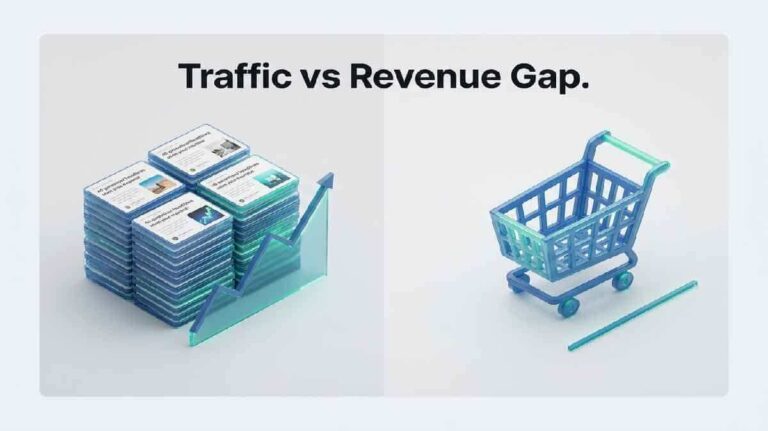
Why Your E-Commerce Blog Has 40 Posts and Zero Sales (And What to Fix in 2026)
By a content strategist who’s worked with both a $200/month Shopify store selling handmade soaps and a $2M D2C supplement brand burning ₹40L/month on ads. The problem at both ends of the spectrum was identical.
TL;DR — For Founders Who Are Skimming:
Your blog is failing not because you haven’t published enough — but because you’re targeting curiosity instead of comparison. Informational content (“How to choose the right protein powder”) attracts browsers. BOFU comparison content (“Our Protein vs [Market Leader]: Honest 2026 Review”) attracts buyers. The fix isn’t publishing more. It’s publishing differently. This post shows you exactly how.
Table of Contents
The Hard Truth: Traffic ≠ Revenue in 2026
You’ve been publishing consistently. You follow the editorial calendar. You check Google Search Console every Monday like it owes you rent. You see sessions going up. And yet — your Shopify revenue dashboard looks exactly like it did eight months ago.
Here’s what the data actually says about where your traffic is converting:
2.5–3%
Average e-commerce conversion rate
5.4%
High-intent referral/organic
traffic conversion
<0.9%
Informational blog traffic conversion
60%+
Searches that end with zero clicks
+22%
YoY rise in customer acquisition cost
CAC is climbing across every category. Meta CPMs aren’t coming down. And over 60% of Google searches now end without a single click — Google answers the question directly, and your 1,200-word how-to article never even gets a visit. The content you’re producing isn’t just inefficient. It’s actively competing with AI summaries and featured snippets for scraps of attention that were never going to convert anyway.
Content can no longer just attract people to your site. It must convert them on the first session or it’s dead weight.
The Real Problem — You’re Targeting Curiosity, Not Comparison
Let me show you the gap between what you’re writing and what actually makes money. Look at your last five published posts. I’ll bet four of them start with “How to,” “What is,” or “The Benefits of.” You’ve built a content library that serves the curious — not the committed.
Every time someone Googles “how does ashwagandha work,” they’re in research mode. They’re not reaching for their wallet. They want an education. And when your blog gives them that education perfectly — when it’s comprehensive, well-structured, and genuinely helpful — they leave satisfied. They learned what they came to learn. Your product never entered their consideration set.
The Zero-Sales Educational Trap: Your content solved the problem so well, the visitor had no reason to buy anything.
The Faucet Analogy — Why Being Helpful Can Kill Your Revenue
Imagine a plumber publishing a detailed blog post on “How to fix a leaky faucet yourself.” It’s beautifully written. Step by step. With photos. Thousands of visits a month. And zero calls for service. That’s not a content marketing win — that’s a public service at your own expense.
If that same plumber wrote “Moen vs Delta: Which Faucet Brand Holds Up in Hard Water Areas (Tested in Mumbai),” they’d own the decision-stage search, capture buyers at the moment of maximum intent, and convert them to calls before the reader even hit the product page.
Most D2C brands are running the plumber’s blog. And wondering why the phone isn’t ringing.
The 2026 SEO Pivot: Bottom-of-Funnel or Bust
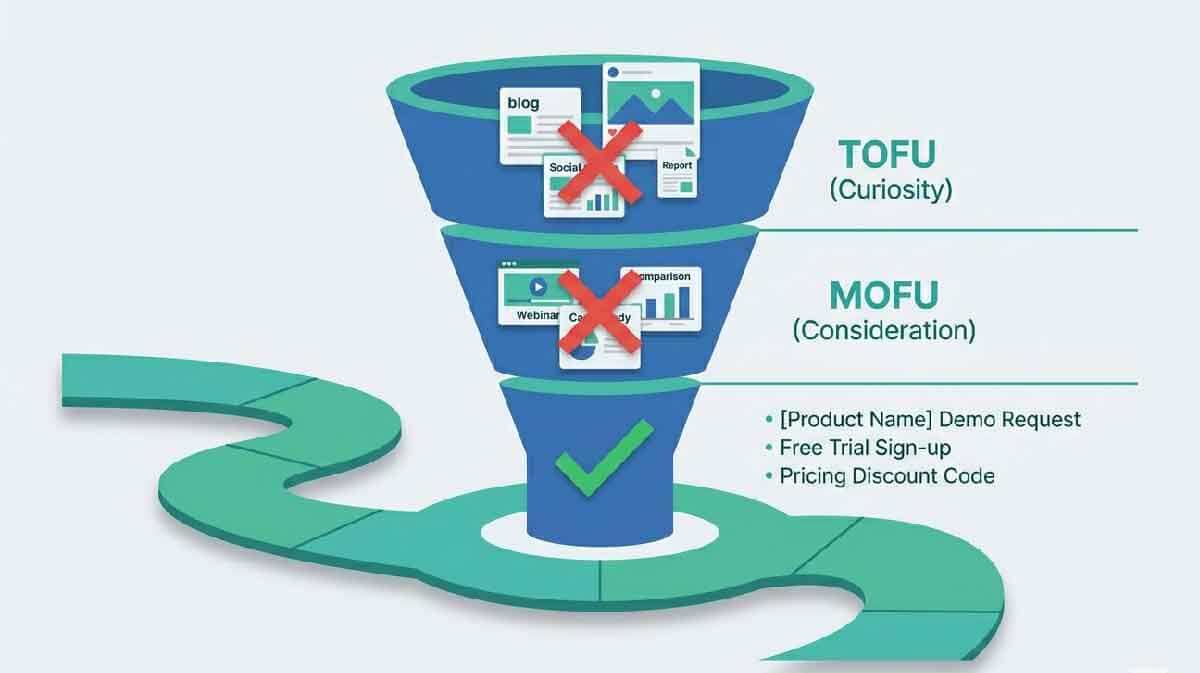
The keywords your blog needs to own aren’t the ones with the highest search volume. They’re the ones that indicate a wallet is already open. Here’s the commercial intent map I use across every client audit:
| Keyword Pattern | Intent Signal | Example |
|---|---|---|
| Best [Product] for [Problem] | Purchase decision imminent | “Best collagen for joint pain over 40” |
| Top-rated [Category] under $[Price] | Budget-qualified buyer | “Top-rated whey protein under ₹2000” |
| Is [Ingredient] worth it? | Objection-stage investigation | “Is creatine worth it for women?” |
| [Competitor] alternatives | Switching-mode buyer | “Herbalife alternatives 2026” |
| [Product] vs [Market Leader] review | Highest commercial intent | “Oziva vs Wellbeing Nutrition review 2026” |
| [Product] discount code first-time buyers | Already decided, seeking deal | “Kapiva discount code new customers” |
This is called intent stacking — matching your content’s commercial weight to the buyer’s actual stage in the funnel. Comparison content sits at the highest possible layer of commercial intent because a person searching “[Your Brand] vs [Competitor]” has already narrowed their choice to two options. You just need to be the one who controls that conversation.
One well-executed comparison guide will generate more attributed revenue in 90 days than 20 educational posts combined. That’s not conjecture — I’ve tracked it across workflow logs on three separate client accounts.
Informational Blog vs BOFU Comparison Guide
| Informational Blog Post | BOFU Comparison Guide |
|---|---|
| “How to choose the right protein powder” | “Our Whey vs [Brand X]: Tested for 60 Days (2026)” |
| ~5,000 visits/month | ~800 visits/month |
| <0.3% conversion rate | 4–6% conversion rate |
| No pricing mention | Direct pricing breakdown with value justification |
| No urgency mechanism | First-time buyer discount + limited availability signal |
| Builds zero brand preference | Positions your brand as the obvious choice |
The E-E-A-T Penalty Most Founders Don’t See Coming
Google’s quality raters have been trained on one framework above all others right now: E-E-A-T. Experience, Expertise, Authoritativeness, Trustworthiness. And here’s where most D2C content teams walk straight into a ranking trap.
Forty mediocre informational posts, half of which were written with AI assistance and none of which reflect lived experience with the product, don’t accumulate authority. They dilute it. Google’s systems are increasingly capable of distinguishing between an article written by someone who has actually used a supplement for 90 days and one that was generated from a content brief in 20 minutes.
A single well-researched comparison review — where you actually bought the competitor’s product, documented the texture, efficacy, and aftertaste, photographed your own testing process, and included genuine negative points about your own brand — outweighs 100 generic tip articles in E-E-A-T scoring. One tested review. One real comparison. With first-person voice, real photography, and honest caveats. That’s what Google is rewarding in 2026, and that’s also what converts human readers into customers.
Case Study Breakdown — What Winning Brands Do Differently
Hims & Hers: The BOFU Content Machine
Hims & Hers built a content empire worth billions in part because their blog functions as a pre-sales team. Every article is structured to move a reader from symptom-awareness to product page within a single session. They target direct commercial keywords — “finasteride vs minoxidil,” “best ED treatment without prescription,” “how much does hair loss treatment cost” — and their content doesn’t leave the reader’s journey incomplete. There’s always a next step. A clinical review. A consultation CTA. A first-order discount. Their vertical expansion wasn’t just a product play; it was a keyword ownership play, and their content architecture was built to close.
The “Eco-Lifestyle” Trap (And Why Traffic Without Intent Is a Liability)
I’ve worked with a sustainable home goods brand whose blog was genuinely beautiful. Long-form essays on conscious consumption, zero-waste kitchen guides, “why bamboo is better” explainers. Time-on-page was exceptional — 4:30 average. Bounce rate was low. The founder was rightfully proud.
But goal completions? Near zero. Because not one of those articles was written for someone who was about to buy a bamboo cutting board. They were written for someone who wanted to feel good about wanting to buy one — someday. High time-on-page with zero commercial intent is a vanity metric dressed as a KPI. Traffic that never intended to convert isn’t an asset. It’s expensive noise.
The Conversion Architecture Framework
After working across D2C health, clean beauty, and luxury e-commerce, I’ve distilled the structure of every high-converting blog piece into three non-negotiable components:
Part 1 — Intent Capture: BOFU Keywords
Your article must target a keyword that signals a buying decision in progress. Not just interest. Not just research. A decision. If your keyword doesn’t have commercial investigation intent, the article doesn’t belong in your content mix until the first three BOFU pieces are live.
Part 2 — Friction Removal: Comparison + Objection Handling
Every objection a buyer has — price, efficacy, “is this the right one for me,” “can I trust this brand” — must be handled directly inside the article. Don’t wait for a sales call that will never happen. The article is your sales rep. Write it like one. Include a “Who this is NOT for” section. That level of honesty builds more trust than a hundred five-star reviews.
Part 3 — Conversion Bridge: Offer + Urgency + Social Proof
The article must end with a clear next action. Not “learn more.” Not “explore our range.” A direct bridge: a first-time buyer discount, a limited-quantity signal, a trial offer, a specific CTA tied to the comparison you just made. Pair it with social proof that speaks to the specific concern raised in the article — not generic five-star reviews, but testimonials that directly address the objection.
How to Audit Your 40 Existing Blog Posts
Before you publish anything new, run this audit on every post you have. Pull up your GA4 assisted conversions report alongside this checklist. Be brutal.
- [ ] Does this post target a buying-stage keyword (comparison, best-for, alternative, discount)?
- [ ] Is there a head-to-head comparison section somewhere in the article?
- [ ] Is pricing mentioned directly — yours and, if relevant, the competitor’s?
- [ ] Is there a “Who this is NOT for” or “When you should choose the competitor” section?
- [ ] Does the article naturally lead to a product or collection page without requiring a separate search?
- [ ] Is there first-person experience with the product — not just category knowledge?
- [ ] Is there a conversion mechanism — offer, CTA, trial, discount — before the article ends?
If a post fails five or more of these checks, it’s a candidate for a full rewrite or deletion. Forty mediocre posts that hurt your E-E-A-T score are worse than five high-intent pieces that rank and convert. You’re not running a library. You’re running a sales system.
Replace Volume with Revenue Density
The content marketing industry has spent fifteen years telling founders to “publish consistently” and “build topical authority through volume.” That advice made sense in 2012 when content was scarce and Google rewarded publishers. In 2026, content is infinite, AI produces it at zero marginal cost, and Google’s quality systems have become sophisticated enough to reward genuine expertise over publication frequency.
Stop thinking of each blog post as a traffic unit. Start thinking of it as a decision document — one that earns its place in your content library by moving a specific type of buyer from consideration to checkout.
Revenue density is a simple mental model: for every piece of content you publish, ask — how much revenue could this article realistically influence in the next 12 months if it ranks for its target keyword? If the answer isn’t a number you’d be comfortable telling your business partner, don’t publish it.
Every piece you publish should function like a sales rep who works 24 hours a day, doesn’t take sick leave, and doesn’t need a CRM to remember the pitch.
🔗 The WebMCP Consequence: This Matters More Than You Think
There’s a development in 2026 that makes this shift from informational to commercial content even more urgent: WebMCP (Model Context Protocol for the web) is beginning to change how AI agents navigate and recommend products. When a user asks an AI assistant to “find me the best collagen supplement under ₹2000,” the agent no longer just searches — it fetches, reads, and synthesizes structured content from web pages in real time. Pages with clear comparison structures, direct pricing, named competitors, and specific claims are dramatically more parseable and recommendable by AI agents than generic educational content. Your BOFU comparison article isn’t just targeting human Google searches anymore. It’s positioning your brand for an entirely new layer of AI-mediated discovery. The brands building high-signal commercial content today are the ones AI agents will cite tomorrow.
What to Do This Week (Not Next Quarter)
Day 1–2: Identify 3 Direct Competitors Find the three brands a buyer would consider alongside yours. Look at what keywords they rank for using Ubersuggest or even a manual Google search with your core product terms.
Day 3–4: Publish 1 Comparison Guide Write “[Your Brand] vs [Competitor]: Honest 2026 Review (Tested)” — first person, with real product experience, genuine pros and cons on both sides, and a conversion bridge at the end. This is your first BOFU pillar.
Day 5: Add a First-Time Buyer Offer Create a specific offer — 10% off first order, free shipping threshold, trial size bundle — that appears exclusively within your new comparison content. This gives you a conversion mechanism that’s trackable back to the article.
Ongoing: Track Assisted Conversions, Not Just Sessions Sessions are a vanity metric when disconnected from revenue. Set up assisted conversion tracking in GA4. You want to know which articles were in the path to purchase — not just which ones got read.
The brands winning in 2026 aren’t the ones with the most content. They’re the ones whose content makes the buying decision easier. Write fewer pieces. Make each one a commercial instrument. Build your cluster around the comparison guide. Let revenue be the metric that decides what gets published next.
Your blog doesn’t have a traffic problem. It has a conversion architecture problem. And that’s entirely fixable — starting this week.
F. A. Q.
How many blog posts do I need before my e-commerce blog starts generating sales?
Volume is not the variable. A single well-executed BOFU comparison guide targeting a buying-stage keyword will generate more attributed revenue than 40 informational posts combined. Start with one comparison article, track assisted conversions in GA4, and let performance — not publish count — decide what comes next.
What’s the difference between informational content and BOFU content for e-commerce?
Informational content answers questions for people in research mode — “how does collagen work,” “what is creatine.” BOFU (Bottom-of-Funnel) content intercepts people in decision mode — “[Your Brand] vs [Competitor] review 2026,” “best collagen for joint pain under ₹2000.” The reader of an informational post is curious. The reader of a BOFU post has their wallet out. One converts at under 0.9%. The other converts at 4–6%.
Will comparison content that mentions competitors hurt my brand?
The opposite. Comparison content that honestly acknowledges where a competitor does something well — and then clearly explains why your product is the better fit for a specific buyer — builds significantly more trust than content that ignores the competition entirely. Buyers are already comparing you. The question is whether you control that conversation or let a third-party review site do it for you.
How do I measure whether my blog is actually contributing to sales?
Stop measuring sessions and start measuring assisted conversions. In GA4, go to Advertising → Attribution → Conversion paths. This shows you which blog posts appeared in a buyer’s journey before purchase — even if the blog wasn’t the final click. A comparison article may not always get last-click credit, but it frequently closes the gap between “considering” and “buying.”
About the Author
Muhammed W delivers strategic content marketing and graphic design for Small Business and e-commerce brands. Our blog covers proven frameworks for SEO content, email marketing, and conversion-focused copywriting — built from real client work across health, beauty, SaaS, and B2B industries. Learn more about our services