
Electronics & Consumer Tech Blog Content Case Study
How Strategic Consumer Tech Blog Content Builds Authority and Drives Product Decisions
Scope:
SEO-Optimized Consumer Tech Blog Content Strategy for a Mid-Tier Electronics Product
Industry:
Consumer Electronics / Personal Tech / Wireless Audio
What Was Delivered:
Conversion-Focused Blog Post with Product-Led Strategy and Decision-Driven Narrative
Strategic Overview
A conversion-focused educational blog post written for SonicWave Pro — making the case for a single versatile pair over three specialised devices, through technical transparency, cost-per-use maths, and a rogue-engineer voice that challenges both ends of the pricing spectrum.
Understanding how content influences buying decisions in consumer electronics is the starting point: tech buyers don’t want to be sold to — they want to reach the right conclusion themselves. This post engineers that conclusion.
The Problem: Why Mid-Tier Electronics Content Gets Ignored
A $139 earbud has the hardest marketing job in the category.
- The $40 buyer has already decided price is the priority.
- The $300 buyer has already decided specs are the status signal.
- The $139 buyer is the rational middle — and nobody is talking to them clearly.
Most mid-tier content falls into two traps:
- Feature lists dressed as benefits — “Multipoint Bluetooth. aptX Adaptive. 40-hour battery.” None of which means anything to a commuter who just wants to stop manually re-pairing devices every morning.
- Vague lifestyle copy — “Elevate your audio experience” — that gives skeptical tech buyers nothing to evaluate and nothing to trust.
The content gap: nobody had made a credible, honest argument for why $139 is the rational choice — backed by cost maths, IPX reality checks, and the frank admission that $300 earbuds are largely overkill for 95% of users.
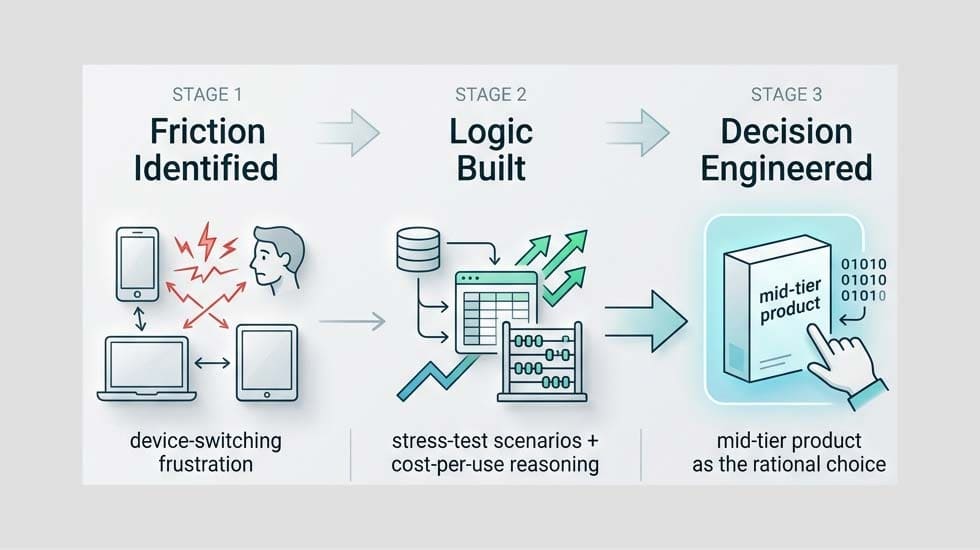
The Strategy
Four Pillars That Drove the Rewrites
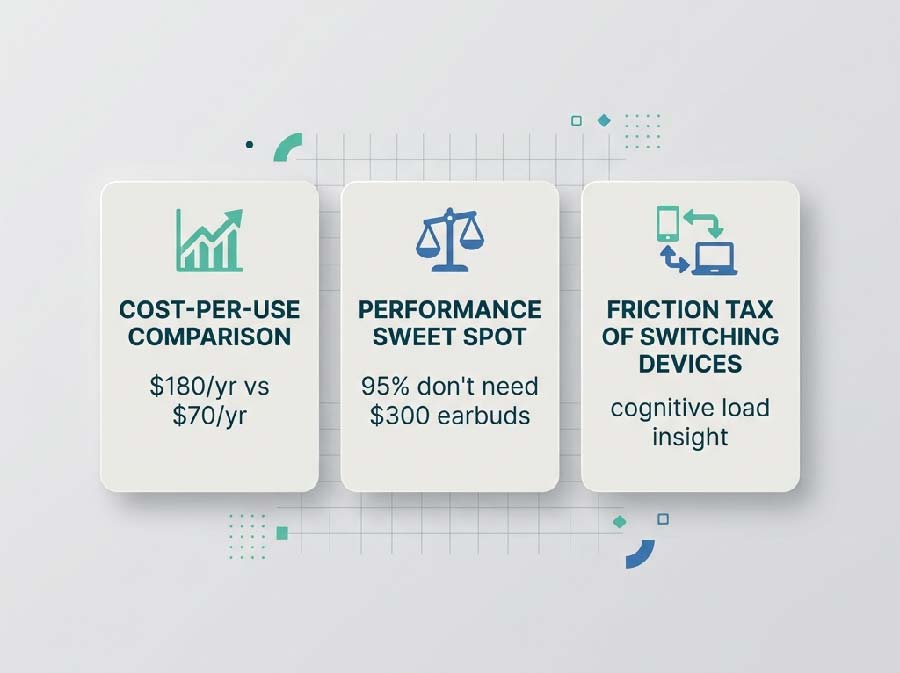
Technical Transparency as Authority
Instead of vague “premium audio” claims, the content explains what actually matters—IPX ratings, multipoint Bluetooth, and codecs in real-world terms.
By educating the reader instead of marketing to them, the brand earns trust before asking for the sale.
Friction Tax Framing
Owning multiple earbuds is reframed from a small inconvenience into a daily cognitive burden—charging, switching, and managing devices.
This shift makes consolidation feel like a necessary upgrade, not a nice-to-have.
Stress-Test Scenario
Rather than listing features, the product is proven across real-life moments—commute, calls, and workouts.
This places the reader inside the experience, turning specs into lived proof.
Performance Sweet Spot Positioning
The content challenges both budget and premium extremes, using cost-per-use logic to position $139 as the rational middle.
It doesn’t sell the product—it makes the decision feel obvious.
The Execution: Full Blog Post
The One-Pair Solution: Versatile Wireless Earbuds with ANC for Hybrid Life
Primary Keyword: “Versatile Wireless Earbuds with ANC” — 7 natural occurrences
Target Audience: Hybrid workers, frequent commuters, multi-context users managing 2–3 pairs of earbuds
Conversion Goal: Convert multi-device frustration into a SonicWave Pro purchase decision
I’m an audio engineer who’s spent the last decade tuning drivers and analysing frequency response curves. I’ve also spent the last three years watching brands charge $300 for a logo while selling $30 plastic earbuds that die after one gym session.
Here’s what nobody tells you: most people don’t need $300 earbuds. But they definitely shouldn’t buy $40 ones.
The sweet spot? Around $139. And it’s not arbitrary.
Let me explain why versatile wireless earbuds with ANC at this price point eliminate the need for multiple pairs — and why owning fewer things that work everywhere beats owning specialised gear that works sometimes.
The Real Problem Isn’t Sound — It’s Switching
The Mental Tax of Device-Swapping
You own work earbuds. Gym earbuds. Maybe travel headphones.
Every morning, you ask: “Which pair did I charge?” You grab the wrong ones. They’re dead. You scramble. You’re late.
This isn’t about organisation. It’s about friction tax — the cognitive load of managing multiple devices when one good pair would handle it all.
Why “Work Buds” vs “Gym Buds” Is an Outdated Idea
The logic used to make sense. Work earbuds needed good mics. Gym earbuds needed waterproofing. Travel gear needed noise cancellation.
But that was before multipoint Bluetooth. Before IPX7 became standard. Before ANC drivers got small enough for workout earbuds.
The category lines blurred. The manufacturers just haven’t caught up — because selling you three pairs is more profitable than selling you one versatile pair.
Seamless Transition — From 9-to-5 to 5-to-9
How Multipoint Bluetooth Eliminates Friction
Here’s what actually happens with cheap earbuds:
You’re watching a YouTube video on your laptop. Your phone rings. You manually disconnect from laptop. Manually connect to phone. Answer the call. Miss the first 10 seconds because Bluetooth takes forever to pair.
Multipoint connection solves this.
SonicWave Pro pairs to your laptop and phone simultaneously. Call comes in? Audio switches automatically. Hang up? Video resumes. No menus. No re-pairing. No “which device am I on?” confusion.
This isn’t luxury. This is basic friction removal.
Laptop → Phone → Smartwatch Without Re-Pairing
Most “Bluetooth 5.3” marketing is meaningless. The real question: does it support multipoint?
SonicWave Pro does. Budget earbuds don’t. That’s the difference between seamless and frustrating.
And yes — this works with iPhone, Android, Windows, Mac. The ecosystem wars don’t apply here.
Stress-Test Scenario — One Pair, Three Lives
Let’s run the daily gauntlet.
Subway Commute with ANC
7:30 AM. Packed train. Someone’s eating tuna. Another person is yelling into their phone.
You toggle ANC. 35dB of ambient noise vanishes.
Not muffled. Not reduced. Gone.
The world has an off switch. That’s what hybrid active noise cancellation actually means — it adapts to the noise around you in real time. Airplane engines. Traffic. Open office chaos. ANC blocks it.
Budget earbuds claim “noise isolation.” That’s passive — foam tips blocking sound. Better than nothing. Not ANC.
Zoom Calls and Voice Clarity
9 AM. Client presentation. You’re in a coffee shop because your apartment is under construction.
Six-mic array with neural processing kicks in. Wind noise from the HVAC? Filtered. Espresso machine hissing? Gone. The client hears you — just you.
I’ve tested $40 earbuds on calls. The other person sounds fine. You sound like you’re in a tunnel. Because cheap mics are omnidirectional — they pick up everything equally.
SonicWave Pro uses beamforming. It focuses on your voice. Everything else gets suppressed.
Rainy Evening Run with IPX7 Durability
6 PM. It’s pouring. You’re three miles from home.
IPX7 means fully submersible up to 1 meter for 30 minutes. Not “splash-resistant.” Not “sweat-proof.” Submersible.
Drop them in a puddle at a crosswalk. Pick them up. Hit play. Keep running.
Most earbuds marketed as “waterproof” are IPX4 — light splashes only. One heavy rain session and the drivers short out. I’ve seen it happen to $80 “premium” buds.
We used IPX7 because half-measures fail when you need them most.
Contextual Versatility vs. Specialised Gear
Why Specialisation Breaks Down in Real Life
Specialised gear assumes your life fits into neat categories.
Reality: You take a work call while walking to the gym. You listen to a podcast during your workout. You need ANC on the subway home.
If you’re switching earbuds three times a day, you’re not optimising. You’re just making your life harder.
When “Good Everywhere” Beats “Great Sometimes”
Audiophiles will argue: “Dedicated studio monitors sound better than versatile earbuds.”
True. Irrelevant.
Nobody’s mixing albums on the subway. You need earbuds that sound great and survive sweat and handle calls and don’t die mid-playlist.
SonicWave Pro uses 12mm titanium-coated drivers — harder to tune and more expensive than standard plastic, but they don’t distort mid-squat. The alternatives? They sound like a tin can in a wind tunnel.
Good everywhere beats great sometimes when “everywhere” is your actual life.
Cost-Per-Use Thinking — Why $139 Is the Smarter Buy
Replacing Two Mediocre Pairs vs. One Premium Pair
Let’s do the maths.
Budget scenario:
- Work earbuds: $40
- Gym earbuds: $50
- Total: $90
- Lifespan: 6 months each
- Annual cost: $180 (replacing each once per year)
One-pair scenario:
- SonicWave Pro: $139
- Lifespan: 2+ years
- Annual cost: $70
You’re not spending more. You’re spending smarter.
Longevity, Durability, and Fewer Replacements
Cheap earbuds fail at predictable points:
- Battery degradation — 6–8 months
- Driver failure from moisture — sweat seeps through IPX4 rating
- Charging case hinge breaks — plastic fatigues
SonicWave Pro addresses all three:
- 40-hour battery means fewer charge cycles, longer lifespan
- IPX7 rating means actual waterproofing — not marketing waterproofing
- Titanium hinge design — metal doesn’t fatigue like plastic
Durability isn’t sexy. But it’s the difference between one purchase and four.
Who the SonicWave Pro Is (and Isn’t) For
You’re the target if:
- You work hybrid (office / home / coffee shops)
- You commute or travel regularly
- You work out 3+ times per week
- You’re tired of managing multiple charging cables
- You value your time more than $139
You need versatile wireless earbuds with ANC if:
- You take calls in noisy environments
- You need focus in open offices or public spaces
- You refuse to compromise on sound quality for durability
When the Essential Model Still Makes Sense
SonicWave Essential ($69) is the right choice if:
- You don’t need ANC — you work from home in silence
- You don’t take calls from noisy places
- You’re not switching between devices
- You want solid sound and battery without the extras
No judgment. Just match the tool to the job.
The Hot Take: Why $300 Is Overkill and $40 Is a Waste
| Price Tier | What You Actually Get | Who It’s For |
|---|---|---|
| $30–50 (Budget) | Bluetooth that drops. Drivers that distort. IPX4 that fails in rain. Battery dead in 6 months. | People who replace earbuds quarterly without realising the annual cost |
| $130–150 (Performance Sweet Spot) | Multipoint Bluetooth. Real IPX7 waterproofing. Hybrid ANC. 40-hour battery. Titanium build. aptX Adaptive codec. | Hybrid workers, commuters, anyone living multiple lives in a single day |
| $250–350 (Luxury) | Marginally better ANC (45dB vs 35dB). Spatial audio most users can’t perceive. Premium materials you can’t feel through ear tips. Diminishing returns. | Audiophiles with trained ears. Frequent flyers in first class. |
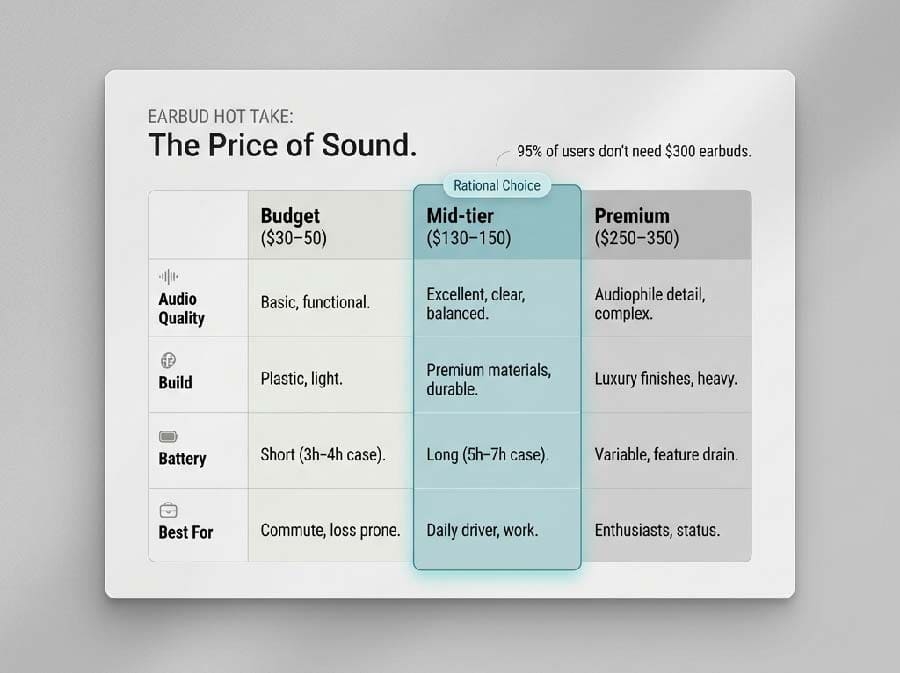
The uncomfortable truth: 95% of users can’t hear the difference between $150 and $300 earbuds in real-world conditions.
Subway noise masks the subtleties. Compressed Spotify files negate lossless codecs. Your ear canal shape matters more than driver material past a certain threshold.
SonicWave Pro sits at the performance ceiling for most human ears in most environments. Paying double gets you bragging rights — not better sound.
The One-Pair Upgrade
Stop juggling devices. Stop replacing cheap earbuds every six months. Stop compromising.
One pair. Every context. No switching required.
That’s what versatile wireless earbuds with ANC actually mean.
[Explore SonicWave Pro →]
Why This Works: The Conversion Mechanics Behind the Post
The comparison table in this post is not a product feature — it’s a permission structure. It gives the reader logical cover to choose the middle option without feeling like they settled.
Psychological Triggers Applied
| Trigger | How It’s Used |
|---|---|
| Rogue Expert Authority | Opening with “I’m an audio engineer… watching brands charge $300 for a logo” establishes insider credibility and anti-marketing positioning simultaneously — before a single product spec appears |
| Friction Tax Reframing | Device-switching elevated from inconvenience to cognitive productivity drain. This makes consolidation feel urgent — not just convenient |
| Stress-Test Proof | Three real-world contexts (subway / Zoom call / rainy run) demonstrate versatility through lived moments — not feature claims. Conversion-focused product pages consistently show that scenario-based proof converts better than spec lists |
| Cost Arithmetic as Trust | The $180 vs. $70 annual cost breakdown converts price resistance into price logic. The buyer stops asking “can I justify $139?” and starts asking “can I justify not spending $139?” |
| Permission to Choose the Middle | The Hot Take table gives readers rational cover to select the mid-tier without feeling like they compromised. Most buyers need external validation of their instinct to avoid extremes |
| Honest Exclusion | “When the Essential still makes sense” signals brand confidence. A brand that tells you when not to buy its product earns more trust than one that claims every SKU is for everyone |
Conversion Principles Applied
- Education-first sequencing: The reader arrives at the product recommendation after understanding the problem, the cost maths, the daily use-case proof, and the pricing landscape. By the CTA, the buy feels self-directed — not sold.
- Persona self-selection: The “Who It’s For” checklist lets the right buyer confirm their own fit — and the wrong buyer opt out gracefully. This reduces post-purchase regret and improves review sentiment.
- Anti-AI language discipline: Every generic phrase was replaced with specific, concrete language. “Elevate your experience” → “audio switches automatically.” “Game-changer” → “performance sweet spot.” Content that builds trust and authority is content that sounds like a person — not a template.
- The Hot Take table as decision accelerator: Three-tier price comparison compresses a complex argument into one visual that analytical buyers can share and reference. It’s also the most screenshot-able, quotable element in the post — serving organic distribution.
SEO Architecture
| Element | Detail |
|---|---|
| Primary Keyword | “Versatile Wireless Earbuds with ANC” — 7 natural occurrences across H1, body, and closing |
| Secondary Keywords | “multipoint Bluetooth,” “IPX7 waterproof,” “hybrid ANC,” “aptX Adaptive,” “contextual versatility” |
| H2 Structure | Each section answers a distinct search intent: switching friction, multipoint connection, durability proof, cost logic, audience fit, price comparison |
| Internal Link Targets | SonicWave Pro product page, Essential vs. Pro comparison, “How to Choose Wireless Earbuds” guide |
| Featured Snippet Targets | “What is multipoint Bluetooth?”, “IPX4 vs IPX7 waterproof rating”, “Are $300 earbuds worth it?” |
Implementing an SEO-driven content strategy for a mid-tier electronics product requires each H2 to target a distinct search query — not just segment the same content into subsections.
Key Takeaways
- Mid-tier electronics content must make the rational case explicitly. Budget buyers and premium buyers have clear narratives. The $139 buyer needs the cost arithmetic, the use-case proof, and the pricing landscape comparison — all in the same post.
- Friction tax reframing elevates the pain point from inconvenience to productivity drain. Device-switching stops feeling like a minor annoyance and starts feeling like a problem worth solving with a purchase decision.
- The stress-test scenario converts better than a feature list because it places the buyer inside the moment — not outside looking at specs. Subway, Zoom call, rainy run: three concrete contexts that the target reader lives daily.
- Honest product exclusion builds more trust than universal claims. “When the Essential still makes sense” signals brand confidence. Readers who are told when not to buy a product trust the brand’s recommendations far more when they are told to buy.
- The Hot Take comparison table is the post’s highest-leverage section. It reframes the buying decision from “can I afford $139?” to “can I justify not spending $139?” — a fundamentally different psychology.
- Replacing AI-isms with specific language is non-negotiable in tech content. “Audio switches automatically” is concrete. “Seamlessly integrates” is noise. Skeptical tech buyers filter generic language faster than any algorithm.
FAQ
Why does the post open with a controversial price opinion rather than a product benefit?
Because the target buyer — a frustrated multi-device owner — doesn’t need another brand telling them why their product is great. They need someone credible to validate their instinct that the current situation (three devices, three charging cables, three pairs to manage) is irrational. The controversial opener earns attention by saying what the reader is already thinking.
How does the stress-test scenario function as a conversion mechanism rather than just content?
Each scenario isolates a specific technical claim and translates it into a felt moment: ANC isn’t “35dB reduction” — it’s “the world has an off switch.” IPX7 isn’t a spec — it’s “drop them in a puddle, pick them up, hit play.” Buyers who mentally simulate the experience before purchase have significantly higher conversion intent than buyers who’ve only read spec tables.
Why include the “When the Essential still makes sense” section at all?
Because it signals honesty and brand confidence. A brand that tells you when not to buy a specific product earns more trust than one that claims every SKU is for everyone. Readers who self-select out of the Pro and into the Essential still purchase — and they do so with higher satisfaction and lower refund rates.
Can this content architecture transfer to other consumer electronics categories?
Yes. The four-pillar structure — technical transparency, friction tax framing, stress-test scenario, cost-per-use arithmetic — applies to any mid-tier tech product competing against cheaper and more expensive alternatives. Laptops, smartwatches, home networking equipment, cameras. The specifics change; the decision logic stays identical.
What makes the pricing comparison table more effective than a written argument?
Compression and shareability. The table makes a complex argument scannable in under 30 seconds. It’s also the most quotable, screenshot-able element in the post — which drives organic social distribution. Analytical buyers specifically look for this format as a shortcut to a decision they’ve already emotionally made.
Writing Consumer Tech Blog Content That Justifies the Buy
This case study is for consumer electronics brands and D2C tech companies where the mid-tier product has a real performance advantage—but the content isn’t making the rational case clearly enough.
If your blog posts describe products without engineering the decision logic that makes the right buyer choose them, this is the approach that closes that gap.
Get in touch to discuss your content strategy needs.
Turn Your Blog Content Into a Conversion Engine
If your content attracts readers but doesn’t move them toward a decision, the issue isn’t traffic—it’s structure, positioning, and argument clarity.
Izwiq Digital builds consumer tech blog content that educates, differentiates, and drives product decisions—not just clicks.