
Beauty Cosmetics Email Campaign Case Study
How a Strategic Beauty Cosmetics Email Campaign Built Trust, Educated Buyers, and Drove Conversions
Scope:
Email Marketing Strategy & Conversion-Focused Copywriting for a Beauty Cosmetics Brand
Industry:
Beauty & Cosmetics / Skincare / D2C E-Commerce
What Was Delivered:
3-Email Beauty Cosmetics Emailing Campaign (Nurture + Conversion Sequence)
Strategic Overview
A 3-email nurture sequence written for Luminelle Beauty’s Radiance Renewal Vitamin C Serum — converting educated, skeptical consumers who’ve been burned by ineffective products before.
The sequence moves readers from “I’ve tried everything” to “I finally understand why this works” — through chemistry, not claims.
The Problem: Why Standard Beauty Email Sequences Don’t Convert This Audience
The typical beauty email sequence leads with a benefit, adds social proof, and closes with a discount. That approach fails a specific type of buyer — and this campaign was written entirely for them.
This audience is not price-sensitive. They are outcome-skeptical.
- They’ve spent on premium vitamin C serums that turned orange in weeks.
- They’ve seen “clinically proven” on labels that never delivered results.
- They’ve tried consistent routines and still seen minimal change.
A benefits-first email for this reader triggers immediate dismissal. The copy needed to do something harder: validate their frustration, expose the industry mechanism that caused it, then present the product as the logical corrective.
The strategic insight the sequence is built on: the customer is not skeptical of skincare — they’re skeptical of claims without mechanisms.
The Strategy:
Four Pillars That Drove the Rewrites
Narrative Arc: One Job Per Email
Each email performs a single function. No multitasking, no pivots.
- Email 1: Emotional validation + founder integrity. Zero product pitch.
- Email 2: Industry education + formulation science. Light product introduction.
- Email 3: Relatable social proof + purchase with risk removal. Full CTA.
Each email earns the right to the next one. Trust is built in sequence, not in a single email that tries to do everything.
The Vitamin C Loophole as the Strategic Hook
Brands can legally label derivatives — Sodium Ascorbyl Phosphate, Magnesium Ascorbyl Phosphate — as “vitamin C” on product packaging, even though these require enzymatic skin conversion and deliver inconsistent results.
Exposing this loophole reframes the buying decision entirely. It moves the reader from brand preference to formulation literacy — which means they’re evaluating ingredients rather than aesthetics, at exactly the moment Luminelle’s superiority becomes self-evident.
Frictionless Ritual, Not Aspirational Self-Care
The sequence deliberately avoids wellness ritual framing — which creates pressure and is associated with products people buy but don’t sustain.
Instead, the routine is framed as “Before Coffee, Before Chaos” — a 3-minute default behavior that happens before the brain is fully engaged. The product becomes automatic, not aspirational.
Perceived effort reduction increases compliance. Compliance extends trial duration. Extended trial produces visible results.
Timeline-Based Trust Building
Rather than promising miracles, the sequence sets specific, science-backed milestones:
- Day 3 — brightness and texture
- Day 14 — tone clarity and dark spot fading
- Week 8 — collagen support and firmness
Specific timelines prevent post-purchase disappointment — the leading cause of refund requests in the skincare category. Readers who know what to look for at each stage are more likely to reach Week 8 and conclude the product worked.
The Execution: Full Email Sequence
Email 1: The Emotional Bond
Subject: Why your glow didn’t fail—you were sold the wrong version
Preview: The formulation compromise no one talks about.
Strategic Intent: Build founder credibility and validate reader frustration before any product mention. Create psychological buy-in through the “aha moment” story.
Hi [First Name],
I’m [Founder Name], and I need to tell you something that’s going to sound dramatic — but it’s true.
Three years ago, I was reformulating what would become our Radiance Renewal Serum. We’d tested 11 different vitamin C versions, and only one delivered the measurable brightening and collagen support we needed: 15% L-Ascorbic Acid.
But here’s what happened every single time I presented it to manufacturers:
“Too expensive.”
“Too unstable.”
“Customers won’t notice the difference anyway.”
They wanted me to use derivatives instead. Cheaper. Easier to stabilize. Legally still “Vitamin C” on the label.
And that’s when it hit me.
The skincare industry had normalized “almost effective.”

You didn’t fail. Your skin didn’t fail. You were just never given the full picture.
Most vitamin C serums are designed to survive shipping — not to change your skin.
They use derivatives like Sodium Ascorbyl Phosphate or Magnesium Ascorbyl Phosphate because they don’t oxidize under store lights. Because they don’t require the low pH that makes L-Ascorbic Acid actually penetrate your skin. Because they’re easy.
But “easy to manufacture” and “effective for your skin” are two completely different things.
I refused to cut corners. We formulated at 15% L-Ascorbic Acid, pH 2.5–3.5, in airless packaging that costs three times more than standard bottles.
Why? Because I got tired of watching smart, consistent people do everything right — and still see minimal results.
Tomorrow, I’m going to show you exactly why most vitamin C fails. The chemistry. The trade-offs. The loopholes brands exploit.
It’s uncomfortable. But it’s necessary.
Talk soon,
[Founder Name]
Founder, Luminelle Beauty
P.S. If you’ve ever wondered why your expensive vitamin C serum turned orange after two weeks, you’re not alone. And you’re definitely not wrong.
Strategic Logic — Email 1
- Founder vulnerability as trust signal: The manufacturer rejection story (“Too expensive. Too unstable.”) positions the founder as someone who chose efficacy over margin. Most brands hide formulation challenges — this one exposes them.
- Blame redirection: “You didn’t fail. Your skin didn’t fail.” removes customer shame and redirects frustration toward industry norms. Validation before solution.
- Open loop tension: The cliffhanger drives Email 2 opens — the reader has narrative tension that needs resolution.
- Zero product pitch: Email 1 contains no call-to-action beyond “keep reading.” Trust is built before any purchase is asked for.
Email 2: Authority & Education
Subject: Most Vitamin C serums aren’t broken—just diluted
Preview: The difference labels don’t explain.
Strategic Intent: Expose the industry “villain” — derivatives marketed as equivalent to L-Ascorbic Acid — and establish brand authority through formulation transparency, not marketing hype.
[First Name],
Let’s talk about the vitamin C loophole.
Here’s what’s legal: Brands can put “Vitamin C” on the front of the bottle — even if the ingredient list contains derivatives that behave nothing like actual vitamin C.
Here’s what’s not disclosed: Your skin has to convert those derivatives into L-Ascorbic Acid before they do anything useful.
It’s like getting paid in Monopoly money and hoping the bank will exchange it for real cash.
Sometimes it works. Often it doesn’t. And even when it does, you’re only getting a fraction of the value.
The Villain: Why Derivatives Exist
Brands use derivatives because they solve manufacturing problems, not skin problems:
- Sodium Ascorbyl Phosphate (SAP): Stable, gentle, significantly less effective
- Magnesium Ascorbyl Phosphate (MAP): Even more stable, even less potent
- Ascorbyl Glucoside: Requires enzymatic conversion your skin may or may not perform
The conversion happens in your skin — if your enzyme activity is high enough, if your pH is right, if your barrier is healthy.
Your skin isn’t a chemistry lab. What you get is unpredictable results.
This is why people say “Vitamin C doesn’t work for me.” It’s not that vitamin C failed them. It’s that they never actually used vitamin C.
The Hot Take: Real Vitamin C Is Uncomfortable — And That’s the Point
Here’s what most brands won’t tell you:
L-Ascorbic Acid only works at pH 2.5–3.5. That’s acidic. It tingles briefly. Some brands panic and raise the pH to make it “gentler” — which makes it completely ineffective because it can’t penetrate your skin.
We formulated at pH 2.8. It works. And if your skin truly can’t tolerate that acidity, you need a different active ingredient — not a watered-down version that doesn’t deliver.
What Makes Radiance Renewal Different
| Factor | Most Vitamin C Serums | Radiance Renewal |
|---|---|---|
| Active Form | Derivatives (SAP, MAP, Ascorbyl Glucoside) | Pure L-Ascorbic Acid |
| Concentration | 5–10% (often unstated) | 15% (clinical threshold) |
| pH Level | 4.5–6 (too high to penetrate) | 2.8 (optimal penetration) |
| Packaging | Dropper bottles (oxidizes fast) | Airless pump (minimizes oxidation) |
| Results Timeline | Slow or inconsistent | Measurable within 2–8 weeks |
We use 15% L-Ascorbic Acid because research shows concentrations between 10–20% deliver measurable improvements in hyperpigmentation, collagen synthesis, and photoprotection.
We formulated at pH 2.8 because that’s the only way it penetrates your skin barrier.
We use airless packaging because oxidized vitamin C doesn’t just stop working — it can irritate your skin.
This is expensive. This is harder to stabilize. But it’s the only form with 40+ years of research proving it works.
Tomorrow, I’ll introduce you to Jamie — who stopped wearing concealer by week two but still took the full 60 days to decide if she wanted to keep it.
— [Founder Name]
P.S. Want to see the full ingredient breakdown and why each one matters? [LINK: Ingredient Library]. We hide nothing because we have nothing to hide.
Strategic Logic — Email 2
- Monopoly money metaphor: Enzymatic conversion becomes instantly comprehensible through analogy — scientific accuracy without requiring a chemistry background.
- Industry villain exposure: Naming specific derivatives and explaining why brands use them (manufacturing convenience over efficacy) positions Luminelle as science-driven without a single direct attack on competitors.
- Hot take reframing: “Real vitamin C is uncomfortable — and that’s the point” challenges the “gentle equals better” conditioning that’s been used to justify watered-down formulations.
- Comparison table as conversion tool: The side-by-side visual compresses a complex argument into one scannable block — serving both time-poor skimmers and analytical deep-readers.
- Soft CTA in P.S.: The Ingredient Library link captures hesitant buyers who aren’t ready to purchase but want to keep researching — keeping them in the funnel without pressure.
Email 3: Conversion & Logic
Subject: By week two, Jamie stopped wearing concealer
Preview: And why we still told her to take 60 days.
Strategic Intent: Use a relatable, undramatic customer journey to demonstrate achievable outcomes. Drive purchase with 60-day guarantee and zero-pressure framing.
[First Name],
Jamie is a 34-year-old marketing director in Mumbai.
Normal skin type. Post-acne dark spots that wouldn’t fade. A bathroom shelf full of half-used vitamin C serums that either oxidized within weeks or did absolutely nothing.
She was skeptical. She told me so in her first email.
But here’s what happened.
Week One: The Texture Test
Jamie’s first concern: “Will this pill under my makeup?”
Day 3 feedback: “It absorbs in like 15 seconds. I actually forgot I was wearing it. My skin feels… smoother? Not oily. Just smooth.”
This is what proper formulation feels like. When you combine 15% L-Ascorbic Acid with low-molecular-weight hyaluronic acid and the right solvent system, you get deep penetration — no surface buildup.
No pilling. No stickiness. Just skin that feels like it just drank a glass of cold water.
Week Two: The Concealer Moment
Day 14 feedback: “I’m not sure how to explain this, but my skin looks… clearer? Like I can see the difference in real lighting, not just bathroom mirror lighting. I skipped concealer yesterday.”
This is tyrosinase inhibition at work. L-Ascorbic Acid interrupts melanin production at the source. Post-acne marks lighten. Sun damage softens. Overall tone becomes more even.
Not dramatic. Noticeable.
Week Eight: The Long Game
Week 8 feedback: “My skin feels… firmer? I don’t know if that makes sense. But when I touch my face, it bounces back differently. And those dark spots from last year? They’re still there, but they’re fading.”
Collagen synthesis takes time. Real, structural collagen that improves firmness doesn’t happen overnight.
At eight weeks, you see lasting improvements: skin that recovers faster, fine lines that soften, a glow that doesn’t disappear by noon.
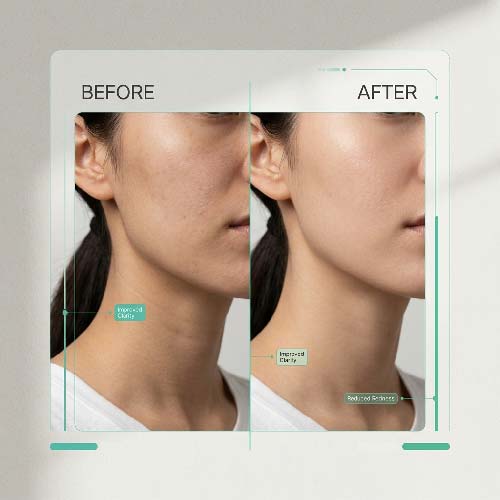
This is why we told Jamie to take the full 60 days — even though she saw results at two weeks.
The 3-Minute Ritual: Before Coffee, Before Chaos
Here’s Jamie’s routine now:
- Cleanse (30 seconds)
- 2–3 drops Radiance Renewal Serum (15 seconds to absorb)
- Moisturizer (30 seconds)
Total: Under 3 minutes.
Not a wellness ritual. Not self-care. Just a default morning behavior that happens before her brain is fully awake.
The product became automatic — not aspirational.
Our Guarantee: 60 Days, Keep the Bottle
If after 60 days of consistent use your skin isn’t noticeably brighter, smoother, or more even — we’ll refund every rupee.
No questions asked. No forms to fill. Keep the bottle.
We’re not selling relief. We’re offering measurable, progressive improvement backed by 40+ years of L-Ascorbic Acid research.
You can’t undo years of sun damage overnight. But you can stop letting it get worse without a fight.
[Start Your 60-Day Trial — Shop Now]
— [Founder Name]
Founder, Luminelle Beauty
P.S. Not sure if 15% L-Ascorbic Acid is right for your skin type? Take our [LINK: 2-Minute Vitamin C Quiz] to see if you’re a good candidate.
Strategic Logic — Email 3
- Relatable, not aspirational: Jamie is deliberately ordinary — 34, skeptical, post-acne marks, half-used serums on her shelf. No influencer aesthetics. Success that feels achievable converts better than success that feels exceptional.
- Timeline specificity as trust signal: Week 1 (texture), Week 2 (tone clarity), Week 8 (collagen) breaks outcomes into observable, time-bound checkpoints — reducing anxiety and increasing follow-through.
- “Before Coffee, Before Chaos” framing: Pre-conscious morning automation removes the perceived effort and pressure that causes compliance to drop after the first week.
- “Keep the bottle” guarantee: Removes the final objection — “what if it doesn’t work for me?” — by shifting risk entirely to the brand.
- Vitamin C Quiz as soft CTA: Captures hesitant buyers in a low-commitment engagement that keeps them in the nurture flow without forcing the decision.
Why This Works: The Conversion Mechanics Behind the Sequence
Psychological Triggers Applied
| Trigger | How It’s Used |
|---|---|
| Blame Redirection | “You didn’t fail. Your skin didn’t fail.” shifts the reader from self-doubt to industry-directed frustration — creating openness to a brand that explains what actually went wrong |
| Formulation Literacy as Empowerment | Teaching readers to identify derivatives, check pH, and evaluate packaging doesn’t create dependency — it builds the kind of loyalty that survives competitor discounts |
| Narrative Tension | Emails 1 and 2 both end on a cliffhanger that requires the next email to resolve. The sequence feels like a story, not a funnel |
| Reframing Discomfort as Proof | “Real vitamin C is uncomfortable — and that’s the point” turns mild tingling from a deterrent into a signal of product quality |
| Realistic Identity Mirror | Jamie isn’t aspirational. She’s recognisable. Readers see themselves in her scepticism, her ordinary routine, and her understated results — which makes the outcome feel genuinely achievable |
Conversion Principles Applied
- Graduated pressure: Zero CTA in Email 1. Soft CTA (Ingredient Library) in Email 2. Primary CTA with guarantee in Email 3. Each email asks only for what the reader is ready to give at that stage.
- Staged credibility: Founder story → industry mechanism → chemistry proof → real-world outcome. Each layer adds a different type of evidence — personal, structural, scientific, social.
- Heuristic creation: The sequence gives readers repeatable mental tools: “Is this derivative or L-Ascorbic Acid?”, “What’s the pH?”, “Is this an airless bottle?” Every time they use these tools to evaluate a competitor, they come back.
- Language precision: “Measurable, progressive improvement” instead of “unlock your radiance.” “Week 2: The Concealer Moment” instead of “imagine waking up to glowing skin.” Specificity does the work that hype cannot.
Content Architecture at a Glance
| Core Function | Product Mention | CTA | |
|---|---|---|---|
| Email 1 | Emotional validation + founder integrity | None | None — read the next email |
| Email 2 | Industry education + formulation proof | Introduced via comparison table | Soft — Ingredient Library |
| Email 3 | Social proof + risk removal | Full pitch | Primary — 60-Day Trial |
P.S. Strategy — Three Paths, Three Buyer Types
| P.S. Hook | Buyer Type Served | |
|---|---|---|
| Email 1 | “You’re not alone” — oxidation frustration validation | Emotionally primed, not yet analytical |
| Email 2 | Ingredient Library deep-dive | Research-driven, not yet ready to buy |
| Email 3 | Vitamin C Quiz | Interested but hesitant — needs personalisation before committing |
The Content Ecosystem: Where This Sequence Sits
This email campaign completes a three-format content set for the Radiance Renewal Serum — each piece serving a different stage of the buyer journey:
- Product Description → Point-of-sale conversion (benefit-first, sensory storytelling)
- Blog Post → SEO authority building (industry exposé, formulation education)
- Email Sequence → Nurture and relationship conversion (founder narrative, timeline management)
All three formats reinforce the same core message: most vitamin C uses ineffective derivatives — 15% L-Ascorbic Acid at pH 2.8 in airless packaging is the evidence-based alternative — and results are measurable within 2–8 weeks.
Tonal and strategic consistency across all three touchpoints is what builds genuine brand authority.
Key Takeaways
- Outcome skeptics need mechanisms, not benefits. This audience has been burned by claims. What converts them is an explanation of why previous products failed and how this one is structurally different.
- One email, one job. The moment an email tries to validate, educate, and convert simultaneously, it does none of those things well. Staging trust across three emails respects the reader’s decision timeline.
- Empowerment converts better than persuasion. Teaching readers to audit competitors’ formulations builds loyalty that survives aggressive discounting — because the brand becomes a resource, not just a vendor.
- Realistic social proof outperforms aspirational testimonials. Jamie’s “it bounces back differently?” is more credible than any dramatic before/after — and credibility is what this audience is specifically looking for.
- Frictionless framing drives compliance. “Before Coffee, Before Chaos” reduces perceived effort. Products that feel automatic get used consistently. Consistent use produces results. Results produce reviews.
- The guarantee copy is conversion copy. “No questions asked. No forms to fill. Keep the bottle.” removes specific, named fears — not vague reassurance. That specificity is what makes the risk reversal work.
FAQ
Why doesn’t Email 1 mention the product at all?
Because the sequence is built for a reader who has already been disappointed by the category. A product mention in Email 1 triggers the “here comes the pitch” response that shuts down receptivity. Email 1’s only job is to make the reader feel understood — and to create the trust that makes Emails 2 and 3 land.
Isn’t it risky to call out the industry so explicitly?
For a brand competing on formulation quality and transparency, it’s the lowest risk positioning available. Brands that can back up the claim are differentiated. Brands that can’t are exposed by their own comparison table.
How does the “Before Coffee, Before Chaos” framing actually improve conversion?
It removes the primary barrier to compliance in skincare: perceived effort. Rituals that require conscious motivation get abandoned under stress. A habit framed as pre-conscious automation is far more durable — and a customer who uses the product consistently for 60 days is far less likely to return it.
Can this email architecture work for other premium skincare products?
Yes — the Bond → Educate → Convert structure transfers to any category where: (a) the audience has prior category disappointment, (b) there is a genuine formulation differentiator, and (c) the brand can credibly explain the science. Retinol, AHAs, niacinamide, and SPF all have the same structure available.
What makes Jamie’s story more effective than a standard five-star review?
She’s sceptical from the first email. She has a specific, ordinary concern (“Will this pill under my makeup?”). Her results language is tentative and human (“firmer? I don’t know if that makes sense”). That tentativeness is the trust signal — it sounds like someone reporting honestly, not someone who was paid to review.
Building Content That Earns Authority Before It Asks for the Sale
This case study is for beauty and skincare brands that need content to do two things:
rank for high-intent keywords and convert skeptical buyers who don’t trust claims.
If your content is informative but not building credibility—or readable but not driving action—this is the strategy that fixes it.
Get in touch to discuss your email strategy needs.
Need a Beauty Cosmetics Emailing Campaign That Actually Converts?
If your email campaigns rely on discounts, generic flows, or “glow” claims that don’t convert—
this is the strategy that builds trust first and drives sales after.
I help D2C beauty and skincare brands turn skeptical subscribers into paying customers through education-first email campaigns.